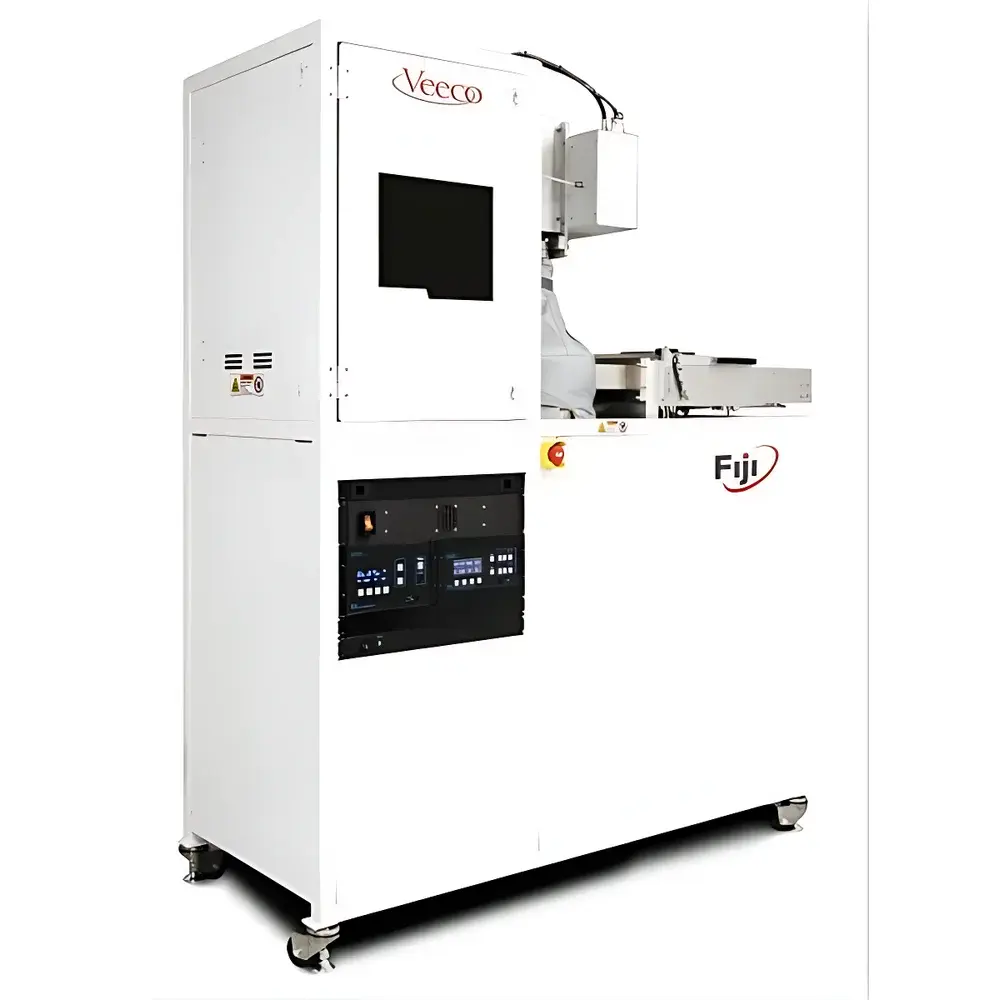
Veeco Fiji G2 Plasma Atomic Layer Deposition System
| Brand | Veeco |
|---|---|
| Origin | USA |
| Model | Fiji G2 Plasma ALD |
| Substrate Size | Up to 200 mm |
| Process Temperature | 500°C for 200 mm wafers |
| Precursor Channels | Standard 4, upgradeable to 6 |
| Dimensions (W × H × D) | 1845 × 715 × 1920 mm |
| Uniformity (1σ) | Thermal Al₂O₃ – 1.5% |
| Power Supply | 220–240 VAC, 4200 W per reactor (excl. pumps) |
| Cycle Time | <2 s per cycle (Al₂O₃ at 200°C) |
| Precursor Source Capacity | 50 cc stainless steel ampoules (max. 25 mL fill) |
| Carrier/Plasma Gases | 100 sccm Ar (precursor), 500 sccm Ar (plasma), 100 sccm N₂, 100 sccm H₂, 100 sccm O₂ (all MFC-controlled) |
| Valve Response Time | ≤10 ms |
| Independent Precursor Heating | Up to 200°C |
| Maximum Sample Height | 57 mm |
| In-situ Options | QCM, spectroscopic ellipsometry, RGA port, optical emission spectroscopy (OES), ozone generator, LVPD, integrated glovebox, substrate biasing |
Overview
The Veeco Fiji G2 Plasma Atomic Layer Deposition System is a high-precision, dual-mode thin-film synthesis platform engineered for research and pilot-scale semiconductor process development. It supports both thermal and plasma-enhanced ALD (PE-ALD) operation, enabling atomic-level control over film composition, thickness, and interface quality across a broad spectrum of functional materials. The system implements the self-limiting surface reaction mechanism inherent to ALD—sequential, saturating exposures of gaseous precursors separated by inert purge steps—ensuring exceptional conformality on high-aspect-ratio structures and sub-nanometer thickness control with repeatability better than ±0.02 Å per cycle. Its modular architecture integrates vacuum-compatible fluidic pathways, ultra-fast pneumatic valves (≤10 ms response), and independently heated precursor delivery lines, minimizing condensation and enabling stable vapor delivery of solid, liquid, and gaseous precursors—including metalorganic, halide, and hydride compounds.
Key Features
- Dual-mode operation: seamless switching between thermal ALD (for oxide/nitride stability) and plasma-enhanced ALD (for low-temperature nitride growth, improved film density, and enhanced precursor reactivity)
- Automated load-lock integration with temperature-controlled wafer handling, supporting unattended batch processing and cleanroom-compatible operation
- Up to six independently heated (≤200°C) precursor channels with 50 cc stainless-steel ampoules, compatible with solid, liquid, and volatile precursors
- High-precision mass flow controllers (MFCs) for carrier (Ar, 100 sccm), plasma (Ar/N₂/H₂/O₂, up to 500 sccm), and reactive gas delivery
- Uniform heating zone accommodating substrates up to 200 mm diameter; optional high-temperature configuration enables 800°C processing for 100 mm wafers
- Sub-2-second Al₂O₃ cycle time at 200°C, optimized for throughput without compromising monolayer fidelity or interfacial purity
- Robust vacuum architecture with base pressure <1×10⁻⁷ Torr and integrated turbomolecular pumping
Sample Compatibility & Compliance
The Fiji G2 accommodates rigid and flexible substrates up to 200 mm in diameter and 57 mm in height—including Si, SiC, GaN, sapphire, quartz, and polymer foils. Its chamber design meets ISO Class 5 cleanroom compatibility standards and supports GLP/GMP-aligned process documentation when paired with Veeco’s compliant software suite. The system is routinely deployed in environments requiring adherence to ASTM F392 (thin-film uniformity testing), SEMI S2/S8 (safety and ergonomics), and IEC 61000-6-3 (EMC emissions). Optional ozone generation, substrate biasing, and integrated glovebox interfaces enable inert-atmosphere loading for air-sensitive precursors (e.g., alkylamides, pyrophoric metal hydrides), satisfying USP analytical instrument qualification protocols for critical material synthesis.
Software & Data Management
Controlled via Veeco’s proprietary ALD Commander™ software, the Fiji G2 provides full recipe-based automation with real-time parameter logging, audit-trail-enabled user access control, and electronic signature support compliant with FDA 21 CFR Part 11. All process parameters—including valve timing, temperature ramps, gas flows, plasma power profiles, and purge durations—are programmable with microsecond resolution. Data export conforms to ASTM E1482 (materials data exchange format) and supports direct integration with LabArchives ELN and enterprise MES platforms via OPC UA. Optional in-situ diagnostics—including quadrupole mass spectrometry (RGA), optical emission spectroscopy (OES), and real-time quartz crystal microbalance (QCM)—are fully synchronized with process events and timestamped to within ±100 µs.
Applications
- Gate dielectrics (Al₂O₃, HfO₂, La₂O₃) and high-k/metal gate stacks for advanced CMOS nodes
- Diffusion barriers (TiN, TaN, WN) and seed layers for Cu interconnect metallization
- Passivation layers (AlN, SiN) for GaN HEMTs and SiC power devices
- Solid-state electrolytes (LiPON, Li₂O, MgₓZn₁₋ₓO) and cathode coatings for microbatteries
- Functional coatings for MEMS/NEMS—anti-stiction films (Al₂O₃), etch-stop layers (SiN), and piezoelectric oxides (ZnO, AlN)
- Conformal encapsulation of perovskite photovoltaics and OLED emissive layers
FAQ
Does the Fiji G2 support both thermal and plasma ALD modes within a single run?
Yes—the system allows dynamic mode switching during a single process sequence, enabling hybrid cycles such as thermal nucleation followed by plasma-enhanced growth.
Can the system handle solid precursors like aluminum tri-sec-butoxide or tungsten hexafluoride?
Yes—each precursor line includes independent heating (up to 200°C) and pressure-controlled vaporization, validated for metalorganics, halides, and reactive gases.
Is remote monitoring and troubleshooting supported?
Yes—via secure TLS-encrypted VNC and SNMP-based health telemetry, with configurable alerts for vacuum integrity, temperature deviation, or valve actuation failure.
What level of process reproducibility can be expected across multiple instruments?
Veeco’s factory calibration protocol ensures cross-system thickness repeatability of ≤±0.3% (1σ) for Al₂O₃ on 200 mm wafers, verified using certified SRM 2069 reference wafers.
Are service contracts and application support available globally?
Yes—Veeco offers multi-tier technical support, including on-site installation qualification (IQ), operational qualification (OQ), preventive maintenance plans, and application-specific process optimization services through its global network of field application engineers.