
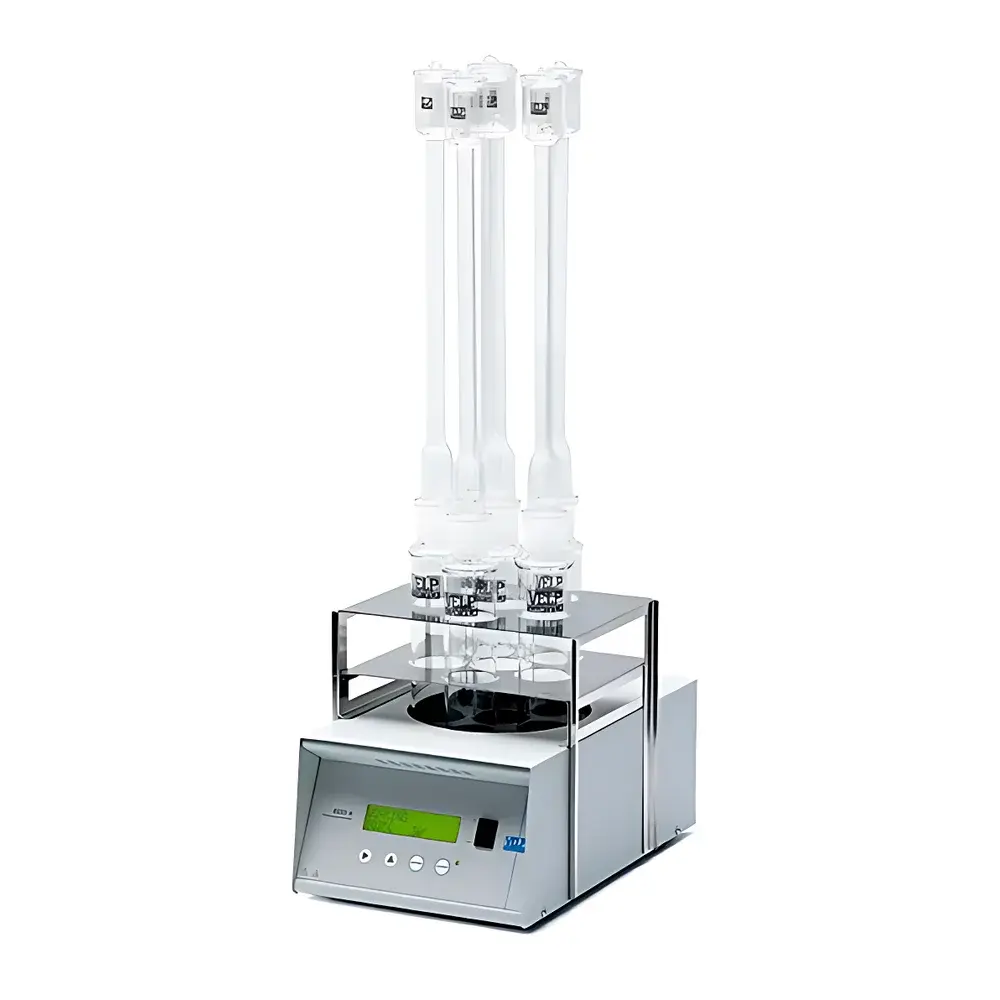
VELP ECO Series COD Digesters
| Brand | VELP |
|---|---|
| Origin | Italy |
| Model | ECO Series |
| Digestion Method | Rapid Digestion |
| Heating Module | Single Aluminum Block |
| Batch Capacity | 25 samples |
| Temperature Range | Ambient to 160 °C (ECO 8/16/25) |
| Temperature Accuracy | ±1 °C |
| Temperature Uniformity | ±0.5 °C |
| Temperature Stability | ±0.5 °C |
| Digestion Vessel Capacity | 5 mL (standard COD vials) |
| Timer Range | 1–199 min or continuous mode |
| Timer Resolution | 1 min |
| Display | LED showing set temperature and remaining time |
| Safety Features | Audible end-of-cycle alarm, automatic shutdown, optional safety shield |
| Power Supply | 230 V / 50–60 Hz (standard) |
| Power Consumption | 140–700 W depending on model |
Overview
The VELP ECO Series COD Digesters are precision-engineered thermal reactors designed for rapid, reproducible chemical oxygen demand (COD) analysis in accordance with standard methods including ISO 6060, APHA 5220 D, and ASTM D1252. These instruments employ controlled conductive heating via a high-purity anodized aluminum heating block to achieve precise, uniform temperature distribution across all sample positions—critical for minimizing inter-vial variability in oxidative digestion. Unlike conventional reflux-based systems requiring 2-hour digestion at 150 °C, the ECO Series enables accelerated protocols: complete COD digestion in as little as 30 minutes at 160 °C, significantly improving laboratory throughput without compromising analytical integrity. The system’s thermally stable architecture supports not only COD but also broader sample preparation workflows—including total organic carbon (TOC), chromium, nitrogen, sulfur, and trace metal determination in environmental matrices such as wastewater, sludge, soil, sediments, animal feed, and biological tissues.
Key Features
- Single-piece anodized aluminum heating block engineered for exceptional thermal homogeneity (±0.5 °C uniformity) and long-term stability (±0.5 °C drift over extended operation)
- Five pre-programmed digestion temperature setpoints (70, 100, 120, 150, and 160 °C) on ECO 8 and ECO 25 models; full-range digital control (ambient to 200 °C) on ECO 6
- Dual-mode timer: discrete interval selection (30/60/90/120 min) or fully adjustable 1–199 min countdown with continuous operation option
- Integrated LED display showing real-time setpoint temperature and remaining digestion time
- Automated safety protocols: audible end-of-cycle alarm, auto-shutdown, over-temperature cut-off, and probe fault detection with visual/audible alerts
- Modular adapter compatibility supporting multiple tube formats: Ø16 mm (standard COD vials), Ø22 mm (sludge digestion), and Ø42 mm (high-volume TOC or suspended solids applications)
- Robust epoxy-coated steel chassis with compact footprint optimized for benchtop use in regulated QC/QA laboratories
Sample Compatibility & Compliance
The ECO Series accommodates a broad spectrum of environmental and industrial sample types—including municipal and industrial wastewater, activated sludge, digested biosolids, agricultural runoff, soil extracts, and organic-rich matrices such as animal feed and plant tissue. Its standardized digestion geometry ensures compliance with method-defined vessel dimensions and heating profiles required by ISO 6060:2023 (water quality — determination of chemical oxygen demand), US EPA Method 410.4, and DIN 38409-H41. Optional accessories—including PTFE-sheathed conical tubes (NS 29/32), corrosion-resistant alloy reduction sleeves, and KS-type concentration tubes—extend applicability to aggressive digestions involving concentrated H₂SO₄/H₃PO₄ mixtures or perchloric acid-based protocols. All ECO models support GLP-compliant documentation when integrated with external data loggers or LIMS interfaces.
Software & Data Management
While the ECO Series operates as a standalone thermal platform without embedded software, its deterministic timer and calibrated thermal control ensure full traceability for audit-ready workflows. Each unit records no internal data logs; however, the consistent temperature ramping profile, fixed dwell times, and visual/tactile end-point indicators (LED countdown + audible tone) align with FDA 21 CFR Part 11 principles when paired with laboratory-controlled procedural documentation. Optional integration with VELP’s REAXIS software suite (via RS-232 or USB-to-serial adapters) enables remote parameter setting, batch logging, and export of timestamped temperature/time events for electronic record retention. All firmware versions undergo periodic validation per ISO/IEC 17025 calibration management requirements.
Applications
- Routine COD analysis in wastewater treatment plants and environmental testing labs per ISO 6060 and APHA Standard Methods
- High-throughput pretreatment for ICP-OES/MS analysis of metals (Cr, Ni, Zn, Cu, Pb) in digested sludge and sediment samples
- TOC sample oxidation prior to NDIR or TC/TIC measurement using high-capacity ECO 6 with Ø42 mm vessels
- Chromium(VI) reduction and total Cr digestion in industrial effluents under acidic hot-block conditions
- Nitrogen and sulfur speciation workflows requiring controlled thermal decomposition of organic matrices
- Method development and validation studies where thermal reproducibility and inter-laboratory comparability are critical
FAQ
What standards does the ECO Series comply with for COD analysis?
The ECO Series meets the thermal performance criteria specified in ISO 6060:2023, APHA 5220 D, and ASTM D1252 for closed-reflux colorimetric COD determination.
Can the ECO 25 handle 200 mL digestion tubes?
No—only the ECO 6 model supports Ø42 mm × 200 mL conical tubes; ECO 8, ECO 16, and ECO 25 are configured exclusively for Ø16 mm and Ø22 mm vials.
Is temperature calibration traceable to national standards?
Yes—each unit ships with a factory calibration certificate referenced to NIST-traceable RTD standards; annual recalibration is recommended per ISO/IEC 17025 clause 6.6.
Does the system support GLP audit trails?
As a Class II standalone thermal device, it does not generate electronic audit trails internally, but its deterministic operation and external documentation practices satisfy GLP Annex 11 requirements when validated within the lab’s QMS.
What safety certifications do ECO models hold?
All units are CE-marked and comply with IEC 61010-1:2010 for electrical safety in laboratory equipment; optional safety shields meet EN 61010-2-010 for protection against splashes and thermal exposure.
Related Products







