
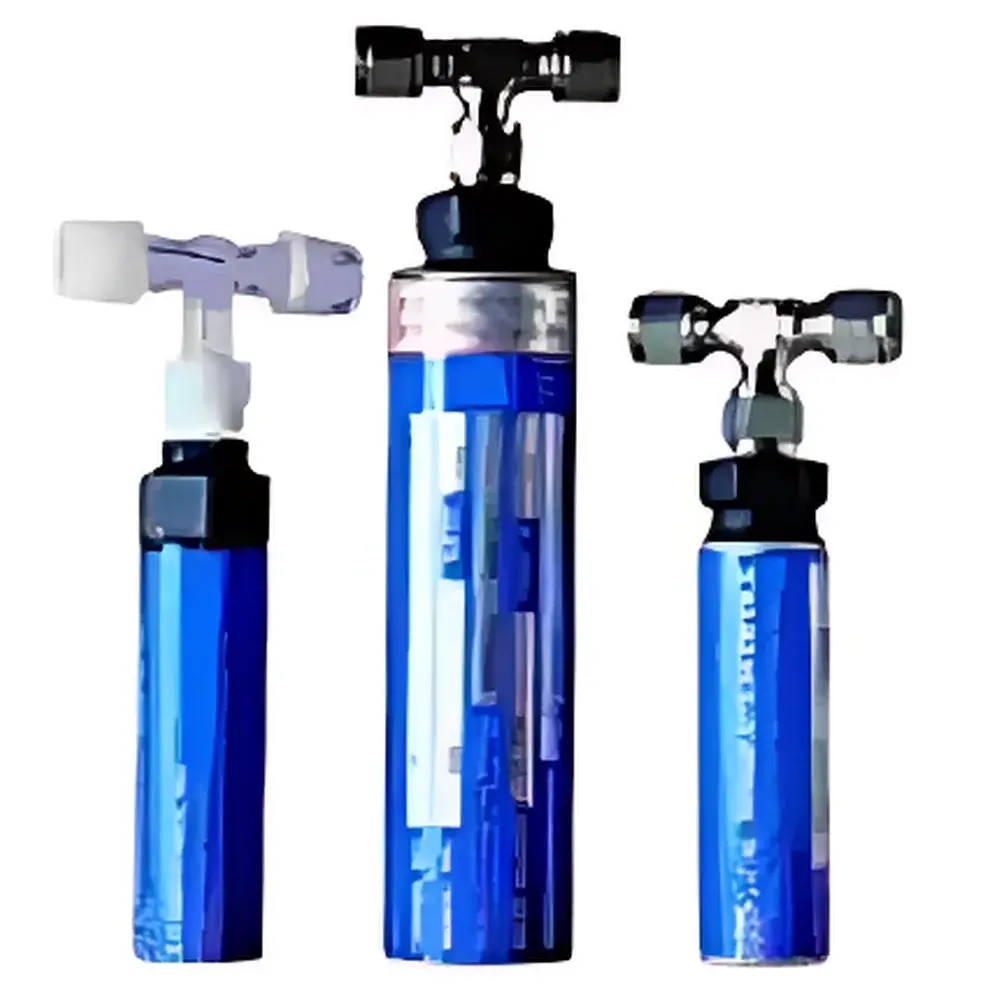
VICI Dynacal & G-Cal Gas Permeation Tubes
| Brand | VICI |
|---|---|
| Origin | USA |
| Series | Dynacal (Standard, XLT Long-Life, Membrane-Type) & G-Cal |
| Permeation Rate Range | 5–50,000 ng/min (Dynacal) |
| Temperature Sensitivity | Low (G-Cal), Controlled-Environment Optimized (Dynacal) |
| Compliance | Designed for ASTM D6167, ISO 6145-8, USP <1225>, and GLP/GMP traceable calibration workflows |
| Application Scope | Chromatographic calibrations (GC, GC-MS), ambient air monitoring, toxic gas standard generation, EPA Method TO-14/TO-15 support |
Overview
VICI Gas Permeation Tubes are precision-engineered primary standard generators for volatile organic compounds (VOCs), inorganic gases, and reactive vapors. Based on the fundamental principle of Fickian diffusion through polymer membranes—typically fluorinated ethylene propylene (FEP) or polyimide—the devices produce a stable, temperature-dependent mass flow of analyte vapor into a carrier gas stream. Unlike cylinder-based standards, permeation tubes operate without pressure regulation or phase change, delivering inherently stable output rates over extended periods when maintained within specified thermal boundaries. The Dynacal series is optimized for laboratory-grade calibration systems requiring high reproducibility under thermostatically controlled conditions (±0.05 °C), while the G-Cal series incorporates thermally compensated membrane geometry to minimize output drift across ambient temperature fluctuations (±3 °C), making it suitable for field-deployable calibrators and mobile monitoring platforms.
Key Features
- Dynacal Tube Options: Standard tubular design (full-length wall permeation), XLT Long-Life variant (stainless-steel encapsulated for 3×–12× extended service life depending on effective permeation length), and membrane-window type (localized 0.5–2 mm aperture for low-rate, contamination-resistant output)
- G-Cal Series: Integrated thermal inertia compensation; certified output stability ≤±2% over 15–35 °C ambient range; compatible with mass flow controllers (MFCs) for precise dilution down to sub-ppb levels
- Material Integrity: All permeation elements use USP Class VI-certified FEP tubing or custom-synthesized polyimide membranes; no leachable additives or plasticizers
- Traceability: Each tube is supplied with NIST-traceable calibration certificate listing gravimetrically determined permeation rate at 25.0 °C, uncertainty budget (k=2), and activation energy (Ea) for temperature correction
- Robust Architecture: Stainless-steel end caps, PTFE-sealed fittings, and vacuum-brazed joints ensure leak integrity per ISO 15848-1 (≤1×10⁻⁶ mbar·L/s He)
Sample Compatibility & Compliance
VICI permeation tubes support over 120 certified chemical species—including arsine (AsH3), phosphine (PH3), carbon monoxide (CO), nitrogen oxides (NO/NO2), methane (CH4), benzene, formaldehyde, and hydrogen sulfide (H2S)—with validated performance under EPA Methods TO-14A, TO-15, and IO-4.1. Devices comply with ISO 6145-8 (gas mixtures by dynamic volumetric methods), ASTM D6167 (permeation tube calibration procedures), and support 21 CFR Part 11-compliant data audit trails when integrated with VICI’s CalMaster software. All units are manufactured in an ISO 9001:2015-certified facility and undergo 100% post-calibration verification prior to shipment.
Software & Data Management
When used with VICI CalMaster v4.x or third-party calibration management platforms (e.g., Empower, Chromeleon), permeation tubes enable automated temperature-compensated concentration calculation using the Arrhenius equation: ln(P) = ln(P0) – (Ea/R)(1/T – 1/T0). CalMaster stores full calibration history, applies real-time drift correction, logs MFC setpoints and actual flows, and generates PDF reports compliant with GLP documentation requirements—including operator ID, environmental chamber logs, balance calibration records, and uncertainty propagation summaries. Audit trail functionality meets FDA 21 CFR Part 11 requirements for electronic records and signatures.
Applications
- Primary calibration standard generation for gas chromatography (GC-FID, GC-ECD, GC-MS) and photoionization detectors (PID)
- Dynamic dilution systems for ambient air quality monitors (e.g., O3, SO2, NOx analyzers per EN 14625)
- Reference material production for proficiency testing programs (e.g., ILAC-G13, ISO/IEC 17043)
- Method validation and instrument qualification (IQ/OQ/PQ) per USP and ICH Q2(R2)
- Mobile emissions testing and fugitive VOC source characterization
FAQ
How is the permeation rate verified and certified?
Each tube undergoes gravimetric calibration in a temperature-controlled microbalance system per ASTM D6167. Certified rate includes expanded uncertainty (k=2) derived from balance repeatability, temperature homogeneity, weighing duration, and Arrhenius model fit residuals.
Can a single permeation tube be used for multiple analytes?
No. Each tube is loaded with one pure compound or eutectic mixture. Cross-contamination or co-permeation is physically prohibited by sealed construction and material-specific diffusion kinetics.
What carrier gas is recommended for optimal stability?
Ultra-high-purity nitrogen (99.999%) or zero-air (hydrocarbon-free) is recommended. Avoid CO2-containing gases with amine-containing analytes due to potential adsorption effects.
How often must a Dynacal tube be recalibrated?
Annual recalibration is recommended for critical applications; however, stability data show ≤1.5% drift over 12 months when stored at 4 °C and operated within ±0.1 °C of calibration temperature.
Is G-Cal suitable for regulatory stack testing?
Yes—G-Cal units are routinely deployed in EPA Protocol Gas Generation Systems (PGGS) for Method 301 validation and continuous emission monitoring system (CEMS) linearity checks, provided dilution ratios and flow metrology meet PS-18 specifications.
Related Products







