
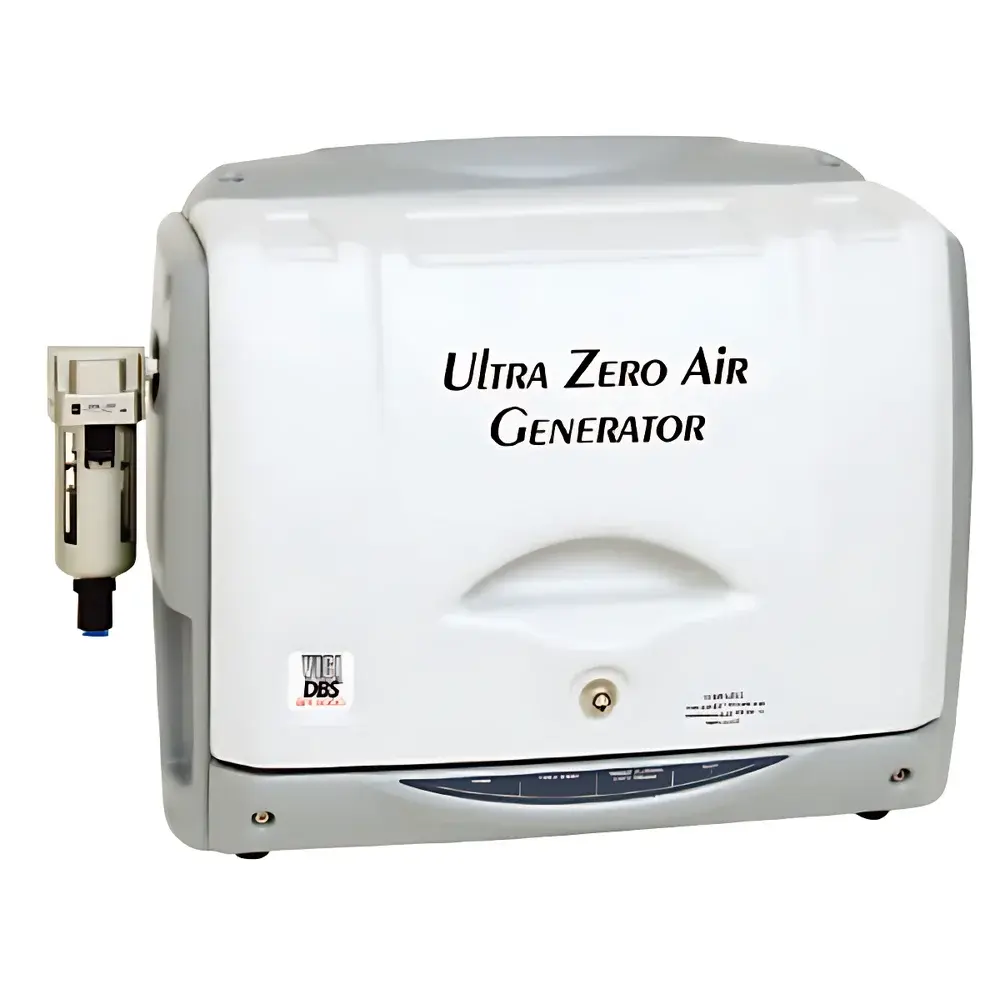
VICI GC> Ultra-Zero Air Generator
| Brand | VICI |
|---|---|
| Origin | USA |
| Model | GC> Ultra-Zero Air Generator |
| Hydrocarbon (HC) Purity | < 0.1 ppm |
| CO₂ Removal | < 5 ppm |
| CO Removal | < 50 ppm |
| NOₓ & SOₓ Removal | < 0.1 ppm |
| Flow Rate Range | 1–30 L/min |
| Maximum Output Pressure | 6.5 barg (95 psig) |
| Technology | Catalytic Oxidation + Multi-Stage Purification |
| Cabinet Mount Option | 19-inch Rack Compatible |
Overview
The VICI GC> Ultra-Zero Air Generator is an engineered gas purification system designed to deliver ultra-high-purity zero-air for critical analytical and process applications. It operates on a dual-stage catalytic oxidation and multi-bed adsorption principle: compressed instrument air first passes through a high-efficiency hydrocarbon oxidation catalyst operating at elevated temperature, converting trace volatile organic compounds (VOCs) and hydrocarbons into CO₂ and H₂O; these byproducts—along with residual moisture, CO, CO₂, NOₓ, and SOₓ—are subsequently removed via proprietary desiccant, CO₂ scrubber, and chemisorbent beds. This architecture ensures continuous, stable output meeting the most stringent purity specifications required by flame ionization detectors (FID), total organic carbon (TOC) analyzers, continuous emission monitoring (CEM) systems, and industrial process control instrumentation. Unlike conventional zero-air generators relying solely on activated carbon or membrane filtration, the GC> platform achieves true ultra-zero performance across multiple contaminant classes simultaneously—enabling baseline stability, reduced detector noise, and improved signal-to-noise ratio in trace-level analysis.
Key Features
- Catalytic oxidation core certified to reduce total hydrocarbons to < 0.1 ppm (v/v), validated per ASTM D6216 and ISO 8573-1 Class 1 solid particle / Class 2 water / Class 1 oil standards
- Integrated multi-contaminant removal: CO₂ < 5 ppm, CO < 50 ppm, NOₓ & SOₓ < 0.1 ppm, dew point ≤ –40 °C at 100 kPa
- Wide operational flow range of 1–30 L/min at up to 6.5 barg (95 psig), compatible with both single-instrument and multi-point distribution networks
- Modular, serviceable design with color-coded quick-connect fittings and standardized replacement cartridges—no tools required for routine maintenance
- Rack-mount configuration available for 19-inch EIA-standard enclosures, supporting integration into centralized laboratory utility systems or mobile analytical platforms
- Real-time pressure and flow monitoring with local digital display; analog 4–20 mA outputs available for SCADA or BMS interfacing
Sample Compatibility & Compliance
The GC> Ultra-Zero Air Generator is validated for use with gas chromatography–flame ionization detection (GC-FID), TOC combustion modules, CEM stack gas analyzers (per EPA Method 7E, EN 14181), and semiconductor process tool purge lines. Its output meets or exceeds the air purity requirements specified in USP , ASTM D6216-22 (Standard Specification for Zero Air), ISO 8573-1:2010 Class 0 for oil content, and EU GMP Annex 1 (2022) provisions for critical process gases. All internal wetted materials comply with FDA 21 CFR Part 11 material compatibility guidelines, and the system supports full audit trail logging when integrated with compliant LIMS or ELN platforms.
Software & Data Management
While the base unit operates as a standalone hardware system, optional digital interface modules enable seamless integration into regulated environments. The RS-485/Modbus RTU port supports remote status polling and alarm event reporting. When paired with VICI’s optional AirLog™ firmware (v3.2+), the generator provides timestamped operational logs—including cumulative runtime, cartridge life estimation, pressure drop trends, and purity verification timestamps—exportable as CSV or PDF for GLP/GMP documentation. All data handling conforms to ALCOA+ principles (Attributable, Legible, Contemporaneous, Original, Accurate, Complete, Consistent, Enduring, Available) and supports 21 CFR Part 11 electronic signature workflows when deployed with validated third-party software.
Applications
- Carrier and makeup gas supply for GC-FID systems requiring sub-ppb hydrocarbon background for environmental pesticide residue, petrochemical hydrocarbon profiling, and forensic toxicology screening
- Combustion air source for high-sensitivity TOC analyzers in pharmaceutical water system validation (PW, WFI, PWRS) per USP
- Calibration and span gas dilution air in continuous emissions monitoring (CEM) systems compliant with EPA PS-11 and EN 15267-3
- Purge and sweep gas for FTIR gas cells, cavity ring-down spectrometers (CRDS), and laser-based trace gas sensors
- Cleanroom HVAC make-up air supplementation where hydrocarbon-free air is mandated for photolithography tool environments
FAQ
What is the difference between “zero air” and “ultra-zero air”?
Zero air typically refers to air purified to < 0.5 ppm total hydrocarbons; ultra-zero air—as delivered by the GC> series—achieves < 0.1 ppm HC plus simultaneous control of CO, CO₂, NOₓ, SOₓ, and moisture to levels appropriate for sub-ppb detection limits.
Can this generator replace cylinder-based zero air in regulated labs?
Yes—when installed with documented IQ/OQ protocols and maintained per VICI’s SOP-AG-003, it qualifies as an equivalent or superior alternative to compressed zero-air cylinders under FDA, EMA, and PMDA inspection expectations.
How often do consumables require replacement?
Under typical lab use (20 L/min, 8 h/day), the oxidation catalyst lasts ≥ 24 months, while the CO₂ and moisture beds require replacement every 12–18 months—monitored automatically via differential pressure sensors and logged in AirLog™.
Is external drying or compression required?
No—the GC> accepts standard shop air (4–10 barg, ≤ 40 °C, ≤ 70% RH) directly; integrated pre-filtration removes particulates, oil aerosols, and bulk moisture prior to catalytic treatment.
Does it support automated calibration verification?
Not natively—but optional integration with VICI’s AirCheck™ portable hydrocarbon analyzer enables scheduled on-line purity verification per ISO/IEC 17025 method validation requirements.



