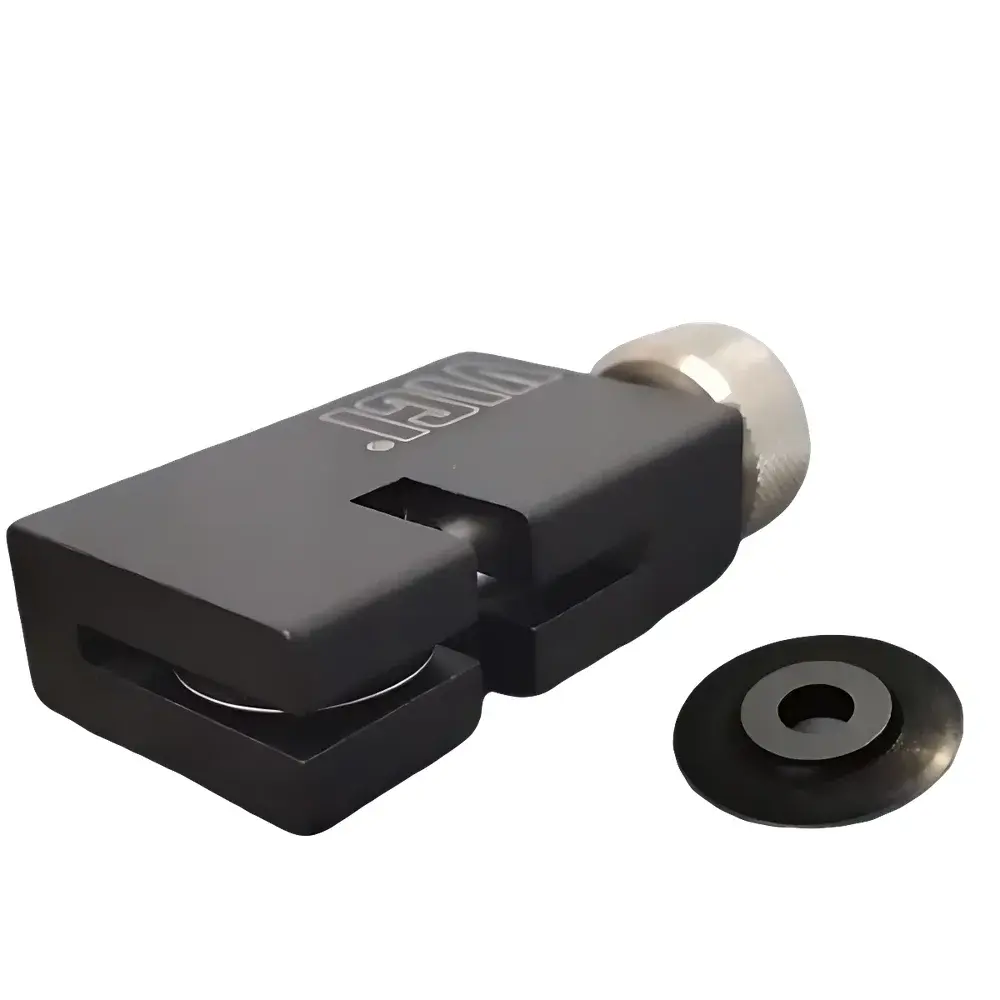
VICI JR-792 Stainless Steel Tubing Cutter
| Brand | VICI |
|---|---|
| Origin | USA |
| Model | JR-792 |
| Tube Compatibility | 1/16" (1.59 mm) and 1/8" (3.18 mm) OD stainless steel tubing |
| Cutting Mechanism | Adjustable scissor-grip rotary wheel with tungsten carbide cutting wheel |
| Blade Replacement | Tool-free, snap-in JR-793 replacement wheels |
| Finish Quality | Burr-minimized, perpendicular, dimensionally stable cuts |
| Construction | Precision-machined stainless steel body with ergonomic polymer grips |
Overview
The VICI JR-792 Stainless Steel Tubing Cutter is an engineered hand tool designed for precision manual cutting of small-diameter stainless steel tubing in laboratory, analytical instrumentation, and process control environments. It operates on a calibrated rotary scissor-grip principle: as the user rotates the tool around the tube, a hardened tungsten carbide cutting wheel progressively scores and severs the wall under controlled radial pressure. This mechanism ensures consistent axial alignment, minimizes deformation, and eliminates the need for secondary deburring—critical when preparing tubing for high-integrity fluidic connections in HPLC, GC, gas chromatography sampling loops, or microfluidic manifold assemblies. Unlike generic tubing cutters, the JR-792 features a fixed-radius guide collar and depth-limited wheel carriage that constrains cut geometry to near-perpendicularity (±0.5° tolerance), preserving internal diameter integrity and reducing flow path turbulence.
Key Features
- Precision-engineered for 1/16″ (1.59 mm) and 1/8″ (3.18 mm) outer diameter stainless steel tubing—optimized for 316 SS and other austenitic grades commonly used in analytical fluid paths.
- Tungsten carbide cutting wheel (JR-793) with replaceable snap-in design—no tools required; average service life exceeds 200 clean cuts per wheel under standard lab conditions.
- Stainless steel main body with corrosion-resistant surface finish and overmolded ergonomic polymer grips for tactile control and reduced hand fatigue during repetitive use.
- Integrated depth stop prevents over-penetration and maintains consistent wall engagement across varying tube hardnesses and work-hardening states.
- No external power source or calibration required—fully mechanical operation ensures reliability in glovebox, fume hood, and ISO Class 5 cleanroom settings.
Sample Compatibility & Compliance
The JR-792 is validated for use with seamless, annealed stainless steel tubing meeting ASTM A269 and ASTM A213 specifications. It is not rated for use with nickel alloys (e.g., Inconel), titanium, or polymer tubing (e.g., PTFE, PEEK), which require alternative cutting methodologies due to differential hardness and thermal response. The tool conforms to general laboratory safety standards for hand-held mechanical instruments (ANSI/ASSP Z49.1) and supports GLP-compliant documentation workflows when paired with traceable blade lot numbers (JR-793 wheels are serialized per manufacturing batch). While not a regulated medical device, its consistent cut quality contributes to meeting USP Analytical Instrument Qualification requirements for sample introduction system integrity.
Software & Data Management
As a purely mechanical cutting instrument, the JR-792 does not incorporate embedded electronics, firmware, or data logging capabilities. However, it integrates seamlessly into digitally managed laboratory environments through complementary documentation practices: QR-coded JR-793 blade packaging enables traceability in LIMS or electronic lab notebooks (ELN); maintenance logs—including blade replacement dates, operator ID, and tubing lot numbers—can be captured in audit-ready formats compliant with FDA 21 CFR Part 11 when entered via validated ELN systems. No software installation or network connectivity is required or supported.
Applications
- Preparation of inlet/outlet tubing for HPLC, UHPLC, and LC-MS systems where burr-free terminations prevent column clogging and seal failure.
- Fabrication of custom-length capillary segments for gas chromatography injectors, detector cells, and pneumatic control lines.
- Field service and maintenance of process analyzers (e.g., online IR, UV-Vis spectrophotometers) requiring rapid, on-site tubing replacement without soldering or flaring.
- Microfluidic prototyping labs where dimensional repeatability and surface finish directly impact laminar flow stability and sensor interface reliability.
- Calibration lab workflows involving certified reference material delivery lines, where internal diameter consistency affects volumetric accuracy.
FAQ
Can the JR-792 cut tubing larger than 1/8″?
No. The guide collar and wheel geometry are mechanically constrained to 1/16″ and 1/8″ OD stainless steel tubing only. Attempting to cut larger diameters risks misalignment, excessive wheel wear, and non-perpendicular cuts.
Is the JR-793 replacement wheel compatible with other VICI cutters?
Yes—the JR-793 wheel is standardized across VICI’s JR-series tubing cutters (JR-791, JR-792, JR-794) and shares interchangeability with legacy JR-700 series tools manufactured after 2012.
Does the cutter require periodic recalibration?
No. As a passive mechanical device with no adjustable metrology components, the JR-792 maintains dimensional fidelity through precision machining and material stability. Routine visual inspection for wheel wear and grip integrity suffices for operational verification.
Can it be used in inert atmosphere gloveboxes?
Yes. Its all-metal construction, absence of lubricants or volatile binders, and zero outgassing profile make it suitable for argon- or nitrogen-purged environments used in moisture-sensitive or oxygen-sensitive applications.