
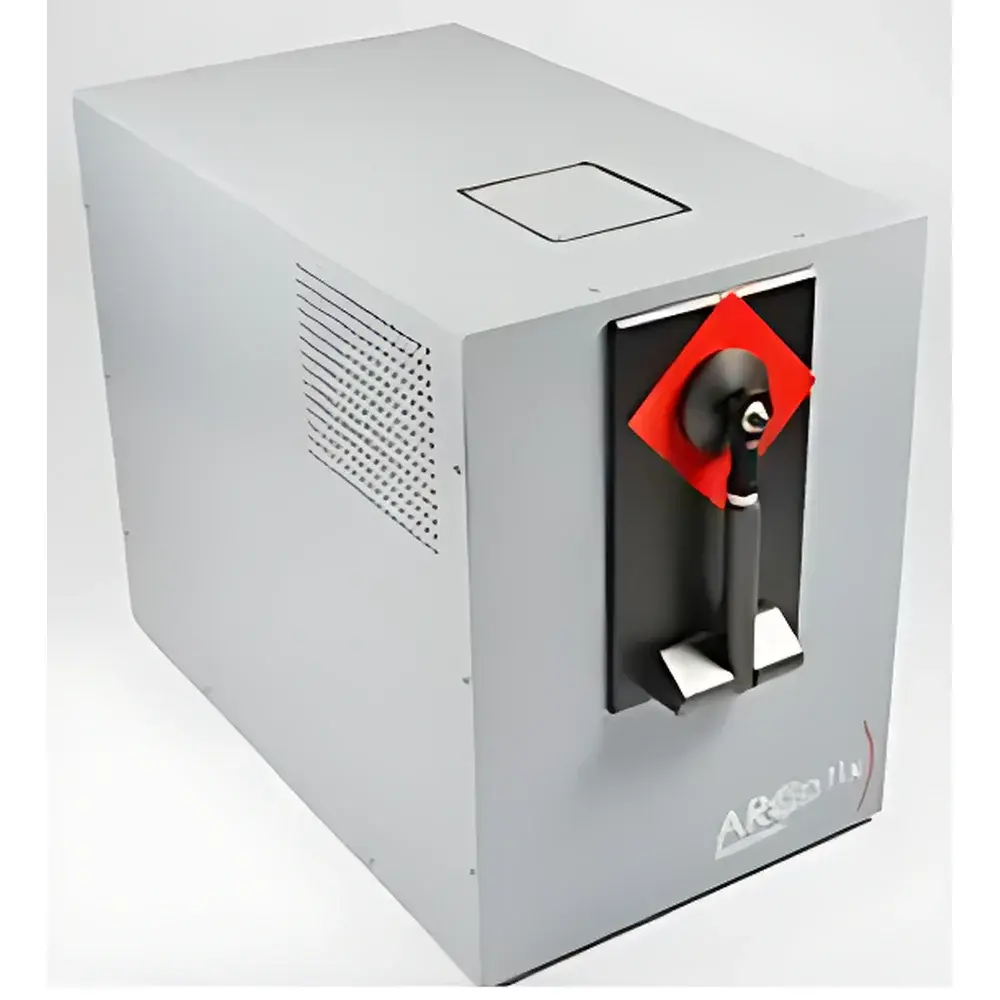
VIS-NIR Diffuse Reflectance Spectrometer
| Origin | Canada |
|---|---|
| Manufacturer Type | Distributor |
| Origin Category | Imported |
| Model | VIS-NIR |
| Pricing | Upon Request |
| Component Category | Light Source |
Overview
The VIS-NIR Diffuse Reflectance Spectrometer is a laboratory-grade optical measurement system engineered for quantitative spectral characterization of scattering and opaque solid samples across the visible to near-infrared wavelength range (typically 350–1050 nm). It operates on the principle of diffuse reflectance spectroscopy (DRS), where incident broadband light interacts with a sample’s surface and subsurface layers, and the spectrally resolved backscattered radiation is collected via an integrating sphere or cosine-corrected detector geometry. This configuration enables robust, non-destructive analysis of color, pigment concentration, chemical composition, and structural homogeneity—particularly valuable in materials science, agricultural quality control, pharmaceutical tablet coating assessment, and soil analysis. The system is designed for integration into standardized optical benches and modular spectroscopic workflows, supporting both routine QC and advanced research applications requiring high photometric stability and inter-laboratory reproducibility.
Key Features
- Optimized optical path architecture featuring high-efficiency VIS-NIR broadband illumination and calibrated diffuse collection optics
- Modular design compatible with standard fiber-optic coupling (e.g., SMA 905), enabling seamless integration with Ocean Insight, Avantes, or Hamamatsu spectrometers
- Stable, temperature-controlled tungsten-halogen or quartz-tungsten-halogen (QTH) light source with spectral output spanning 360–2500 nm (with appropriate filtering)
- Integrated reference channel for real-time intensity normalization, minimizing drift from lamp aging or thermal fluctuation
- Compliant mechanical interface for ISO 9001-certified calibration standards (e.g., Spectralon® reference tiles) and NIST-traceable reflectance validation
- Rugged aluminum housing with EMI-shielded electronics and passive thermal management for long-duration acquisition stability
Sample Compatibility & Compliance
The spectrometer accommodates flat, curved, granular, powdered, or textured solid samples—including tablets, fabrics, soils, plant leaves, painted surfaces, and polymer films—without requiring transmission geometry or vacuum environments. Sample positioning is facilitated by adjustable stage mounts and optional motorized XYZ translation. All optical components meet RoHS Directive 2011/65/EU requirements. System-level documentation supports GLP-compliant operation per ISO/IEC 17025:2017 and aligns with ASTM E308-22 (Standard Practice for Computing the Colors of Objects by Using the CIE System) and ASTM E1421-21 (Standard Guide for Describing and Measuring Performance Characteristics of Spectrophotometers Used in Color Measurement). Optional IQ/OQ/PQ protocols are available for regulated pharmaceutical and food safety environments.
Software & Data Management
The instrument interfaces via USB 2.0 or Ethernet with vendor-neutral spectral acquisition software (e.g., OceanView, AvaSoft, or custom LabVIEW-based drivers). Raw data export is supported in CSV, ASCII, and HDF5 formats, ensuring compatibility with MATLAB, Python (NumPy/SciPy), and chemometric platforms such as Unscrambler® or Pirouette®. Software includes built-in Kubelka-Munk transformation modules for converting reflectance spectra into absorption/scattering coefficient estimates. Audit trail functionality—compliant with FDA 21 CFR Part 11—can be enabled through third-party LIMS integration, recording user actions, calibration events, and metadata timestamps. All firmware updates are digitally signed and version-controlled.
Applications
- Quantitative pigment analysis in paints, inks, and cosmetic formulations
- In-line monitoring of grain moisture and protein content in agri-processing facilities
- Non-invasive assessment of tablet coating uniformity and dissolution behavior in pharmaceutical development
- Soil organic matter estimation and mineralogical classification in environmental geoscience
- Quality screening of recycled plastics based on spectral fingerprinting of polymer blends
- Calibration transfer between benchtop and portable NIR systems using PCA-based spectral matching
FAQ
What wavelength range does this VIS-NIR spectrometer cover?
Standard configuration spans 350–1050 nm; extended-range variants (up to 1700 nm or 2500 nm) are available with InGaAs detector options and appropriate source/filter combinations.
Is the system supplied with calibration certificates?
Yes—NIST-traceable reflectance calibration using certified Spectralon® standards is included, with optional annual recalibration services aligned to ISO/IEC 17025.
Can it be used for transmission measurements?
No—the optical design is optimized exclusively for diffuse reflectance geometry; transmission capability requires separate collimated beam modules and sample holders.
Does the system support automated sample mapping?
Yes—when integrated with motorized XY stages and TTL-triggered acquisition, it supports raster-scanning of heterogeneous surfaces for spatially resolved spectral imaging.
What are the environmental operating conditions?
Rated for ambient temperatures of 15–30 °C, relative humidity ≤70% non-condensing, and vibration isolation class M (per ISO 10816-1) when mounted on optical tables.





