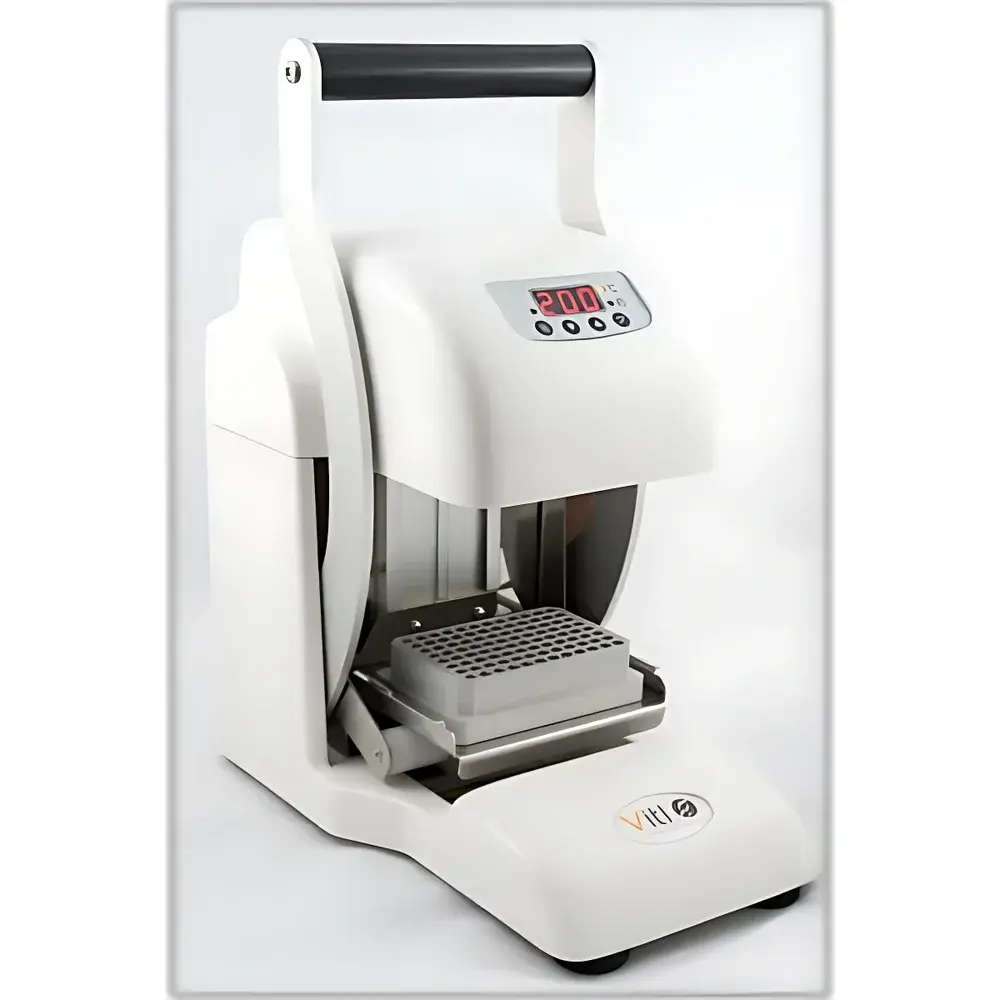
Vitl VTS Variable Temperature Sealer
| Brand | Vitl Life Science Solutions |
|---|---|
| Origin | United Kingdom |
| Model | VTS |
| Sealing Temperature Range | 125–200 °C (1 °C increments) |
| Sealing Time Range | 1–9 s (0.5 s increments) |
| Warm-up Time to 170 °C | <10 min |
| Dimensions (W×D×H) | 220 × 325 × 425 mm |
| Weight | 7.2 kg |
| Power Supply | 110–120 / 220–230 VAC |
| Plate Compatibility | 96-well, 384-well, 1536-well microplates and deep-well plates (requires separate adapter) |
Overview
The Vitl VTS Variable Temperature Sealer is an engineered laboratory thermal sealing instrument designed for precise, reproducible, and contamination-free sealing of microplates used in molecular biology, diagnostics, and biobanking applications. Based on resistive heating and controlled thermal transfer principles, the VTS applies uniform pressure and programmable temperature profiles across the entire plate surface—ensuring complete, bubble-free, and hermetic seals without compromising well integrity or sample stability. Unlike fixed-temperature sealers, the VTS enables method-specific optimization of sealing parameters to match the thermal requirements of diverse sealing films—including aluminum foils, PCR-grade polymer films, and solvent-resistant barrier membranes. Its robust architecture, validated over five years of continuous operational testing, delivers consistent single-cycle sealing performance with audible completion feedback—minimizing operator error and eliminating risks associated with under-sealing (evaporation, cross-contamination) or over-sealing (well deformation, film delamination).
Key Features
- Programmable sealing temperature range from 125 °C to 200 °C in 1 °C increments—covering manufacturer-recommended thresholds for all major PCR and cryogenic sealing films.
- Adjustable dwell time from 1.0 to 9.0 seconds in 0.5-second increments—enabling fine-tuned control for low-mass films or high-thermal-capacity plates.
- Sub-10-minute warm-up to 170 °C ensures rapid transition between protocols and supports high-throughput workflow integration.
- Ergonomic, low-profile design with intuitive front-panel interface and tactile feedback—optimized for daily use in ISO-certified cleanrooms and GLP-compliant laboratories.
- Acoustic confirmation signal upon sealing cycle completion—preventing inadvertent resealing or thermal overexposure.
- Modular adapter system supporting 96-well full-skirt, semi-skirted, and unskirted plates, as well as 384-well and 1536-well formats and deep-well storage plates (adapters sold separately).
Sample Compatibility & Compliance
The VTS accommodates standard ANSI/SLAS-format microplates and deep-well plates manufactured from polypropylene, polycarbonate, and cyclic olefin copolymer (COC). It is compatible with commercially available heat-seal films certified for PCR, qPCR, digital PCR, and long-term cryogenic storage (−80 °C and liquid nitrogen). The instrument meets IEC 61010-1 safety standards for laboratory electrical equipment and operates within electromagnetic compatibility (EMC) Class B limits per EN 61326-1. While not a medical device per FDA 21 CFR Part 820, its performance characteristics align with analytical method validation requirements outlined in USP , ISO 15189:2022 (clause 5.3.2), and CLSI EP25-A for sealed plate integrity verification.
Software & Data Management
The VTS operates via embedded firmware with non-volatile parameter memory—retaining up to 10 user-defined sealing protocols. No external software or PC connection is required for routine operation; however, protocol export and audit trail functionality are supported through optional Vitl Connect™ USB interface module (VITL-USB-COMM), enabling traceable recordkeeping compliant with 21 CFR Part 11 Annex 11 requirements. All parameter changes—including temperature, time, and cycle count—are logged with timestamp and operator ID when integrated with LIMS or ELN platforms.
Applications
- Thermal sealing of PCR/qPCR plates prior to thermocycling—ensuring vapor-tight closure during high-temperature denaturation steps.
- Long-term biobank storage of clinical samples using solvent-resistant foil seals—maintaining integrity during DMSO or ethanol exposure.
- Sealing plates for automated liquid handling systems where mechanical clamping is incompatible with plate geometry.
- Preparation of plates for water-bath or heated-block-based thermal cycling instruments requiring uniform thermal contact at the lid interface.
- Quality control workflows involving evaporation rate testing (ASTM D5402), seal burst pressure validation (ISO 8536-4), and microbial ingress assessment (ISO 11737-1).
FAQ
Does the VTS require calibration or periodic certification?
No routine calibration is mandated by the manufacturer; however, users performing GxP-regulated work should implement annual performance verification using reference plates and thermal imaging or seal integrity test kits.
Can the VTS be used with adhesive-based sealing films?
No—the VTS is designed exclusively for heat-activated thermoplastic and metalized films. Adhesive films require ambient-pressure laminators or roller-based sealers.
Is the VTS compatible with robotic deck integration?
Yes—its compact footprint, fixed-height sealing head, and programmable I/O signals (via optional module) support integration into automated workcells meeting SLAS-2004 mechanical interface standards.
What happens if a plate is misaligned under the sealing head?
The VTS incorporates mechanical alignment guides and a spring-loaded pressure mechanism that self-centers minor positional deviations; however, severe misalignment may result in partial sealing and requires visual inspection per SOP.
Are replacement heating elements or thermal sensors field-serviceable?
Yes—Vitl provides certified service kits and technical documentation for qualified field engineers; end-user replacement is not recommended due to thermal calibration dependencies.