
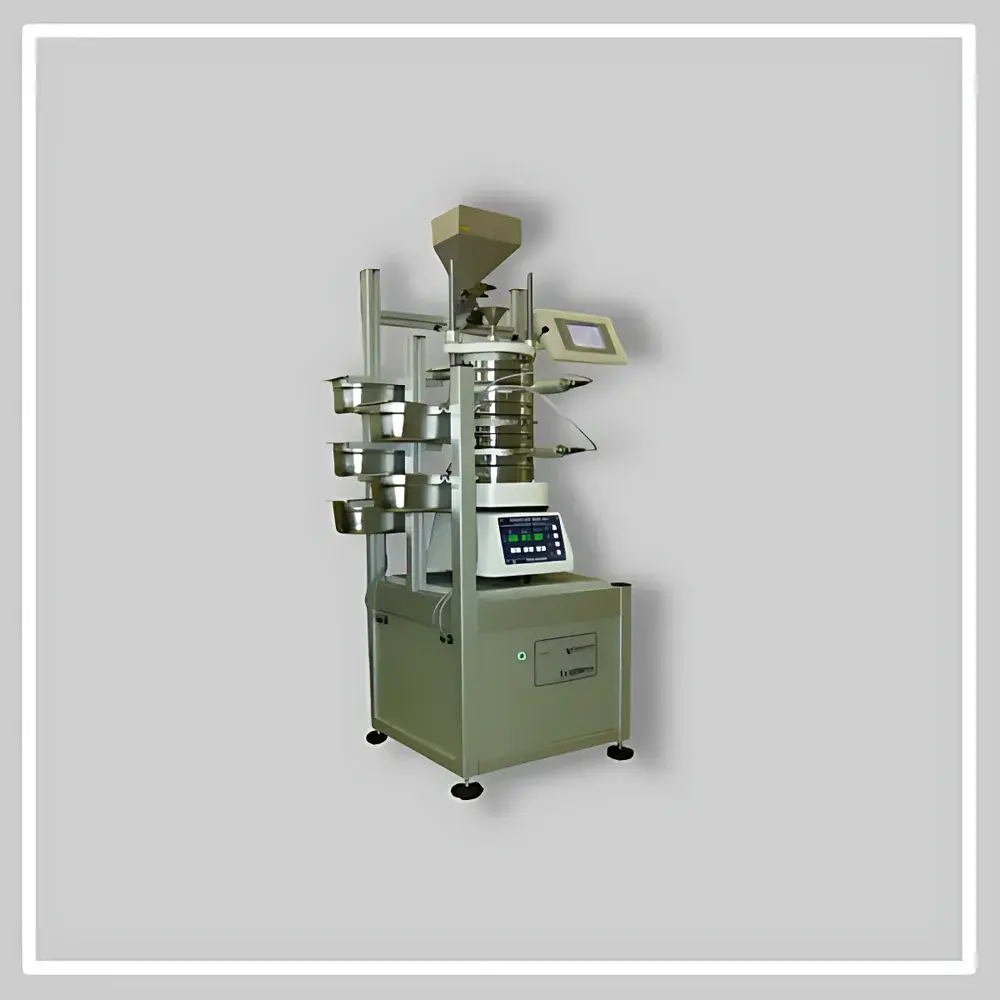
Volstaedt ContSieve 2.0 Continuous Vibration Sieve
| Brand | Volstaedt |
|---|---|
| Origin | Germany |
| Model | ContSieve 2.0 |
| Power Consumption | <2700 W |
| Dimensions (W×D×H) | 500 × 500 × 1600 mm |
| Weight | ~65 kg |
| Protection Rating | IP54 |
| Operating Ambient | 18–30 °C, 25–85 % r.H. |
| Power Supply | 230 V, 50/60 Hz, 10 A (optional 110 V/60 Hz) |
| Ultrasonic Generator | DGS35-100/200 |
| Transducer | C35-SP1 |
| Effective Ultrasonic Power | 400 W |
| Sieve Drive System | Digital Plus |
| Sound Pressure Level | 70 dB(A) |
| Feed System Type | Volumetric Particle Feeder |
| Feed Volume Capacity | 3.5 L |
| Construction Material | Stainless Steel |
| Cleaning Method | Alcohol-based wipe-down |
| Pre-use Calibration | SI-traceable automation class 10A “D” |
| Max. Sieve Aperture | 200 mm |
Overview
The Volstaedt ContSieve 2.0 Continuous Vibration Sieve is an industrial-grade, fully automated particle sizing instrument engineered for high-throughput, reproducible dry-sieving operations in quality control and R&D laboratories. It operates on the principle of controlled mechanical vibration combined with ultrasonically assisted particle dispersion—enabling efficient separation of granular materials across defined sieve apertures up to 200 mm. Unlike batch-mode sieving systems, the ContSieve 2.0 integrates a volumetric feed mechanism and real-time laser-controlled material supply regulation, ensuring consistent mass flow and minimizing segregation or clogging during extended operation. Its architecture conforms to fundamental principles of ASTM E11 and ISO 3310-1 for test sieve specifications, while its digital drive system delivers precise amplitude and frequency modulation to maintain mechanical stability under variable load conditions.
Key Features
- Touchscreen-operated HMI via ruggedized industrial tablet—no external PC required; intuitive interface supports multi-language localization (English, German, French, Spanish).
- Pre-programmable storage for up to five independent sieving protocols, each configurable for vibration frequency (digital plus control), ultrasonic intensity (0–100% of 400 W effective power), amplitude range, dwell time per sieve level, and inter-stage pause intervals.
- Laser-guided volumetric feed system ensures constant sample delivery rate (±1.5% repeatability) and automatic adjustment to maintain optimal layer thickness on the sieve surface.
- Stainless steel construction (AISI 304) throughout wetted and structural components, compliant with FDA-relevant material safety guidelines for non-sterile pharmaceutical and food-grade applications.
- IP54-rated enclosure provides protection against dust ingress and low-pressure water splashes, supporting deployment in shared production-floor environments without dedicated cleanroom infrastructure.
- Digital Plus sieve drive enables closed-loop feedback control of vibration parameters, minimizing drift over prolonged operation (>8 h continuous duty cycle).
Sample Compatibility & Compliance
The ContSieve 2.0 accommodates free-flowing, semi-cohesive, and mildly agglomerated dry particulates—including metal powders, mineral ores, polymer granules, ceramic precursors, and pharmaceutical excipients. It is validated for use with standardized woven-wire test sieves conforming to ISO 3310-1 (apertures from 20 µm to 200 mm) and ASTM E11. The system meets essential requirements for GLP-compliant documentation: all parameter settings, start/stop timestamps, operator ID (via optional RFID login), and real-time vibration metrics are logged internally and exportable as CSV or PDF reports. While not intrinsically certified for hazardous area use, its electrical design complies with CE marking directives (2014/30/EU EMC, 2014/35/EU LVD) and RoHS 2011/65/EU material restrictions.
Software & Data Management
No proprietary software installation is required—the embedded tablet runs a deterministic real-time OS with deterministic I/O response (<10 ms latency). All operational data—including sieve sequence logs, ultrasonic energy consumption per cycle, vibration waveform snapshots (FFT-derived), and feed volume tracking—are stored locally on encrypted internal flash memory (32 GB). Export options include USB mass storage mode and Ethernet TCP/IP transfer to networked file servers or LIMS platforms. Audit trail functionality satisfies baseline FDA 21 CFR Part 11 expectations for electronic records: user authentication, immutable timestamping, and change history for critical parameters. Optional integration with LabWare LIMS or Thermo Fisher SampleManager is supported via standard OPC UA v1.04 interface.
Applications
- Quality assurance of incoming raw materials (e.g., sand, catalysts, battery electrode powders) against contractual particle size distribution (PSD) specifications.
- In-process monitoring of milling, granulation, or spray-drying output in continuous manufacturing lines (ICH Q5E-aligned process analytical technology support).
- Method development and validation studies for USP <786> and Ph. Eur. 2.9.30 sieve analysis procedures.
- Research into powder flowability, fluidization behavior, and electrostatic charging tendencies correlated with sieve-cut fractions.
- Recycling stream characterization—e.g., separation efficiency assessment of shredded e-waste or construction debris by particle geometry and density proxies.
FAQ
Is the ContSieve 2.0 compatible with standard ISO/ASTM test sieves?
Yes—it accepts all commercially available ISO 3310-1 and ASTM E11-compliant test sieves with frame diameters of 200 mm and 300 mm (with optional adapter kit).
Can the ultrasonic module be disabled for non-cohesive samples?
Yes—ultrasonic activation is fully decoupled from vibration control and may be toggled off or set to zero intensity in any protocol.
What maintenance intervals are recommended?
Daily visual inspection of feed chute and sieve clamping mechanism; monthly verification of transducer coupling integrity and calibration of laser feed sensor using NIST-traceable reference masses.
Does the system support 21 CFR Part 11 compliance out-of-the-box?
It provides foundational elements (audit trail, electronic signatures, secure user roles); full compliance requires site-specific validation per your organization’s SOPs and risk assessment.
Is remote diagnostics or firmware updates possible?
Firmware updates are performed offline via USB; remote diagnostic access is not enabled by default but can be activated under controlled IT security review per ISO/IEC 27001 policies.



