
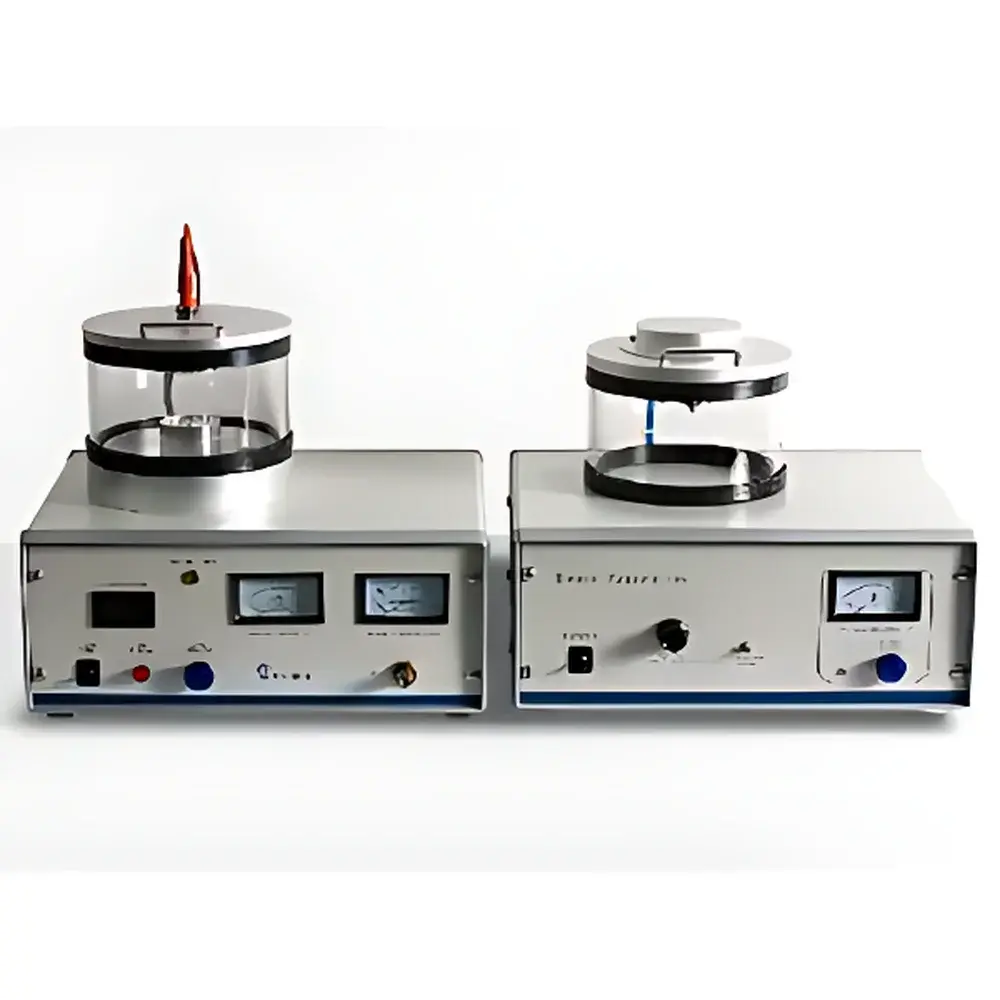
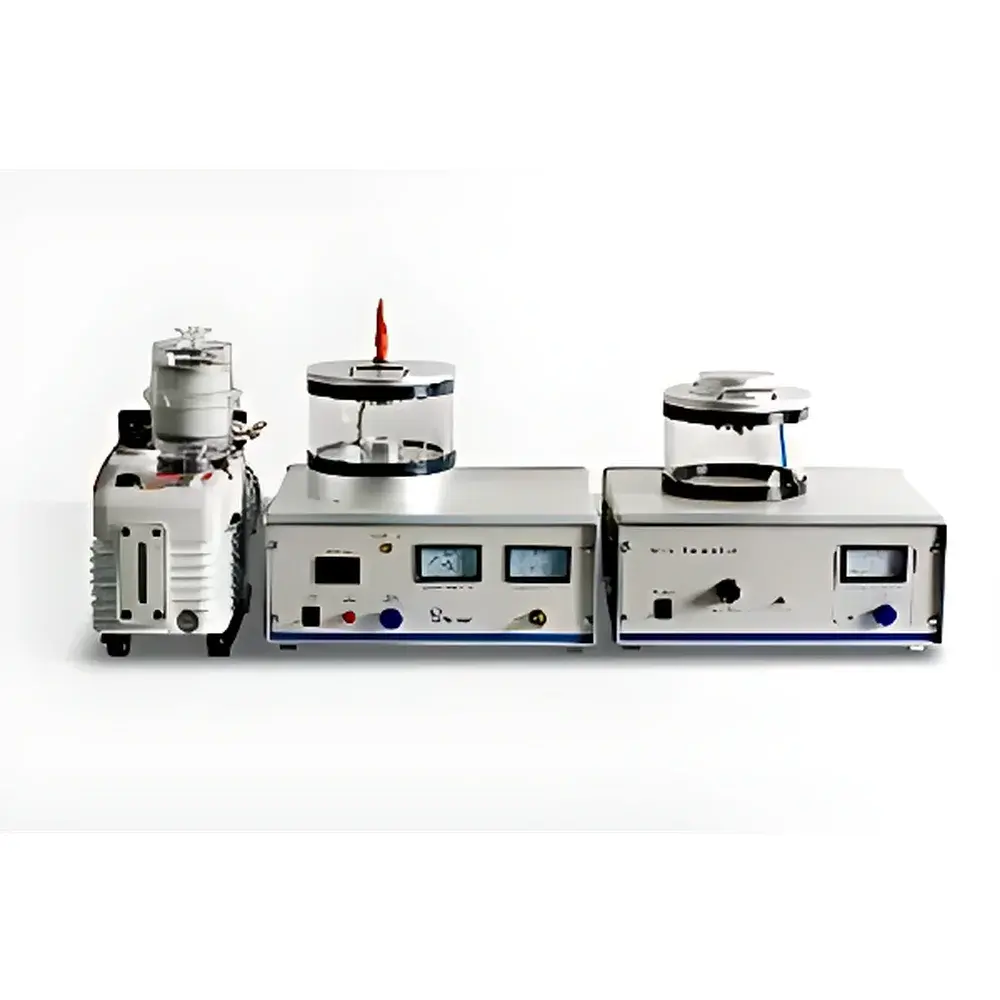
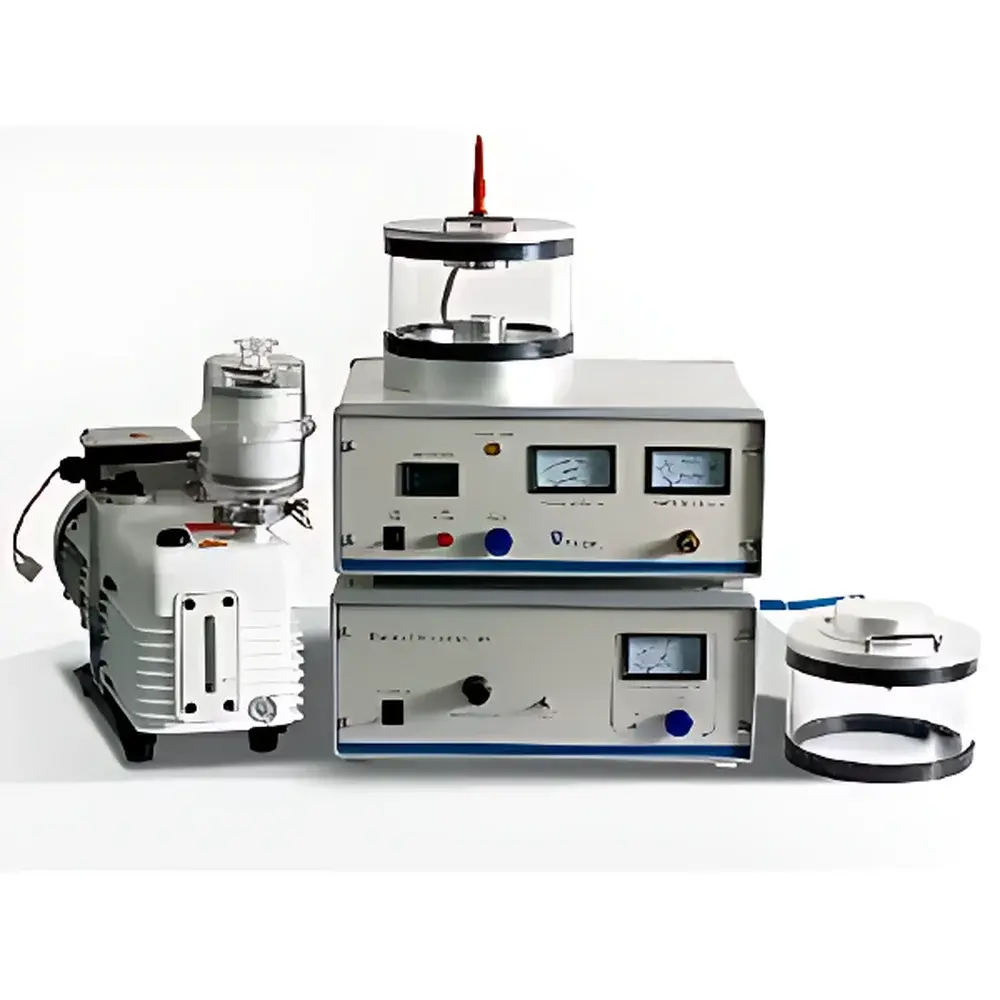
VPI SD-900C Dual-Mode Ion Sputter Coater with Carbon Evaporation
| Brand | VPI (BoYuan Micro-Nano) |
|---|---|
| Origin | Beijing, China |
| Model | SD-900C |
| Sputtering Target Materials | Au, Ag, Pt, Cr, Al, Cu |
| Target Dimensions | Ø50 mm × 0.12 mm |
| Sputtering Voltage Range | 0–1600 V DC |
| Sputtering Current Range | 0–50 mA |
| Sputtering Time Control | 0–360 s |
| Carbon Evaporation Current | 0–100 A AC |
| Evaporation Voltage | 0–30 V AC |
| Evaporation Time | 0–1 s |
| Chamber Material | Borosilicate Glass |
| Chamber Dimensions | 160 mm × 110 mm (D × H) |
| Sample Stage Diameter Range | Ø50–70 mm |
| Sputtering Gases | Ar, N₂, O₂ |
| Vacuum System | VRD-8 Rotary Vane Pump (2 L/min) |
| Input Power | 220 V / 50 Hz (optional 110 V configuration) |
Overview
The VPI SD-900C is a compact, dual-function thin-film deposition system engineered for high-resolution electron microscopy sample preparation. It integrates two complementary physical vapor deposition (PVD) techniques—DC magnetron ion sputtering and resistive thermal evaporation—within a single borosilicate glass vacuum chamber. The instrument operates on well-established principles: sputtering relies on glow discharge plasma generation between a conductive target (cathode) and grounded sample stage (anode) under controlled low-pressure inert or reactive gas environments (Ar, N₂, O₂), enabling energetic ejection and directional deposition of metal atoms; thermal evaporation employs Joule heating of ultra-pure carbon fiber filaments to produce atomic carbon vapor that condenses uniformly onto substrates without lateral diffusion—critical for sub-nanometer grain formation and minimal edge artifacts. Designed specifically for SEM, TEM, EBSD, and microprobe analysis workflows, the SD-900C delivers reproducible, contamination-minimized coatings while maintaining full operational transparency and manual process control.
Key Features
- Dual-mode operation: Independent yet co-located sputtering and carbon evaporation modules eliminate cross-contamination and streamline workflow transitions.
- Manually adjustable DC sputtering parameters: Precise control over voltage (0–1600 V), current (0–50 mA), and time (0–360 s) enables fine-tuning of film thickness, grain size, and surface coverage.
- Optimized thermal carbon evaporation: High-current AC heating (0–100 A) of ultra-pure carbon fiber ensures rapid, uniform sub-1 nm amorphous carbon layer formation—ideal for high-magnification imaging and quantitative EDS/WDS analysis.
- Borosilicate glass vacuum chamber (160 mm × 110 mm): Provides full visual access during deposition, facilitates rapid chamber cleaning, and resists chemical etching from reactive sputtering gases.
- Modular sample stage: Accommodates Ø50 mm and Ø70 mm specimen mounts with vertical height adjustment; custom stage configurations available upon request.
- Integrated safety architecture: Vacuum interlock prevents sputtering initiation below safe pressure thresholds; SETPLASMA pre-set button allows operator-defined plasma ignition conditions to minimize arcing and substrate damage.
Sample Compatibility & Compliance
The SD-900C supports a broad range of non-conductive and beam-sensitive specimens—including biological tissues, polymers, ceramics, geological sections, and nanomaterials—without requiring prior conductive priming. Its low-energy, low-heat-input carbon evaporation mode preserves delicate ultrastructural features, while variable sputtering parameters accommodate both high-Z metals (Pt, Au) for secondary electron yield enhancement and low-Z metals (Cr, Al) for reduced charging in low-kV SEM imaging. Though not certified to ISO/IEC 17025 or GLP standards out-of-the-box, the instrument’s fully manual, deterministic control architecture enables full traceability of process parameters—supporting internal SOP documentation, audit-ready logbooks, and compliance with laboratory quality management systems aligned with ISO 9001 and ASTM E1558 (Standard Guide for Preparation of Specimens for Scanning Electron Microscopy).
Software & Data Management
The SD-900C operates via analog/manual interface only—no embedded firmware or digital software layer. All process variables (voltage, current, time, gas flow via external regulator) are set and monitored using calibrated front-panel meters and mechanical dials. This design prioritizes operational simplicity, long-term reliability, and immunity to firmware obsolescence or cybersecurity vulnerabilities. Users maintain complete procedural autonomy: each run is manually logged with timestamp, target material, gas type, pressure reading, and deposition settings—ensuring full repeatability and alignment with FDA 21 CFR Part 11 principles when paired with laboratory-controlled documentation practices. No proprietary drivers, cloud connectivity, or vendor-dependent updates are required.
Applications
- Routine SEM sample coating: Au/Pt sputtering for topographic contrast enhancement and charge dissipation on insulating specimens.
- High-resolution TEM grid support films: Ultra-thin, continuous carbon films deposited via resistive evaporation for electron-transparent substrates.
- EBSD pattern fidelity preservation: Low-stress Cr or Ni coatings applied at low sputtering power to minimize lattice distortion in crystalline samples.
- Quantitative microanalysis: Conductive carbon layers prevent charging-induced peak shifts in EDS and WDS mapping, improving elemental quantification accuracy.
- Failure analysis of microelectronics: Controlled Pt sputtering for cross-section imaging of solder joints and dielectric layers without thermal degradation.
- Geological and paleontological specimen preparation: Gentle carbon coating of fragile fossil surfaces or clay-rich sediments to enable low-kV, high-contrast imaging.
FAQ
What vacuum level is required for stable sputtering operation?
Stable DC glow discharge typically initiates at 5–20 Pa (37–150 mTorr) with argon; optimal sputtering occurs between 8–15 Pa. The integrated vacuum gauge and micro-valve allow precise manual regulation.
Can I use non-standard target materials such as iridium or palladium?
Yes—the Ø50 mm target holder accepts any electrically conductive, vacuum-compatible disc-shaped target up to 0.12 mm thickness. Custom targets must be bonded to the copper backing plate using high-temperature silver epoxy.
Is the carbon evaporation module compatible with other carbon sources besides fiber rope?
The filament geometry and power delivery are optimized for braided carbon fiber ropes (e.g., HTT-1000 grade). Graphite boats or rods are not supported due to incompatible thermal mass and current distribution requirements.
How often does the vacuum pump require maintenance?
The VRD-8 rotary vane pump requires oil replacement every 200 operating hours or quarterly—whichever comes first—and periodic inspection of the exhaust filter and inlet trap to prevent oil backstreaming into the chamber.
Does the SD-900C meet electromagnetic compatibility (EMC) standards for laboratory installation?
The unit complies with CISPR 11 Group 1, Class B emission limits and is suitable for general laboratory environments. For shared EM-sensitive facilities (e.g., nearby NMR or SQUID systems), localized shielding of the sputtering power supply may be advisable.



