
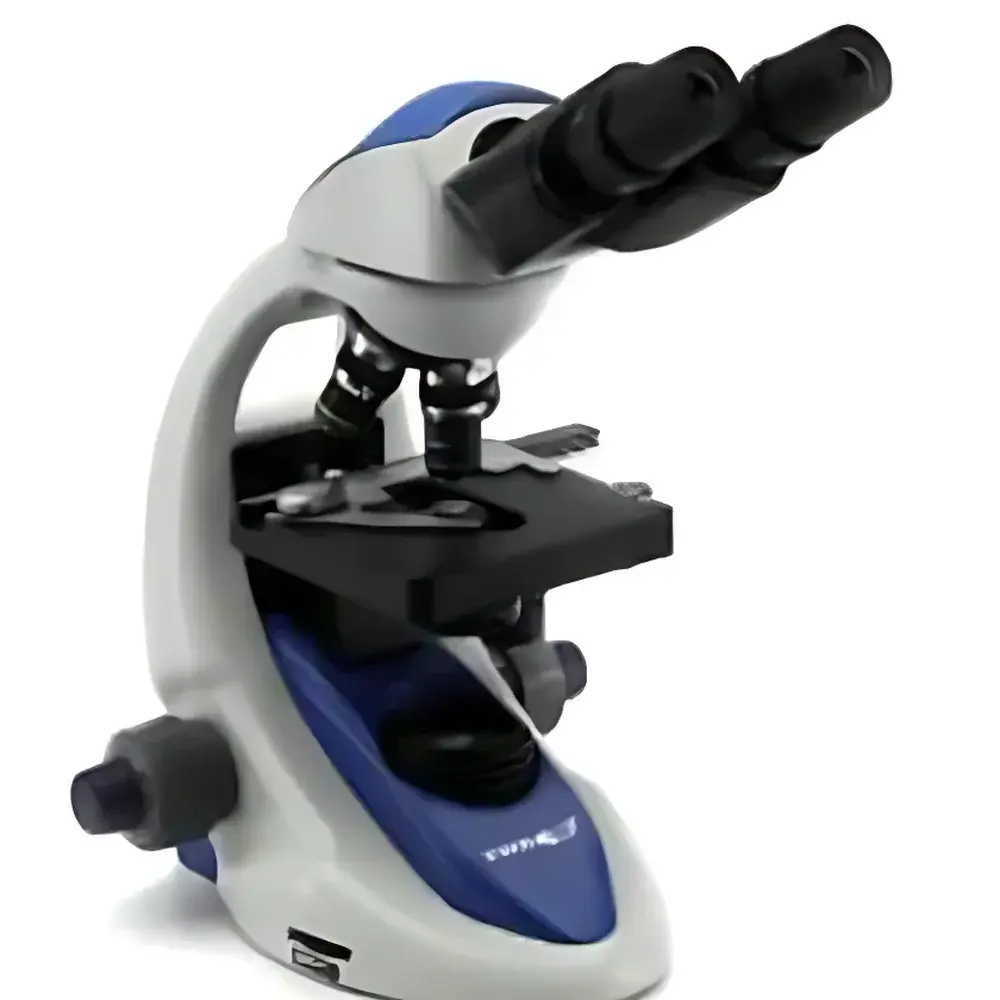
VWR VisiScope® 200 Upright Biological Microscope
| Brand | VWR |
|---|---|
| Origin | USA |
| Model | VWRI630-3292 |
| Microscope Type | Upright |
| Head Type | Trinocular |
| Eyepiece | Widefield 10×/18 mm |
| Objective Lenses | N-plan HC 4×, 10×, 40×, 60× (standard configuration) |
| Stage | 125 × 115 mm mechanical stage with 70 × 30 mm travel range |
| Condenser | Abbe condenser, NA 1.25, pre-centered, height-adjustable, with iris diaphragm |
| Focusing System | Coaxial coarse and fine focus knobs (fine focus graduation: 2 µm) |
| Illumination | 3 W LED Köhler illumination, color temperature ~6,000 K, >50,000 h lifetime |
| Dimensions (W × D × H) | 235 × 290 × 370 mm |
| Weight | 6.5 kg |
| Compliance | CE, UKCA, ISO 9001-manufactured supply chain, RoHS-compliant components |
Overview
The VWR VisiScope® 200 is a high-performance upright biological microscope engineered for educational laboratories, undergraduate teaching facilities, and entry-level research environments requiring consistent optical fidelity, ergonomic usability, and long-term operational reliability. Built upon a rigid cast-aluminum optical chassis and optimized for brightfield microscopy, the VisiScope 200 employs an infinity-corrected optical path with N-plan HC (High Contrast) achromatic objectives—designed to minimize chromatic aberration and deliver sharp, high-contrast images across the full field of view. Its modular trinocular head supports simultaneous visual observation, digital imaging via C-mount adapter (optional), and instructor demonstration—making it particularly suited for collaborative learning and standardized lab curricula aligned with national life science education frameworks. The microscope’s LED-based Köhler illumination system ensures stable, flicker-free brightness with minimal thermal drift, eliminating warm-up time and reducing specimen phototoxicity during extended observation sessions.
Key Features
- Ergonomic trinocular head inclined at 30° with full 360° rotation—reducing cervical strain during prolonged use and enabling flexible workstation integration.
- Widefield 10×/18 mm eyepieces with diopter adjustment on both oculars for user-specific vision correction and binocular balance.
- Four-position revolving nosepiece with parfocal, spring-loaded objective turrets—ensuring rapid, repeatable magnification transitions without refocusing.
- Mechanical stage with calibrated X-Y translation (70 × 30 mm travel), low-profile design, and dual vernier scales for precise specimen repositioning.
- Abbe condenser (NA 1.25) with centering screws and adjustable iris diaphragm—enabling optimal contrast control and resolution tuning per magnification level per ASTM E2827-22 guidelines.
- Coaxial focusing system featuring dual-speed fine focus (2 µm graduation) and robust coarse focus with tension adjustment—providing tactile feedback and resistance to slippage under repeated use.
- 3 W high-CRI white LED illumination (6,000 K CCT) with integrated heat sink and current-regulated driver—delivering uniform field illumination and compliance with IEC 62471 Photobiological Safety standards.
Sample Compatibility & Compliance
The VisiScope 200 accommodates standard 1″ × 3″ glass slides (76 × 26 mm), coverslips (0.13–0.17 mm thickness), and Petri dishes (up to 100 mm diameter) when used with optional stage adapters. It supports routine histological sections, stained cytology preparations, live unstained protozoa, algae cultures, and basic tissue explants—provided specimens are mounted on conventional glass substrates compatible with brightfield transmission optics. All optical components meet ISO 8578:2020 specifications for microscope objective labeling and performance verification. The instrument complies with CE Directive 2014/30/EU (EMC), 2014/35/EU (LVD), and UKCA marking requirements. Electrical safety conforms to IEC 61010-1:2010 for laboratory equipment. While not FDA-listed as a medical device, its design aligns with GLP-relevant documentation practices for academic and industrial training labs.
Software & Data Management
The VisiScope 200 is hardware-ready for integration with third-party digital imaging platforms—including VWR’s certified USB 3.0 CMOS cameras (e.g., VWR 5MP Digital Imaging Module) and industry-standard acquisition software such as ToupView, Ocular, or ImageJ-compatible drivers. The trinocular port accepts standard 23.2 mm or C-mount adapters (thread: M28.5 × 0.6 mm), enabling direct coupling without vignetting at 1× camera projection. Metadata capture—including magnification, objective ID, exposure time, and timestamp—is supported via TTL-triggered synchronization when paired with compliant cameras. No proprietary firmware or closed-loop control software is embedded; all imaging workflows remain fully user-configurable and audit-trail compatible for institutions maintaining ISO/IEC 17025 or CAP-accredited documentation systems.
Applications
- Undergraduate biology and microbiology laboratories: cell morphology studies, mitotic staging, bacterial colony characterization, and Gram stain evaluation.
- K–12 advanced placement (AP) science programs: plant anatomy (stomatal density, vascular bundle analysis), invertebrate dissection support, and protist motility assays.
- Quality control in biomanufacturing training: verification of sterile filtration integrity, media clarity assessment, and yeast/bacterial viability screening.
- Veterinary technician education: blood smear differential counts, skin scraping analysis, and fecal float examination protocols.
- Continuing education workshops: hands-on instruction in microscopy fundamentals, Köhler alignment procedures, and objective maintenance best practices.
FAQ
Is oil immersion capability included with the standard VisiScope 200 configuration?
Yes—the base configuration includes a 100× N-plan HC oil immersion objective (N.A. 1.25), supplied with a dedicated oil immersion lens cleaning kit and compatibility instructions for Type A cedarwood oil or synthetic immersion media.
Can the VisiScope 200 be adapted for phase contrast or darkfield observation?
No—this model is optimized exclusively for brightfield transmitted-light microscopy. Phase contrast and darkfield require specialized condensers, sliders, and objectives not supported by the Abbe condenser or mechanical stage design.
What is the maximum recommended working distance for the 40× objective?
The N-plan HC 40× objective provides a working distance of 0.65 mm, suitable for standard coverglass-mounted preparations but not for thick or unsealed live-cell chambers.
Does the LED illumination support intensity calibration traceable to NIST standards?
While the LED driver delivers stable output over time, factory calibration against photometric reference standards is not provided. Users requiring quantitative intensity validation may integrate external silicon photodiode sensors compliant with CIE S 023/E:2013.
Is service documentation available for preventive maintenance procedures?
Yes—VWR provides downloadable English-language service manuals, alignment checklists, and optical cleaning protocols through its authorized distributor portal, accessible to institutional purchasers with valid warranty registration.
Related Products



