
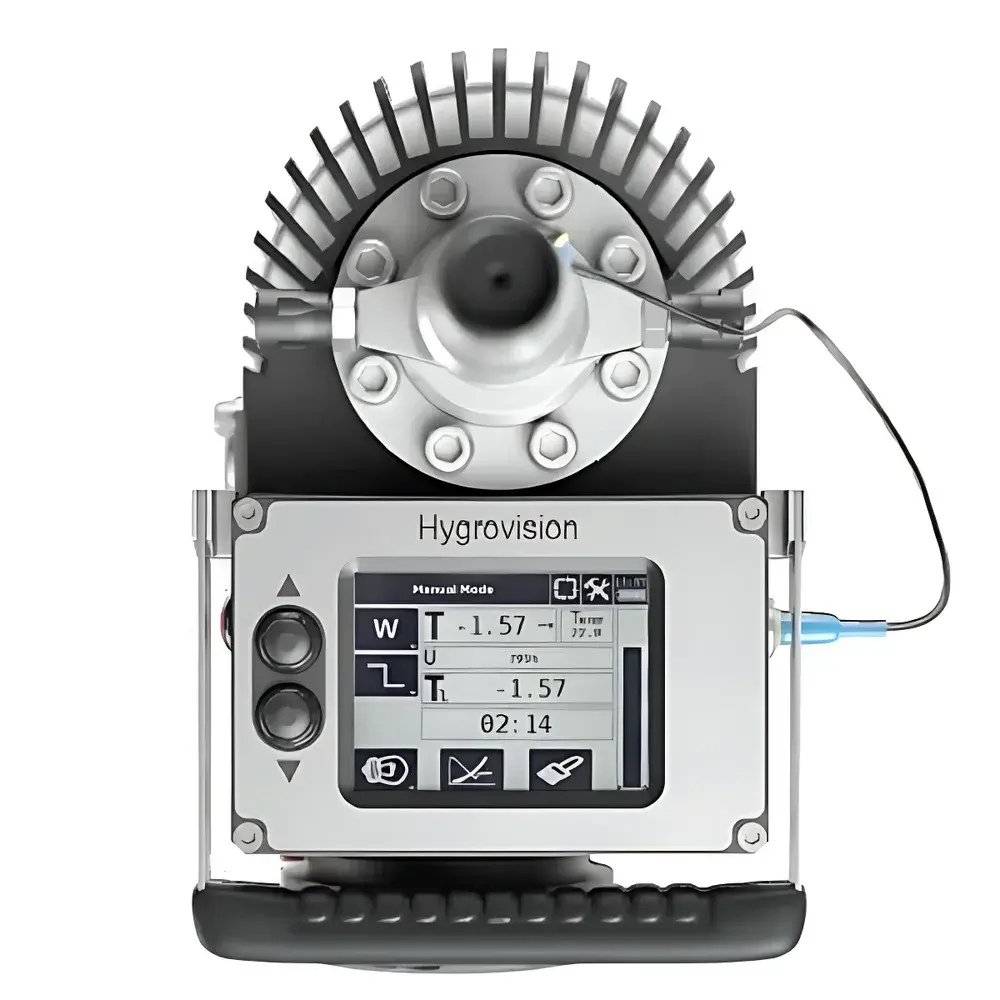
Vympel Hygrovision BL Portable Hydrocarbon & Water Dew Point Analyzer
| Brand | Vympel (Russia) |
|---|---|
| Origin | Russia |
| Model | Hygrovision BL |
| Type | Portable Chilled-Mirror Dew Point Analyzer |
| Principle | Chilled-Mirror Condensation |
| Operating Temperature | −20 °C to +50 °C |
| Accuracy | ±0.5 °C (Class B) |
| Water Dew Point Range | −60 °C to ambient |
| Hydrocarbon Dew Point Range | −30 °C to ambient |
| Sample Flow Rate | 0.5–2 L/min |
| Max Sample Pressure | 160 bar (230 bar optional) |
| Data Storage | Internal memory for ≥5 years of measurements |
| Battery Life | Up to 4 h |
| IP Rating | IP67 |
| ATEX/IECEx Certification | II 2G Ex IIB T5 Gb |
| Dimensions (H×W×D) | 202 × 153 × 257 mm (excl. microscope) |
| Weight | ~7.5 kg |
Overview
The Vympel Hygrovision BL is a field-deployable, dual-parameter chilled-mirror dew point analyzer engineered for trace-level thermodynamic characterization of natural gas, hydrogen, and other industrial process gases. It applies first-principles physics—direct optical detection of phase transition temperatures—to simultaneously determine both water dew point (WDP) and hydrocarbon dew point (HDP) with metrological rigor. Unlike sensor-based or spectroscopic alternatives, the Hygrovision BL relies on the fundamental thermodynamic principle that condensation onset occurs at a unique, pressure- and composition-dependent temperature for each condensable species. Its high-stability Peltier-cooled mirror, coupled with real-time optical imaging and dual-wavelength illumination, enables unambiguous discrimination between aqueous and hydrocarbon condensates—eliminating calibration drift and ensuring long-term measurement integrity without periodic recalibration.
Key Features
- Chilled-mirror measurement architecture compliant with ISO 6327, DIN 51781, ASTM D1142 (water), and ISO TR 11150 / ISO TR 12148 (hydrocarbons)
- Dual-mode operation: fully automated dew point tracking or user-controlled manual mode for diagnostic validation
- Integrated high-resolution optical microscope with switchable LED illumination (visible and near-UV) for real-time, operator-verified condensate identification
- Large capacitive touchscreen interface with intuitive workflow navigation and on-device data review
- Robust mechanical design certified to IP67 ingress protection and ATEX/IECEx II 2G Ex IIB T5 Gb for hazardous area deployment
- Onboard diagnostics including mirror cleanliness assessment, thermal gradient stability monitoring, and automatic mirror temperature calibration prior to each measurement cycle
- Flexible power options: rechargeable Li-ion battery (up to 4 h continuous operation) or universal 100–240 V AC adapter
Sample Compatibility & Compliance
The Hygrovision BL accommodates pressurized gas samples up to 160 bar (230 bar with optional high-pressure module), supporting direct connection to pipeline taps, sampling skids, and dehydration system outlets. It accepts sample temperatures from −20 °C to +50 °C and flow rates of 0.5–2 L/min—optimized for representative sampling without excessive pressure drop or residence time artifacts. All measurement protocols align with internationally recognized standards for hydrocarbon and moisture specification in energy-grade gases. Its traceable chilled-mirror methodology satisfies regulatory requirements for audit-ready documentation under GLP and GMP frameworks. Data logs include timestamped condensate images, mirror temperature profiles, and environmental metadata—enabling full traceability per FDA 21 CFR Part 11 when integrated with validated software environments.
Software & Data Management
Measurements are stored internally in a non-volatile memory archive capable of retaining ≥5 years of timestamped records—including raw mirror temperature curves, annotated condensate images, and operational parameters (pressure, flow, ambient conditions). The device supports USB-C data export in CSV and proprietary .HVD formats compatible with Vympel’s HygroVision Suite (Windows-based desktop application). This software provides advanced post-processing tools: comparative dew point trend analysis, multi-point calibration verification, image annotation, and report generation compliant with ISO/IEC 17025 technical record requirements. Optional cloud synchronization enables centralized fleet management for multi-site operators managing distributed gas quality assurance programs.
Applications
- Field verification of online moisture and hydrocarbon analyzers during commissioning, maintenance, or discrepancy investigation
- Pre-commissioning drying validation of pipelines, LNG carriers, and storage vessels per ISO 8502-9 and API RP 14E
- Hydrogen purity certification for fuel cell applications where water and hydrocarbon contamination must remain below sub-ppm thresholds
- Quality gate monitoring at natural gas custody transfer points to ensure compliance with EN 15940 and GPA 2145 specifications
- Root-cause analysis of hydrate formation or liquid dropout incidents in upstream production facilities
- Calibration reference for fixed-installation dew point transmitters in refinery flare gas recovery systems
FAQ
How does the Hygrovision BL distinguish between water and hydrocarbon condensate?
It uses synchronized dual-wavelength optical imaging: visible-light mode highlights surface wetting behavior typical of water, while near-UV illumination induces characteristic fluorescence in aromatic hydrocarbons—enabling unambiguous visual classification confirmed by independent mirror temperature stabilization events.
Is the instrument suitable for use in explosive atmospheres?
Yes—certified to ATEX Directive 2014/34/EU and IECEx Scheme as II 2G Ex IIB T5 Gb, permitting safe operation in Zone 1 gas-hazardous locations.
Does it require regular calibration with certified gas standards?
No—its chilled-mirror principle is inherently absolute; only periodic mirror cleaning and verification against NIST-traceable temperature references (e.g., dry-block calibrators) are required per ISO/IEC 17025 maintenance schedules.
Can it measure dew point under high-pressure conditions?
Yes—standard configuration supports up to 160 bar; an optional high-pressure module extends capability to 230 bar with reinforced sample cell and pressure-rated optical viewport.
What happens if condensate forms before the mirror reaches its target temperature?
The system implements adaptive cooling control: upon initial condensate detection, it holds mirror temperature stable for ≥15 s to confirm phase equilibrium, then initiates a controlled warm-up ramp to verify reproducibility—rejecting transient or spurious signals per ISO 8573-3 Annex B criteria.



