
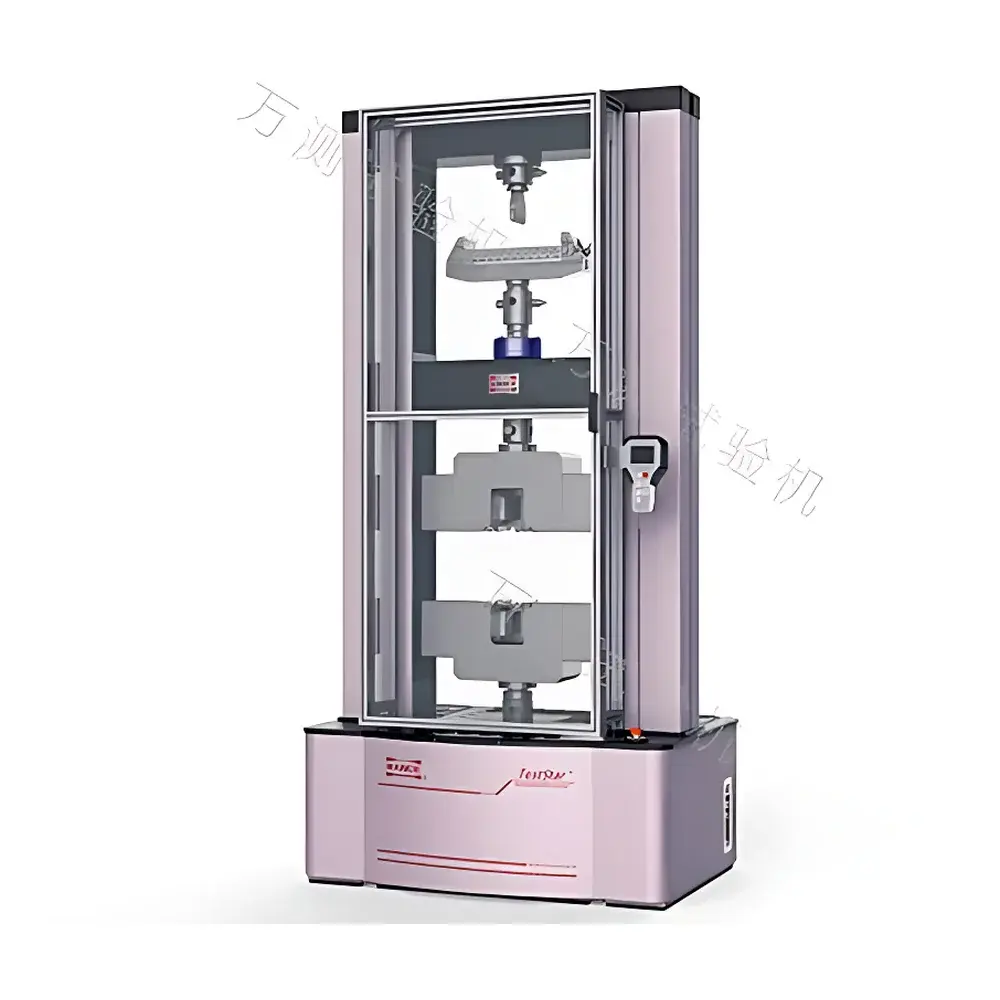
WANCE TSE255D 250 kN Computer-Controlled Electromechanical Universal Testing Machine
| Brand | WANCE |
|---|---|
| Origin | Guangdong, China |
| Manufacturer Type | Authorized Distributor |
| Country of Origin | China |
| Model | TSE255D |
| Instrument Type | Electromechanical Universal Testing Machine |
| Max. Test Load | 250 kN |
| Accuracy Class | Class 0.5 |
| Load Measurement Error | ±0.5% of reading |
| Load Resolution | 1/500,000 FS |
| Force Control Rate Range | 0.005–5% FS/s |
| Force Control Accuracy | ±1% of set value |
| Deformation Resolution | 1/500,000 FS |
| Deformation Error | ±0.5% of set value |
| Displacement Resolution | 0.034 µm |
| Displacement Rate Accuracy | ±0.5% |
| Effective Test Height | 1150 mm |
| Effective Test Width | 650 mm |
| Dimensions (W×D×H) | 1220 × 890 × 2465 mm |
| Power Supply | AC 380 V ±10%, 50 Hz, 5 kW |
| Weight | ~1500 kg |
Overview
The WANCE TSE255D is a high-capacity, computer-controlled electromechanical universal testing machine engineered for precision mechanical property characterization of structural and engineering materials. Based on servo-controlled electromechanical actuation and closed-loop digital control architecture, it applies standardized uniaxial loading—tensile, compressive, flexural, and shear—to specimens in accordance with ISO 6892-1, ASTM E8/E21, ASTM D695, ASTM D790, ISO 178, ISO 604, EN 10002-1, and GB/T 228.1. Its rigid dual-column frame, preloaded high-precision recirculating ball screw drive system, and optimized load train geometry ensure minimal deflection under full 250 kN load, delivering high reproducibility and long-term stability required for accredited laboratory environments.
Key Features
- Class 0.5 accuracy per ISO 7500-1 and GB/T 16491, validated by third-party metrological certification
- Triple closed-loop control modes: force, displacement, and strain—with seamless switching and synchronized data acquisition
- High-resolution measurement system: 24-bit ADC for load (1/500,000 FS resolution), deformation (1/500,000 FS), and position (0.034 µm displacement resolution)
- Modular load cell support: compatible with interchangeable transducers ranging from 100 N to 250 kN, enabling traceable calibration across multiple test ranges
- Robust mechanical architecture: heavy-duty cast-iron base, hardened steel columns, and precision-ground guide rails ensure axial alignment tolerance < 0.02 mm/m
- Integrated safety interlocks: emergency stop circuitry compliant with ISO 13850, mechanical overload protection, and software-based load/strain limit enforcement
Sample Compatibility & Compliance
The TSE255D accommodates specimen geometries from fine-diameter metallic wires (≥0.1 mm) and textile filaments to full-scale structural components (e.g., reinforced concrete prisms, composite laminates, or automotive crash members). Standardized grips—including wedge-action tensile jaws, compression platens, 3-/4-point bending fixtures, and pneumatic clamps—are designed to meet ASTM E8 grip requirements and ISO 6892-1 alignment specifications. All hardware complies with ISO 9001 manufacturing controls and is supplied with individual calibration certificates traceable to NIM (China National Institute of Metrology). The system supports GLP/GMP-aligned workflows through audit-trail-enabled software logging and meets essential requirements for ISO/IEC 17025-compliant testing laboratories.
Software & Data Management
TestPilot v5.x is the dedicated control and analysis platform, developed in compliance with FDA 21 CFR Part 11 for electronic records and signatures. It provides real-time visualization of stress–strain curves, automatic yield point detection (0.2% offset method), modulus calculation (tangent, secant, chord), and fracture energy integration. Data export conforms to ASTM E1434 and ISO 14556 formats, with native support for CSV, XML, and PDF report generation—including customizable templates aligned with internal QA documentation standards. The software architecture supports multi-user role-based access control, encrypted database storage, and automated backup to network drives or cloud repositories (AWS S3 or Azure Blob via optional configuration).
Applications
The TSE255D serves as a primary mechanical testing platform across R&D, quality assurance, and regulatory submission workflows. In metallurgy labs, it characterizes yield strength, ultimate tensile strength, and elongation at break for hot-rolled steels and aerospace-grade aluminum alloys. In polymer and composites development, it quantifies flexural modulus and interlaminar shear strength per ASTM D7264 and ISO 14125. Automotive Tier-1 suppliers use it for validating weld integrity, fastener pull-out resistance, and bumper beam crush behavior. Construction material testing includes compressive strength of grouts and flexural performance of fiber-reinforced cementitious composites. Additional validated use cases span biomedical device validation (ISO 14243), packaging film tear resistance (ASTM D1938), and geotextile tensile capacity (ASTM D4595).
FAQ
What international standards does the TSE255D support for calibration and testing?
It complies with ISO 7500-1 (static calibration), ISO 5893 (dynamic verification), GB/T 16491 (Chinese national standard for UTM), and JJG 475 (verification regulation for electromechanical UTMs).
Can the system be integrated into an existing LIMS or MES environment?
Yes—via OPC UA or RESTful API interfaces (optional module), supporting bidirectional data exchange with LabWare LIMS, Thermo Fisher SampleManager, or Siemens Opcenter.
Is remote diagnostics and firmware update capability available?
Standard Ethernet connectivity enables secure remote maintenance through WANCE’s certified service portal, with version-controlled firmware updates and diagnostic log export.
What is the recommended maintenance interval for the ball screw and drive system?
Lubrication and preload verification are scheduled every 1,000 operational hours or annually—whichever occurs first—per the maintenance manual aligned with ISO 13374 condition monitoring guidelines.
Does the system support high-speed strain measurement using extensometers?
Yes—compatible with clip-on, video, and non-contact digital image correlation (DIC) extensometers (e.g., GOM ARAMIS or MTI MicroSquid), with synchronized analog/digital trigger inputs and sub-millisecond timestamp alignment.



