
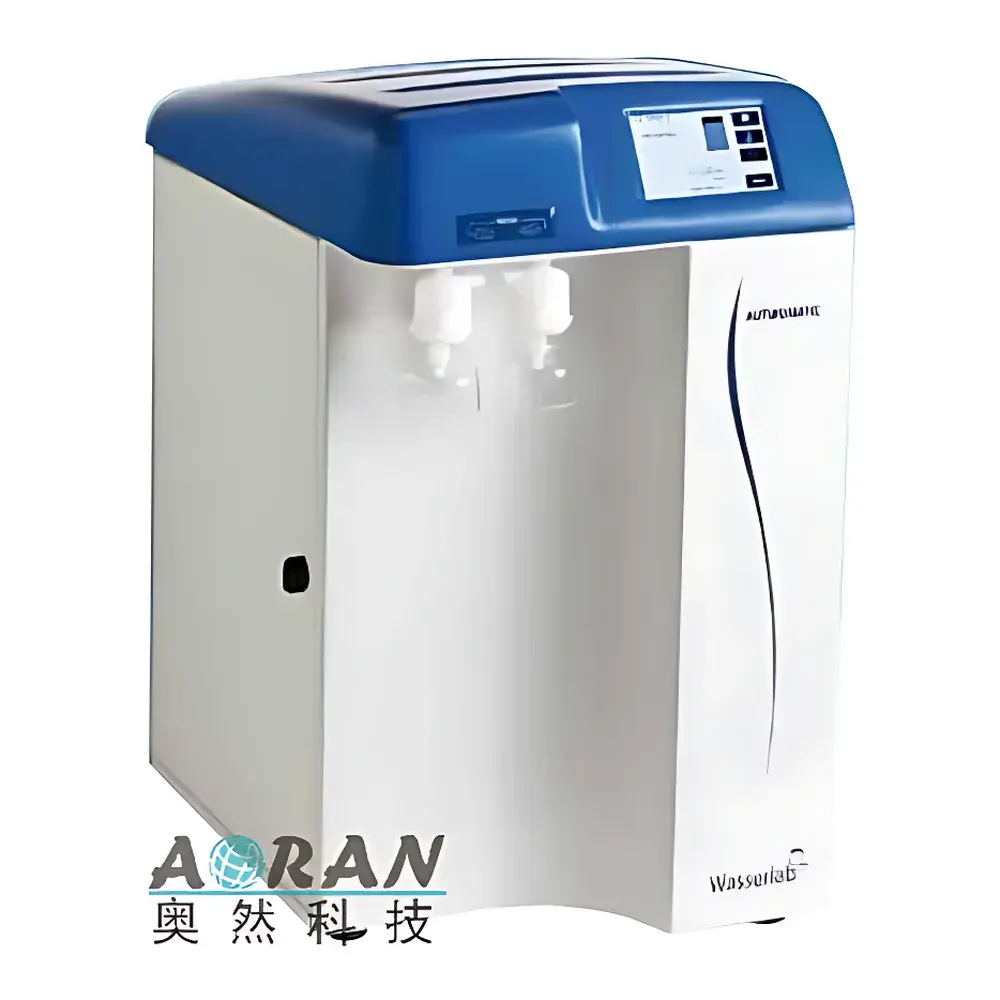
Wasserlab Autwomatic Plus 1+2 Integrated Ultrapure & Pure Water System
| Brand | Wasserlab |
|---|---|
| Origin | Spain |
| Model | Autwomatic Plus 1+2 |
| Purified Water Grade | ASTM Type II / ISO 3696 Class 2 |
| Ultrapure Water Grade | ASTM Type I / ISO 3696 Class 1 |
| Resistivity | 18.2 MΩ·cm @ 25 °C |
| TOC | <3 ppb |
| Endotoxins | <0.03 EU/mL |
| Bacteria | <1 CFU/mL |
| Final Filtration | 0.22 µm PES membrane |
| Flow Rate (Ultrapure) | 1.1 L/min |
| Flow Rate (Pure) | 3/5/10 L/h |
| Feed Water Requirements | Conductivity ≤1500 µS/cm, Pressure 2–6 bar, Temp ≤30 °C, SDI <5, Turbidity <1 NTU, Free Chlorine <1 ppm, Hardness ≤300 ppm CaCO₃ |
| Power Supply | 110–220 VAC, 50–60 Hz |
| Dimensions (H×W×D) | 60×36×49 cm |
| Weight | 35 kg |
| Integrated Pressure Storage Tank | Yes |
Overview
The Wasserlab Autwomatic Plus 1+2 is a dual-grade integrated water purification system engineered for laboratories requiring simultaneous, on-demand access to both ASTM Type II (pure) and ASTM Type I (ultrapure) water in a single footprint. It employs a multi-stage purification architecture comprising pre-filtration (sediment + activated carbon), high-rejection reverse osmosis (RO), dual-stage deionization (DI) with mixed-bed resins, optional 185/254 nm UV oxidation, and terminal 0.22 µm polyethersulfone (PES) filtration. This configuration ensures consistent production of water meeting or exceeding ISO 3696:2017 Class 1 specifications for resistivity (≥18.2 MΩ·cm at 25 °C), TOC (<3 ppb), bacterial load (<1 CFU/mL), and endotoxin levels (<0.03 EU/mL), while concurrently delivering Type II water suitable for glassware rinsing, buffer preparation, and general lab use.
Key Features
- Integrated dual-output design with independent, dedicated outlets for Type I and Type II water—eliminating cross-contamination risk and enabling parallel workflows.
- 4.3-inch full-color capacitive touchscreen interface with intuitive icon-driven navigation, real-time parameter visualization, and multilingual support (English, Spanish, French, German).
- Comprehensive real-time monitoring: feed conductivity, RO permeate conductivity, product resistivity (Type I), product conductivity (Type II), water temperature, UV lamp status, filter saturation indicators, and system pressure diagnostics.
- Automated maintenance management: intelligent cartridge life tracking with visual/audible alerts for pre-filter, RO membrane, DI modules, ultrapure polishing cartridge, UV lamp, and 0.22 µm final filter replacement.
- Programmable dispensing modes: volume-based, time-based, and continuous flow—each configurable per outlet with user-defined presets and audit-trail logging.
- Integrated pressure storage tank (10/30/50 L options) with level sensor feedback and auto-replenishment logic to maintain stable delivery pressure and minimize pump cycling.
- Self-cleaning RO membrane protocol triggered by differential pressure or scheduled intervals to extend membrane service life and sustain rejection efficiency.
Sample Compatibility & Compliance
The Autwomatic Plus 1+2 is validated for compatibility with analytical instrumentation requiring stringent water purity, including HPLC, LC-MS, ICP-MS, AAS, and cell culture applications. Its output meets or exceeds critical international standards: ASTM D1193-20 (Type I and II), ISO 3696:2017 (Class 1 and Class 2), CLSI EP22-A2 guidelines for reagent water quality, and USP “Water for Pharmaceutical Purposes” for purified water. While not certified under FDA 21 CFR Part 11 out-of-the-box, the system supports GLP/GMP-aligned operation via timestamped event logs, user-access-controlled settings, and exportable maintenance records—facilitating internal validation and third-party audit readiness.
Software & Data Management
All operational data—including conductivity/resistivity trends, flow volumes, maintenance events, alarm history, and UV intensity decay—are stored locally in non-volatile memory with a minimum 12-month retention window. The embedded firmware enables CSV export via USB port for integration into laboratory information management systems (LIMS) or electronic lab notebooks (ELN). Optional Ethernet/Wi-Fi connectivity (via add-on module) permits remote monitoring, centralized fleet management, and automated report generation compliant with ISO/IEC 17025 documentation requirements. Audit trails include operator ID (if configured), timestamp, parameter change, and reason code—supporting traceability per ALCOA+ principles.
Applications
- HPLC and UHPLC mobile phase preparation and column equilibration
- LC-MS and GC-MS solvent blanks and calibration standards
- ICP-MS trace metal analysis where sub-ppt contamination must be avoided
- Cell culture media formulation and sterile filtration processes
- Molecular biology applications including PCR, qPCR, and NGS library prep
- Preparation of reference standards, titrants, and volumetric solutions per ISO 6497
- Routine lab tasks: glassware washing, buffer dilution, and reagent dissolution
FAQ
What is the maximum allowable feed water hardness for sustained RO performance?
Feed water hardness must not exceed 300 ppm as CaCO₃ to prevent scaling on the RO membrane surface; softening pretreatment is recommended if local supply exceeds this threshold.
Can the system operate continuously without manual intervention?
Yes—the Autwomatic Plus 1+2 features fully autonomous start/stop logic, automatic RO cleaning cycles, and fail-safe shutdown during low-pressure, high-conductivity, or temperature excursions.
Is the 0.22 µm final filter certified for pyrogen removal?
The PES membrane filter is rated for ≥99.9% retention of particles >0.22 µm and has been independently verified for endotoxin reduction to <0.03 EU/mL when used with upstream UV oxidation and DI polishing.
How frequently should the UV lamp be replaced?
The 185/254 nm dual-wavelength UV lamp is rated for 9,000 hours of operation; the system tracks cumulative exposure and triggers replacement alerts based on irradiance decay modeling.
Does the system support external tank integration?
While the unit includes an integrated pressure tank, it also provides dry-contact relay outputs and analog 4–20 mA signals to interface with external storage vessels and building management systems (BMS).



