
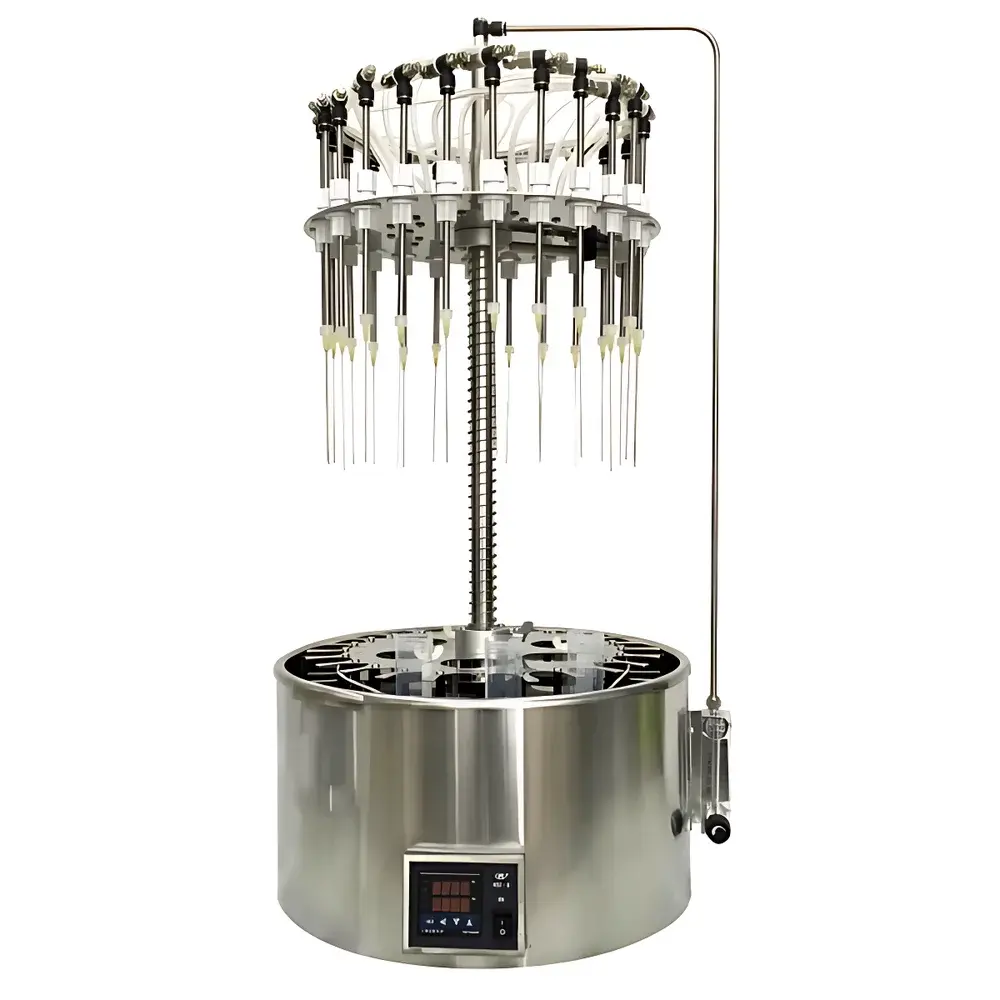
Water Bath Nitrogen Evaporator HSC-24B
| [Origin | Shandong, China |
|---|---|
| Heating Method | Water Bath |
| Temperature Range | Ambient to 99 °C |
| Temperature Stability | ±1 °C |
| Sample Capacity | 24 positions |
| Tube Diameter Compatibility | 11–21 mm |
| Nitrogen Flow Rate | 0–10 L/min |
| Heating Power | 200 W |
| Construction Materials | 316 Stainless Steel, Anodized Aluminum, Plastic-Coated Surfaces |
| Control System | PID Digital Thermostat with Dual LED Display |
| Safety Features | Over-Temperature Alarm] |
Overview
The HSC-24B Water Bath Nitrogen Evaporator is an engineered solution for gentle, reproducible solvent removal and sample concentration in analytical laboratories. It operates on the principle of inert gas-assisted evaporation—introducing controlled streams of nitrogen or other inert gases directly above liquid surfaces in sample vessels, thereby accelerating solvent volatilization while minimizing thermal degradation and oxidation. Unlike dry-block evaporators, the water bath design ensures uniform, low-gradient heating across all 24 sample positions, making it especially suitable for thermally sensitive analytes common in pharmaceutical, environmental, and clinical applications. The unit integrates precise temperature regulation with independent gas flow control per channel, enabling method standardization and inter-laboratory comparability in accordance with GLP-compliant workflows.
Key Features
- PID-controlled digital thermostat with dual LED display for simultaneous setpoint and real-time bath temperature readout; includes over-temperature cut-off alarm for unattended operation.
- Modular gas distribution manifold with individually adjustable stainless steel needle valves—each channel supports discrete flow rates from 0 to 10 L/min, facilitating multi-analyte protocols requiring differential evaporation kinetics.
- Height-adjustable gas needle assembly mounted on a spring-loaded vertical carriage system—accommodates diverse vessel geometries including test tubes, centrifuge tubes (1.5–50 mL), volumetric flasks, beakers, and Erlenmeyer flasks (up to 100 mL capacity).
- Interchangeable, stepless-diameter sample holder plate—precisely fits tubes ranging from 11 mm to 21 mm outer diameter without adapters or inserts, reducing cross-contamination risk and setup time.
- Corrosion-resistant construction: 316 stainless steel gas manifolds and support frames; anodized aluminum heating chamber; powder-coated exterior housing—ensuring long-term durability in high-humidity or solvent-rich environments.
- 200 W submerged heating element with rapid thermal response and stable equilibrium within ±1 °C across the full operating range (ambient to 99 °C), validated per ASTM E2234 for laboratory thermal equipment performance verification.
Sample Compatibility & Compliance
The HSC-24B supports open-vessel evaporation of aqueous and organic solvents—including acetonitrile, methanol, ethyl acetate, hexane, and dichloromethane—under ambient pressure. Its water bath architecture eliminates hot-spot formation, preserving labile compounds such as pesticides (e.g., organophosphates), glucuronide-conjugated metabolites, and thermolabile pharmaceuticals during concentration. All wetted components comply with USP Class VI biocompatibility standards. The instrument meets mechanical safety requirements per IEC 61010-1 and is compatible with ISO/IEC 17025-accredited laboratories’ documentation practices. While not inherently 21 CFR Part 11 compliant, its analog controls support audit-trail-ready SOP integration when paired with external loggers or LIMS interfaces.
Software & Data Management
The HSC-24B operates via standalone hardware controls—no embedded firmware or proprietary software is required. This architecture ensures deterministic response, zero cybersecurity exposure, and seamless integration into regulated environments where validation of electronic records is resource-intensive. Temperature setpoints and gas flow settings are manually recorded per batch in hard-copy or electronic lab notebooks (ELN). For automated data capture, optional external PT100 probes and mass flow meters can be interfaced with third-party DAQ systems (e.g., LabVIEW, MATLAB) using standard 4–20 mA or RS-485 outputs—enabling traceable calibration logs and trend analysis aligned with FDA guidance on computerized system validation.
Applications
- Agricultural residue analysis: Concentration of pesticide extracts from QuEChERS-prepared matrices (fruits, vegetables, cereals, plant tissues) prior to GC-MS or LC-MS/MS quantification.
- Environmental monitoring: Pre-concentration of trace-level contaminants—including PAHs, PCBs, and endocrine disruptors—from drinking water, groundwater, and wastewater samples per EPA Methods 508.1, 525.3, and 8082A.
- Pharmaceutical quality control: Solvent exchange and volume reduction of herbal extract fractions, dissolution media, and stability-indicating assay preparations under cGMP-aligned conditions.
- Clinical toxicology: Preparation of biological fluids (serum, plasma, urine, whole blood) for screening of β-agonists (e.g., clenbuterol), dioxins, and mycotoxins using immunoassay or HRAM-MS platforms.
- Food & beverage safety: Cleanup and concentration steps in multi-residue methods for veterinary drug residues in milk, beer, wine, and soft drinks—validated against EN 15662 and AOAC Official Methods.
FAQ
Is the HSC-24B compatible with volatile organic solvents such as hexane or chloroform?
Yes—the water bath design maintains surface temperatures below solvent autoignition points, and all gas pathways are constructed from chemically inert 316 stainless steel.
Can the unit be used for simultaneous concentration of samples with different solvent boiling points?
Yes—individual gas flow control per position allows optimization of evaporation rate based on solvent volatility, while uniform bath temperature prevents thermal shock.
Does the instrument include calibration documentation or NIST-traceable certificates?
No factory-issued calibration certificate is included; however, the unit is designed for straightforward third-party calibration using standard PT100 reference probes and rotameter-based flow verification kits.
What maintenance intervals are recommended for long-term reliability?
Daily: Drain and wipe bath chamber after use; weekly: Inspect gas needle tips for blockage and clean with ethanol; annually: Verify temperature accuracy with calibrated thermometer and validate flow meter linearity per ISO 6145-1.



