
Wavefront Curvature Sensor ProOpto EUV/NIR
| Brand | ProOpto |
|---|---|
| Origin | Germany |
| Manufacturer Type | Authorized Distributor |
| Import Status | Imported |
| Model | EUV/NIR |
| Pricing | Upon Request |
| Camera Interface | USB 3.0 |
| Spatial Resolution | <10 µm |
| Spectral Range | 1100 nm (NIR) to 1 nm (soft X-ray) |
| Compliance | ISO 11146, ISO 13694, ISO 11670, ISO 15367 |
| Supported Camera Types | >20 models |
Overview
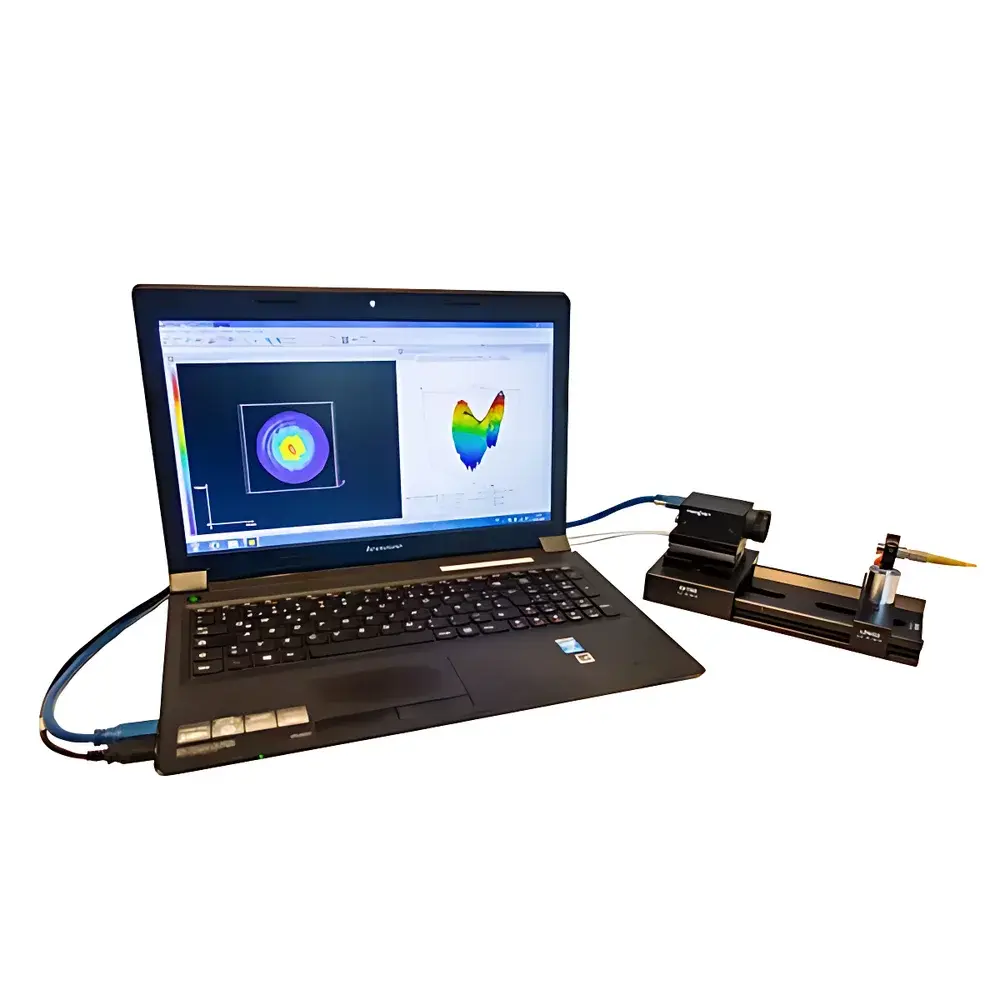
The ProOpto EUV/NIR Wavefront Curvature Sensor is an engineered optical metrology instrument designed for quantitative, non-interferometric wavefront characterization across an exceptionally broad spectral domain—from near-infrared (NIR) at 1100 nm down to the soft X-ray regime at 1 nm. Unlike traditional Shack–Hartmann or interferometric wavefront sensors, this system implements curvature sensing based on the intensity transport equation (TIE), enabling high-fidelity phase retrieval from defocused intensity measurements without requiring coherent illumination or reference beams. The core architecture integrates a precision piezoelectric micro-positioning stage with a high-sensitivity, USB 3.0–enabled CCD camera, allowing rapid, sub-micron–controlled axial translation of the beam relative to the detector plane. This enables acquisition of multiple defocused intensity images used to reconstruct the local wavefront curvature and, subsequently, the full 2D phase distribution. The sensor delivers pixel-level wavefront gradient resolution and supports real-time analysis of critical laser beam parameters including M² (beam propagation ratio), Rayleigh length, beam waist diameter, divergence, and pointing stability—making it suitable for ultrafast laser systems, EUV lithography development, synchrotron beamlines, and free-electron laser diagnostics.
Key Features
- Piezoelectric-driven micro-positioning stage with nanometer-level repeatability for precise axial beam displacement
- Integrated high-quantum-efficiency CCD camera with USB 3.0 interface for low-latency image acquisition and streaming
- Curvature-based wavefront reconstruction algorithm operating directly on intensity derivatives—no interferometric setup or external reference required
- Zernike polynomial decomposition engine for quantitative aberration classification (tilt, defocus, astigmatism, coma, spherical, etc.) and real-time distortion compensation
- Self-referencing optical design eliminating coherence constraints—fully compatible with broadband, partially coherent, and pulsed sources
- Compact, modular form factor optimized for in-line integration into vacuum chambers, beam transport lines, or cleanroom-compatible optical tables
- Sub-10 µm spatial resolution across the full active sensor area, scalable via pixel binning or region-of-interest selection
Sample Compatibility & Compliance
The ProOpto EUV/NIR sensor accommodates diverse radiation sources—including CW and pulsed lasers (ns to fs), synchrotron bending magnet and insertion device outputs, plasma-based EUV sources, and laboratory-scale XUV table-top sources. Its detector coatings and window materials are selected per spectral band (e.g., Si₃N₄ membranes for soft X-rays; fused silica or MgF₂ for UV–NIR), ensuring optimal quantum efficiency and damage threshold. All beam parameter calculations conform rigorously to international standards: beam diameter and M² per ISO 11146-1/2; irradiance profile analysis per ISO 13694; pointing stability evaluation per ISO 11670; and wavefront phase distribution quantification per ISO 15367-1. The system supports GLP-compliant audit trails when paired with validated software configurations, and its firmware architecture is compatible with FDA 21 CFR Part 11–aligned electronic signature and data integrity workflows.
Software & Data Management
The included WaveSense™ Analysis Suite provides a deterministic, scriptable environment for real-time curvature processing, Zernike fitting, and ISO-conformant reporting. It supports batch-mode analysis of time-series acquisitions, automated pass/fail flagging against user-defined tolerances, and export of calibrated datasets in HDF5, CSV, and MAT formats. Over 20 commercially available scientific CCD cameras are natively supported—including models from Andor, Hamamatsu, Basler, and PCO—with automatic gain, exposure, and ROI configuration mapping. Raw intensity stacks and reconstructed phase maps are stored with embedded metadata (wavelength, z-step, ambient pressure, temperature timestamp), enabling traceable reprocessing and inter-laboratory comparison. Software validation documentation (IQ/OQ protocols) and source code escrow options are available upon request for regulated environments.
Applications
- Characterization of high-harmonic generation (HHG) and free-electron laser (FEL) beamlines in the EUV/XUV range
- Optimization of adaptive optics loops in astronomical instrumentation and laser guide star systems
- Quality assurance of industrial ultrashort-pulse laser systems used in micromachining and surface structuring
- In-process monitoring of beam homogeneity and focusability in semiconductor lithography steppers and scanners
- Phase contrast imaging and quantitative phase microscopy in synchrotron-based biomedical experiments
- Development and calibration of next-generation X-ray optics, multilayer mirrors, and zone plates
FAQ
Does this sensor require a reference beam or interferometric alignment?
No. The curvature sensing method relies solely on intensity measurements at multiple axial positions and does not require coherence, a reference arm, or optical path matching.
Can it operate in vacuum or UHV environments?
Yes—custom vacuum-compatible versions with CF flanges and bakeable housings are available; standard units are rated for ≤10⁻³ mbar.
What is the minimum measurable wavefront RMS error?
System-limited sensitivity is typically ≤10 nm RMS for static beams under optimal SNR conditions; dynamic performance depends on exposure time and source stability.
Is real-time closed-loop control supported?
Yes—the API supports sub-50 ms latency between image acquisition and Zernike coefficient output, enabling integration with commercial deformable mirrors and fast steering mirrors.
How is calibration traceability maintained?
Each unit ships with NIST-traceable flat-field and defocus step calibration certificates; optional on-site recalibration services are offered annually.




