
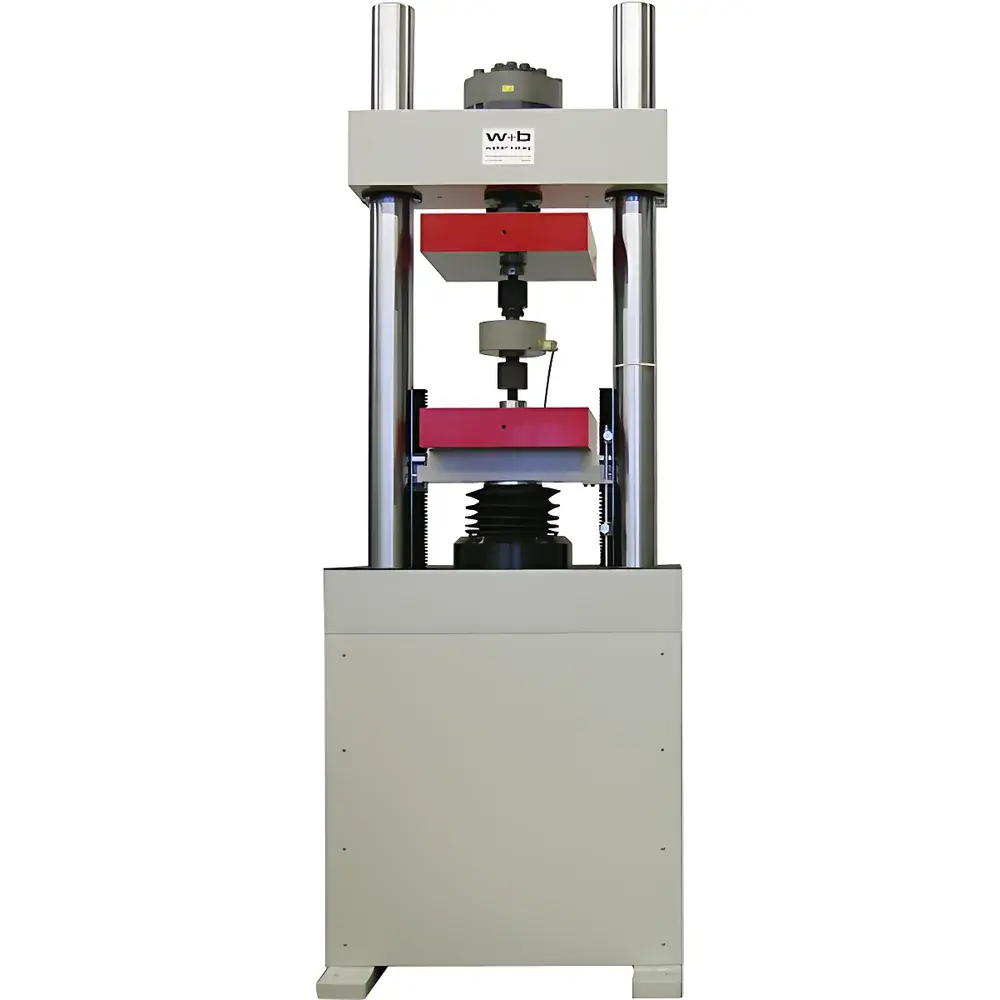
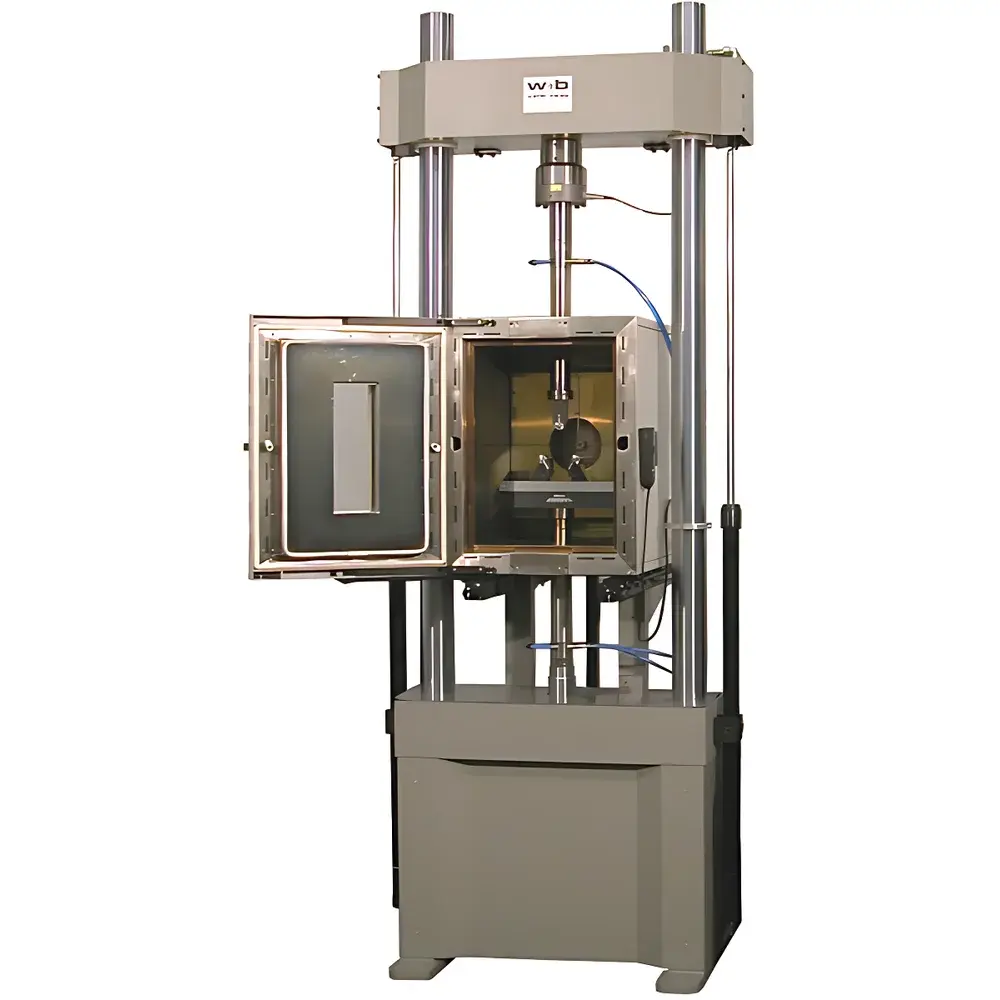
W+B LFV Series Electro-Hydraulic Servo Dynamic Fatigue Testing Machine
| Brand | W+B |
|---|---|
| Origin | Switzerland |
| Model | LFV |
| Type | Electro-Hydraulic Servo Fatigue Testing Machine |
| Maximum Test Force | 2000 kN |
| Frequency Range | 0.01 Hz – 300 Hz |
| Host Weight | 3000 kg |
| Stroke Options | ±50 mm, ±75 mm, or ±125 mm |
| Frame Stiffness | 50 kN/mm |
| Horizontal Clearance (between columns) | 440 mm |
| T-Slot Length | 600 mm |
| Hydraulic Power Unit Flow Rate | 5.5 L/min |
| Cooling Method | Air or Water Cooling |
| Electrical Supply | 400 V / 50 Hz / 4 kW |
| Control Modes | Closed-Loop Force, Displacement, and Strain (with extensometer) |
| Accuracy Class | 0.5, compliant with ISO 7500-1 and EN 10002-2 |
Overview
The W+B LFV Series Electro-Hydraulic Servo Dynamic Fatigue Testing Machine is a high-stiffness, high-fidelity structural testing platform engineered for precision static, quasi-static, and dynamic fatigue characterization of materials, components, and full-scale assemblies. Based on decades of heritage from the original AMSLER hydraulic servo technology lineage—pioneered over a century ago—the LFV system integrates robust electro-hydraulic actuation with real-time closed-loop control architecture to deliver exceptional repeatability and long-term stability under demanding test conditions. Its core measurement principle relies on force-controlled and displacement-controlled servo-hydraulic actuation, with optional strain feedback via calibrated extensometers, enabling compliance with rigorous international standards including ISO 7500-1 (static calibration), EN 10002-2 (tensile testing), and ASTM E4, E8, E606, and E1823 (fatigue and fracture mechanics). Designed and manufactured entirely in Switzerland, the LFV series reflects W+B’s engineering philosophy: “Testing systems tailored to unique experimental requirements”—not off-the-shelf compromises.
Key Features
- Monolithic, chrome-hardened load frame with 50 kN/mm axial stiffness ensures minimal deflection during high-force cyclic loading, critical for accurate hysteresis and energy dissipation measurements.
- Dual long-travel actuators mounted on the upper crosshead enable rapid, precise specimen alignment and accommodative positioning—reducing setup time without sacrificing mechanical integrity.
- Passive T-slot base plate (600 mm length) supports modular fixture integration, including custom wedge grips, bending fixtures, triaxial confining cells, and environmental chambers.
- Integrated swivel-prevention mechanism on each actuator eliminates parasitic torsion during asymmetric or off-axis loading—essential for multiaxial fatigue and structural component testing.
- High-coupling manifold design places servo valves and accumulators in direct proximity to the actuator inlet, minimizing hydraulic lag and pressure ripple across the full 0.01–300 Hz operational bandwidth.
- Class 0.5 load cell (traceable to ISO/IEC 17025-accredited W+B calibration lab) and high-resolution LVDTs provide synchronized, multi-channel acquisition of force, displacement, and strain at up to 10 kHz sampling rate.
- Hydraulic power unit (5.5 L/min flow, air- or water-cooled) is decoupled from the main frame to reduce thermal drift and vibration coupling—maintaining metrological stability over extended test durations.
Sample Compatibility & Compliance
The LFV platform supports a broad spectrum of specimen geometries and material classes—including metallic alloys, fiber-reinforced composites, elastomeric polymers, timber, asphaltic binders, geosynthetic soils, biomedical implants, and cementitious matrices. It accommodates standard tensile coupons (ASTM E8/E21), notched fatigue specimens (ASTM E606), compact tension (CT) and single-edge notched bend (SENB) fracture toughness samples (ASTM E399/E1820), as well as large-scale structural subassemblies (e.g., bridge gusset plates, aerospace shear webs, railway axle sections). All systems are supplied with CE marking and comply with Machinery Directive 2006/42/EC, EMCD 2014/30/EU, and Low Voltage Directive 2014/35/EU. Optional configurations meet GLP/GMP audit requirements, including 21 CFR Part 11-compliant electronic signatures, audit trail logging, and user access level management within the control software.
Software & Data Management
W+B’s proprietary WinTest control and analysis suite provides deterministic real-time control (sub-millisecond loop update), waveform synthesis (sine, triangle, random, block, user-defined), and synchronized multi-parameter acquisition. The software supports automated test sequencing per ISO 1099 (fatigue testing), ISO 6892-1 (tensile), and ASTM D7771 (dynamic modulus of asphalt), with built-in modules for S–N curve generation, crack growth rate (da/dN) calculation per ASTM E647, and hysteresis loop analysis. Raw data export is available in ASCII, HDF5, and universal MDF4 formats—compatible with MATLAB, Python (via h5py), and third-party post-processing tools such as nCode DesignLife and FE-SAFE. Calibration certificates and uncertainty budgets are digitally embedded and version-controlled within each test file.
Applications
- High-cycle and low-cycle fatigue life prediction of aerospace fasteners, turbine blades, and landing gear components.
- Fracture mechanics evaluation: J-integral, KIc, ΔK-threshold, and R-curve determination under controlled ΔK or load ratio (R) conditions.
- Mechanical behavior mapping of viscoelastic polymers and bituminous materials under variable temperature and frequency sweeps (time–temperature superposition).
- Structural validation of civil engineering elements—reinforced concrete beams, steel-concrete composite joints, and seismic dampers—under simulated earthquake spectra (e.g., El Centro, Kobe).
- Bio-mechanical testing of orthopedic implants (e.g., hip stems, spinal cages) per ISO 7206-4 and ASTM F2117 protocols.
- Triaxial testing of soils and rock cores with optional confining pressure up to 100 MPa, integrated with axial and radial deformation measurement.
- Creep–relaxation characterization of thermoplastics and elastomers under constant load or strain hold conditions.
FAQ
What standards does the LFV system comply with for calibration and verification?
The LFV system meets ISO 7500-1 Class 0.5 accuracy requirements for static force measurement and EN 10002-2 for tensile testing. Its load cells are calibrated in W+B’s ISO/IEC 17025-accredited laboratory, recognized under the European Multilateral Agreement (MLA).
Can the LFV be configured for multiaxial testing?
Yes—W+B offers coordinated multi-actuator configurations (e.g., biaxial, triaxial, and spatial loading frames) with synchronized digital control, enabling true path-dependent fatigue simulation.
Is remote diagnostics and preventive maintenance supported?
All LFV systems include embedded Ethernet connectivity for secure remote monitoring, firmware updates, and predictive health analytics. W+B’s global service network provides on-demand access to Swiss engineers (on-site within 14 days) and local technical support (same-day response in China).
What is the expected service life and spare parts availability?
W+B guarantees minimum 20-year functional obsolescence coverage and maintains inventory of critical hydraulic, sensor, and control components throughout the equipment lifecycle.
Does W+B support system retrofits or upgrades for legacy installations?
Yes—W+B provides hardware modernization (e.g., digital controller replacement, new sensor integration) and software migration services, ensuring continued compliance with evolving regulatory and analytical requirements.



