
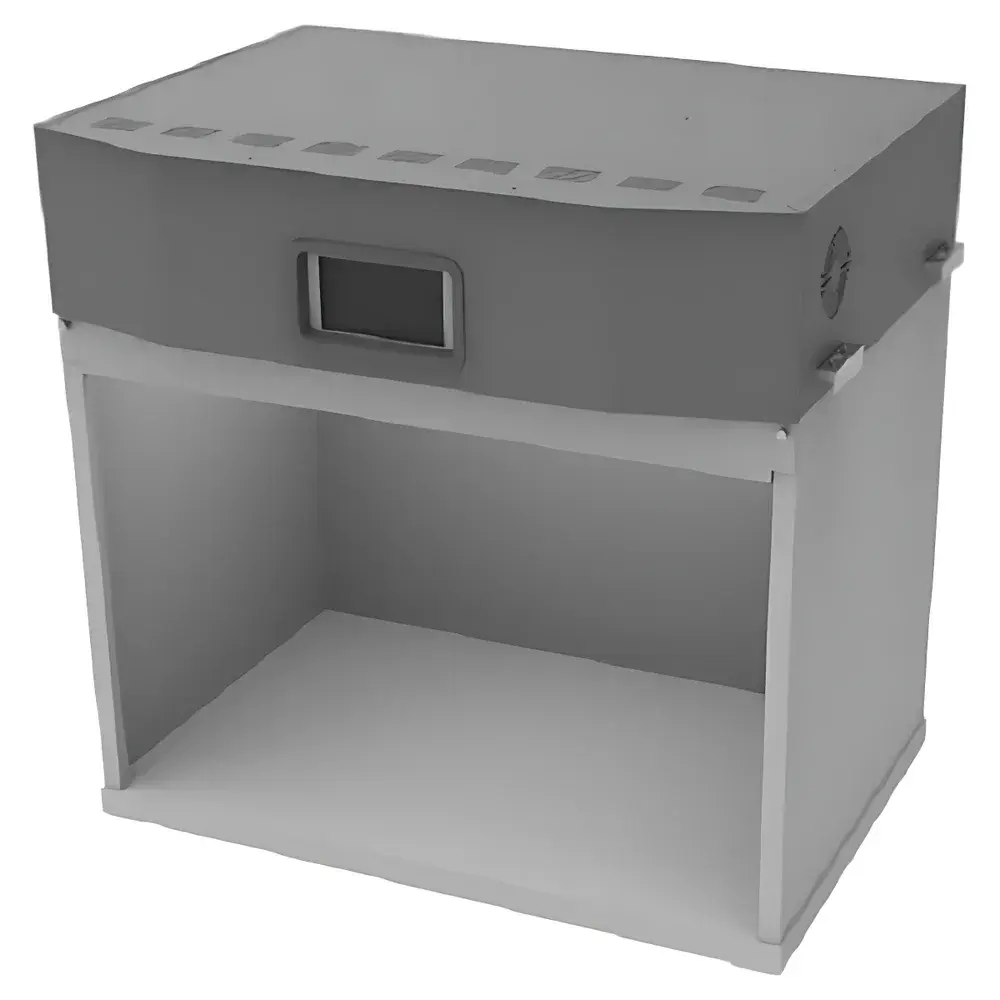
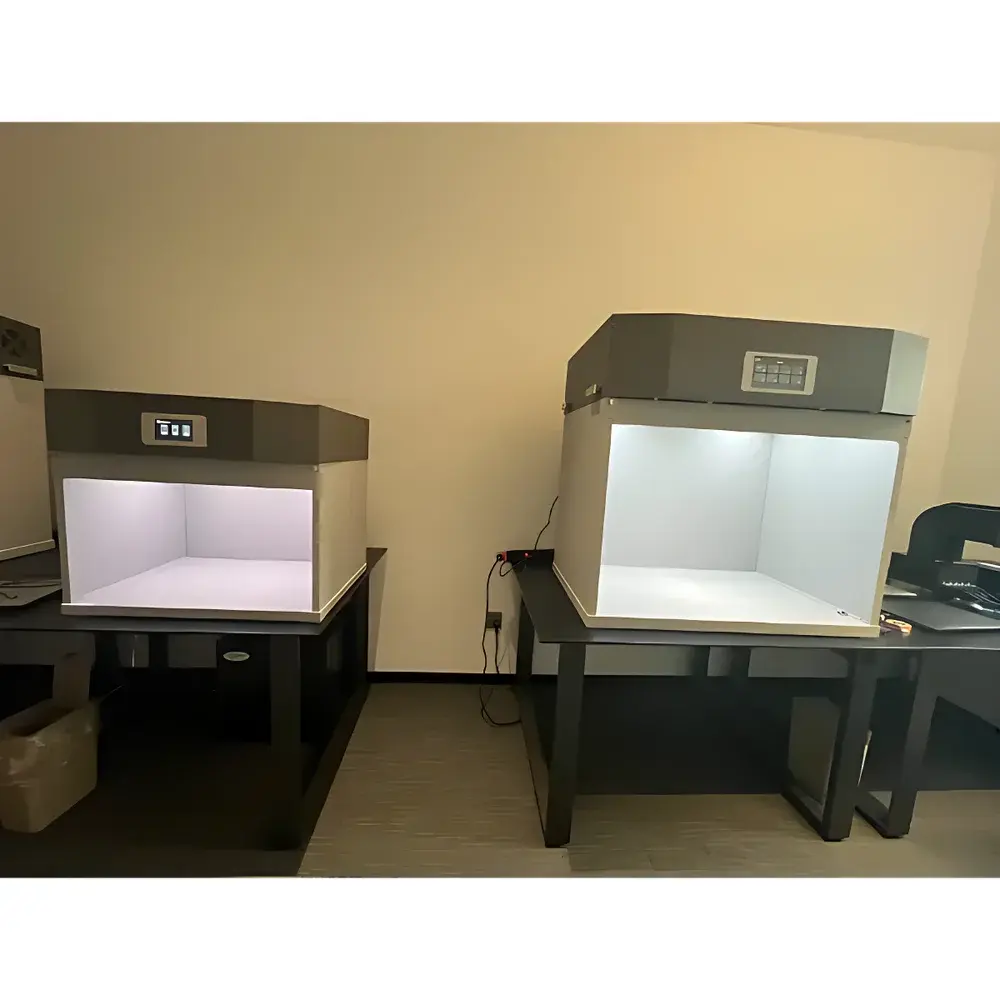
WeSpectra Spectra-LED Multi-Channel Tunable LED Standard Light Source Cabinet
| Brand | WeSpectra |
|---|---|
| Origin | Shanghai, China |
| Model | Spectra-LED |
| LED Channels | 14 |
| Spectral Range | 360–700 nm |
| CCT Tuning Range | 2000–20000 K (±1% accuracy) |
| CIE Ra | ≥95 |
| CIE MI Class | B |
| SPD Reproducibility | Full user-defined or imported spectral power distribution |
| Dimming Resolution | 12-bit per channel (4000 steps) |
| Flicker Frequency | 1–1000 Hz (1 Hz step) |
| Warm-up Time | 0 s |
| Uniformity | ≥80% (Munsell N7 interior) |
| Max Illuminance | ≥2000 lx (D-series), Low-light Mode: 0.1–50 lx |
| Dimensions (L×H×W) | 710×585×585 mm |
| Observation Chamber (L×H×W) | 660×430×530 mm |
| Weight | ~20 kg |
| Power Input | 110–240 V AC, max 180 W |
| Operating Temperature | 0–40 °C |
| Control Interface | Integrated capacitive touchscreen |
| Predefined Sources | D50, D65, LED-B1 (2700 K), LED-B2 (3000 K), LED-B3 (4100 K), UV, Directional D65 |
| Storage | 7 hardware-stored presets, unlimited software-stored SPDs |
| Compliance | ISO 23603, ISO 3664, ASTM D1729 |
| Optional | UV/NIR channel extension, directional illumination module, SDK/API for automated integration |
Overview
The WeSpectra Spectra-LED Multi-Channel Tunable LED Standard Light Source Cabinet is an engineered optical reference system designed for high-fidelity spectral control in color science, photometric calibration, and vision research. Unlike conventional fluorescent or halogen-based light booths, the Spectra-LED employs a precisely balanced array of 14 independently driven LEDs spanning 360–700 nm—covering near-ultraviolet, visible, and early near-infrared bands. Each channel is controlled via 12-bit amplitude modulation, enabling continuous, flicker-free intensity adjustment across 4000 discrete levels without temporal artifacts. The system implements proprietary spectral synthesis algorithms to reconstruct target illuminants—including CIE standard illuminants (D50, D65), industry-specific LED reference spectra (e.g., CIE TM-30 Rf/Rg validation sources), and user-imported SPDs—with metrological traceability. Its zero warm-up time, thermal stability architecture, and long-term radiometric consistency (≥8000 h L70 lifetime) support unattended operation in GLP-compliant laboratories and production QA environments.
Key Features
- Fully programmable spectral power distribution (SPD) synthesis across 360–700 nm with real-time interpolation and spectral fidelity verification
- Independent 12-bit per-channel dimming enables precise chromaticity control (CCT 2000–20000 K, ±1% tolerance) and high CIE Ra (>95) under standardized viewing conditions
- Flicker-free operation with selectable modulation frequencies from 1 Hz to 1000 Hz—ideal for evaluating sensor response, display motion blur, and non-visual photobiological effects
- Directional illumination option supports gloss, sparkle, and graininess assessment per ISO 28178 and ASTM E308 methodologies
- Low-illuminance mode (0.1–50 lx) facilitates mesopic and scotopic vision studies, circadian lighting evaluation, and medical device ambient condition simulation
- Integrated capacitive touchscreen interface stores up to 7 factory- or user-configured illuminants; full spectral library management via PC software with unlimited SPD import/export
- Hardware-level uniformity compensation ensures ≥80% spatial illuminance uniformity across the Munsell N7 observation chamber (660×430×530 mm)
- Modular mechanical design supports ceiling suspension, benchtop mounting, or custom structural integration with optional UV/NIR channel expansion kits
Sample Compatibility & Compliance
The Spectra-LED cabinet accommodates reflective, transmissive, and emissive samples—including printed substrates, textiles, automotive coatings, display panels, and biomedical specimens—within its standardized viewing volume. Its spectral flexibility meets requirements for ISO 23603 (graphic technology — viewing conditions), ISO 3664 (graphic technology and photography — viewing conditions for color assessment), and ASTM D1729 (standard practice for color measurement of opaque materials). It supports CIE S 026/E:2018 photobiological safety assessments and aligns with IEC TR 62778 for blue-light hazard analysis when configured with UV-enhanced channels. The system’s digital control architecture complies with FDA 21 CFR Part 11 data integrity principles when paired with validated software logging and audit-trail modules.
Software & Data Management
The bundled SpectraControl software provides intuitive GUI-based SPD editing, spectral comparison (ΔEuv, CRI, TM-30 metrics), and time-resolved illumination sequencing. It interfaces natively with Konica Minolta CL-500A and JETI Specbos 2501/2501uv spectroradiometers for closed-loop feedback calibration. An open Software Development Kit (SDK) delivers documented C/C++ and Python APIs for integration into automated test benches, robotic sample handlers, or enterprise LIMS platforms. All spectral configurations are stored in vendor-neutral XML format, ensuring interoperability with third-party color management systems (e.g., X-Rite ColorCert, Datacolor TOOLS). Firmware updates and calibration certificates are managed through secure, version-controlled repositories.
Applications
- Color matching and metamerism evaluation in paint, plastic, and textile manufacturing
- Calibration and validation of industrial cameras, multispectral sensors, and machine vision systems
- Photometric characterization of LED luminaires per IES LM-79 and CIE S 025
- Non-image-forming (NIF) photoreception studies including melanopic daylight efficacy ratio (DLER) and circadian stimulus (CS) modeling
- Medical lighting validation per IEC 60601-2-41 and surgical shadow analysis
- Agricultural lighting R:FR ratio tuning and phytochrome activation profiling
- Display white point stability testing under variable ambient SPDs
- Academic research in color appearance models (CIECAM02, CAM16) and observer variability studies
FAQ
Does the Spectra-LED require lamp replacement during its service life?
No. The system uses solid-state LED emitters rated for ≥8000 hours at L70 (70% initial lumen maintenance), eliminating consumable lamp replacements. Radiometric drift is compensated via periodic software recalibration using a traceable spectroradiometer.
Can the cabinet reproduce CIE Illuminant A or F-series fluorescent spectra?
Yes. While optimized for daylight and modern LED references, the full SPD reconstruction capability allows accurate emulation of CIE A, F2, F7, F11, and other legacy illuminants—subject to physical LED spectral coverage constraints.
Is remote control supported over Ethernet or TCP/IP?
Standard communication is USB 2.0; Ethernet or RS-485 interfaces are available as OEM options with custom firmware configuration.
What is the uncertainty of CCT reproduction across the 2000–20000 K range?
CCT accuracy is ±1% relative to CIE 15:2018 calculation methods, verified using NIST-traceable spectroradiometric measurements under controlled thermal conditions.
How is uniformity measured and validated?
Uniformity is defined per ISO 3664:2009 as the ratio of minimum to maximum illuminance across a 10×10 grid within the observation area, measured using a calibrated lux meter at standardized geometry. Factory certification includes full-grid mapping reports.




