
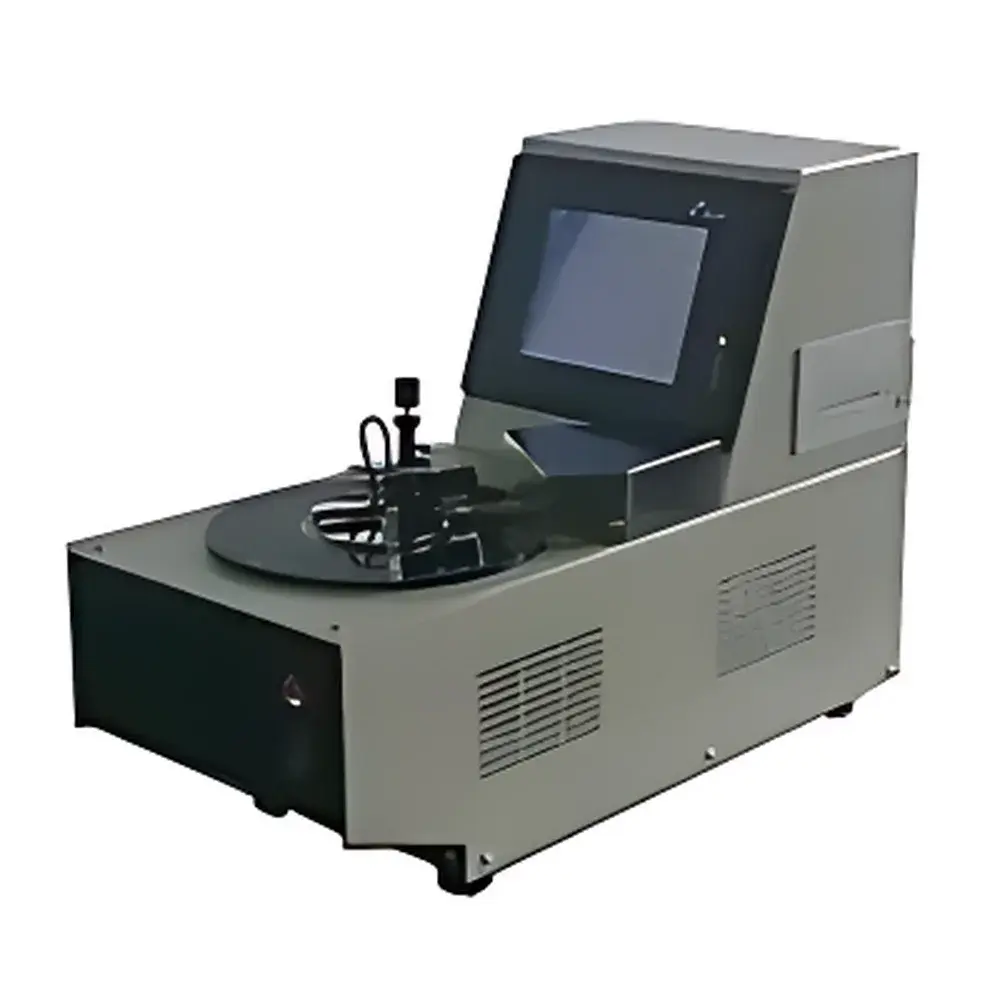
XuFeng XF-5208 Automated Rapid Equilibrium Closed-Cup Flash Point Tester
| Brand | XuFeng |
|---|---|
| Origin | Shanghai, China |
| Model | XF-5208 |
| Detection Method | Closed-Cup Rapid Equilibrium Method |
| Compliance | GB/T 5208–2008, ISO 3679:2004 |
| Temperature Range (XF-5208L) | –5 °C to 110 °C |
| Temperature Range (XF-5208H) | Ambient to 300 °C |
| Sample Volume (XF-5208L) | 2 mL per test |
| Sample Volume (XF-5208H) | 4 mL per test |
| Control Accuracy | ±0.5 °C |
| Interface | RS-232C |
| Power Consumption | 800 W × 2 |
| Dimensions | 280 mm (W) × 380 mm (D) × 350 mm (H) |
| Weight | ~15 kg |
Overview
The XuFeng XF-5208 Automated Rapid Equilibrium Closed-Cup Flash Point Tester is an engineered solution for precise, repeatable flash point determination of volatile liquid and semi-solid petroleum products, solvents, coatings, biofuels (e.g., FAME), chemical reagents, and fragrance materials. It operates strictly in accordance with the rapid equilibrium closed-cup principle defined in GB/T 5208–2008 and its internationally harmonized counterpart, ISO 3679:2004. Unlike traditional stepwise heating methods, this instrument achieves thermal equilibrium between the sample vapor phase and the sealed test cup interior prior to each ignition attempt—minimizing thermal lag and improving measurement reproducibility across low-viscosity and high-boiling-point matrices. The system integrates a Peltier-based cooling module (XF-5208L variant) or high-stability resistive heating (XF-5208H variant), enabling operation across two distinct temperature domains optimized for regulatory compliance and laboratory throughput.
Key Features
- True rapid equilibrium methodology compliant with GB/T 5208–2008 and ISO 3679:2004—ensuring alignment with global quality assurance protocols.
- Dual-variant platform: XF-5208L supports testing from –5 °C to 110 °C with integrated semiconductor refrigeration; XF-5208H extends range to 300 °C for high-boiling hydrocarbons and industrial lubricants.
- Minimal sample consumption: only 2 mL per test for liquids (XF-5208L); 4 mL for viscous or semi-solid samples (XF-5208H), reducing reagent cost and hazardous waste generation.
- Full automation sequence—including cup sealing, programmed ramping, thermoelectric vapor-phase detection, timed ignition, and flash confirmation—executed without manual intervention after START initiation.
- 7-inch full-color capacitive touchscreen interface with intuitive icon-driven workflow navigation, real-time temperature profiling, and on-screen parameter editing (ramp rate, hold time, ignition frequency, pressure compensation).
- Self-diagnostic firmware with audible/visual fault alerts and error-code logging—supporting preventive maintenance and GLP-compliant instrument qualification.
- RS-232C serial port enables bidirectional communication with LIMS or centralized QC servers; optional data export via built-in thermal printer (dot-matrix, paper-roll format) with timestamped reports.
Sample Compatibility & Compliance
The XF-5208 accommodates a broad spectrum of sample types encountered in petrochemical QA/QC, paint formulation, aviation fuel certification, and specialty chemical manufacturing. Validated applications include gasoline, diesel, jet fuel (Jet A-1, JP-8), biodiesel blends (B5–B100), solvent-based and waterborne coatings, resin solutions, fatty acid methyl esters, essential oils, and polymerizable monomers. Its closed-cup design eliminates open-flame exposure risks during analysis and meets occupational safety requirements under OSHA 29 CFR 1910.1200 and EU CLP Regulation (EC No. 1272/2008). All test procedures adhere to ASTM D3278 (equivalent scope), ISO 3679, and national standards referenced in GB/T 5208–2008. Atmospheric pressure correction is applied automatically using onboard barometric sensing, ensuring traceable results independent of elevation or weather conditions.
Software & Data Management
The embedded control software implements deterministic state-machine logic for unambiguous test execution and audit-ready data integrity. Each test record includes operator ID (optional login), ambient pressure, calibration verification status, raw thermocouple readings, ignition event timestamps, and final flash point value with uncertainty estimation based on ISO/IEC 17025:2017 Annex A guidelines. Data files are stored internally (non-volatile memory) and exportable as CSV or PDF via USB or RS-232C. While not FDA 21 CFR Part 11–compliant out-of-the-box, the system supports integration with validated third-party electronic lab notebook (ELN) platforms through standardized ASCII command sets and configurable data headers—facilitating alignment with GMP/GLP documentation workflows in regulated environments.
Applications
- Petroleum refining: Flash point verification of distillates, naphthas, and cut-point fractions prior to blending or shipment.
- Aviation fuels: Routine monitoring of Jet A-1 flash point per ASTM D1655 and DEF STAN 91-91 specifications.
- Coatings & inks: Quality control of solvent recovery efficiency and VOC content assessment in waterborne acrylics and epoxy systems.
- Biofuel production: Certification of FAME purity and oxidation stability in biodiesel batches (EN 14214, ASTM D6751).
- Chemical distribution: Certificate-of-analysis validation for flammable solvents (acetone, toluene, MEK) shipped under IMDG Code Class 3 regulations.
- Academic & method development labs: Platform for evaluating non-standard flash point behavior in novel ionic liquids or nanofluids.
FAQ
What standards does the XF-5208 comply with?
It is fully compliant with GB/T 5208–2008 and ISO 3679:2004 for rapid equilibrium closed-cup flash point determination.
Can the instrument be used for solid or semi-solid samples?
Yes—the XF-5208H variant is specifically designed for higher-viscosity and semi-solid materials requiring up to 4 mL sample volume and extended heating profiles.
Is external refrigeration required for low-temperature testing?
No—the XF-5208L incorporates an integrated Peltier cooling module, eliminating dependency on external chillers or cryogenic media.
How is atmospheric pressure compensated during testing?
An onboard barometric sensor continuously measures ambient pressure and applies real-time correction to the flash point result, ensuring accuracy at varying elevations.
Does the system support remote data acquisition and network integration?
Yes—via standard RS-232C interface with ASCII protocol; compatible with LIMS, SCADA, and centralized QC databases when configured with appropriate middleware.





