
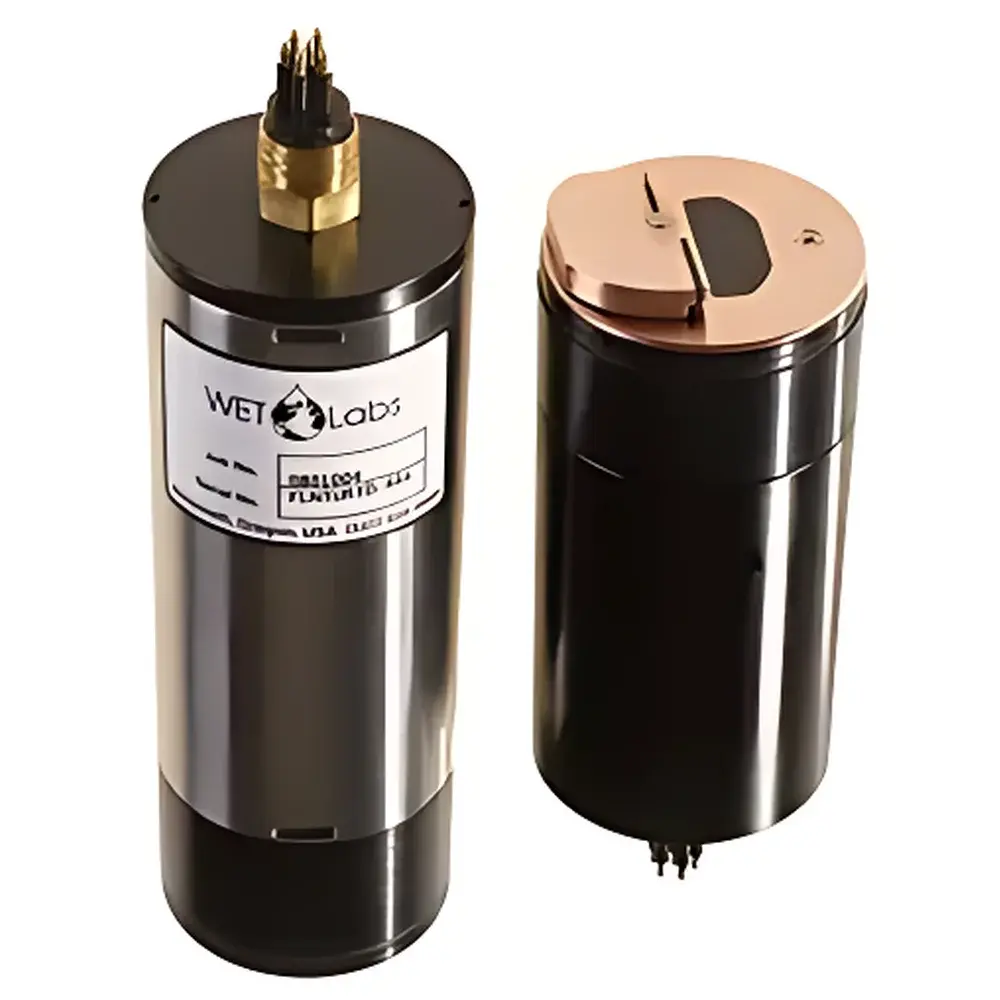
WETStar Self-Contained Algal Fluorometer
| Origin | USA |
|---|---|
| Manufacturer Type | Authorized Distributor |
| Origin Category | Imported |
| Model | WETStar |
| Pricing | Available Upon Request |
| Probe Length | 17.1 cm |
| Diameter | 6.9 cm |
| Weight | 0.8 kg |
| Rated Depth | 600 m |
| Response Time | 0.17 s |
| Optical Detection Limit | ≥0.03 µg/L chlorophyll-a |
| Excitation Wavelength | 470 nm |
| Emission Wavelength | 685 nm |
| Dynamic Range (Standard) | 0.03–75 µg/L |
| Extended Dynamic Range | 0.03–125 µg/L |
Overview
The WETStar Self-Contained Algal Fluorometer is a submersible, autonomous optical sensor engineered for high-sensitivity, in situ quantification of chlorophyll-a fluorescence in natural and engineered aquatic systems. It operates on the principle of pulse-amplitude modulated (PAM)-compatible fluorometry—exciting photosynthetic pigments at 470 nm (blue LED) and detecting emitted fluorescence at 685 nm (red bandpass), enabling robust discrimination of phytoplankton-derived signal against background optical noise. Unlike surface-mounted or flow-through systems, the WETStar integrates all electronics, power management, memory storage, and optical path within a single pressure-rated housing—eliminating reliance on external data loggers or real-time telemetry. Its self-contained architecture supports long-term deployment in lakes, reservoirs, estuaries, coastal zones, and aquaculture facilities, delivering time-series chlorophyll-a concentration data critical for trophic state assessment, algal bloom early warning, and regulatory compliance monitoring under frameworks such as EPA Method 445.0 and ISO 10260.
Key Features
- True autonomous operation: Internal lithium battery pack (field-replaceable) supports >6 months continuous logging at 15-minute intervals; configurable sleep/wake cycles extend mission duration.
- Optically isolated flow cell design: Minimizes ambient light interference and photobleaching artifacts through hydrodynamic shielding and spectral filtering—critical for diurnal deployments and turbid water applications.
- Adaptive auto-ranging: Dynamically selects gain and integration time to maintain linear response across two calibrated ranges (0.03–75 µg/L and 0.03–125 µg/L), ensuring accuracy during rapid phytoplankton biomass shifts.
- Depth-rated titanium-alloy housing: Certified to 600 m water column (60 bar), with O-ring-sealed optical windows and marine-grade corrosion-resistant engineering polymers compliant with ASTM F1901 seawater exposure standards.
- Programmable sampling logic: User-defined schedules include fixed-interval, event-triggered (e.g., temperature or conductivity thresholds), and depth-profiled acquisition modes via ASCII-based configuration files.
- CTD interoperability: Digital RS-232 and SDI-12 interfaces allow synchronized integration with conductivity-temperature-depth profilers without signal attenuation or timing drift.
Sample Compatibility & Compliance
The WETStar is validated for use in freshwater, brackish, and marine matrices—including high-turbidity reservoirs (up to 500 NTU), humic-rich blackwater systems, and saline lagoons (up to 45 ppt). Its optical calibration traceability follows NIST-traceable chlorophyll-a reference standards (Sigma-Aldrich C6144), with factory verification per ISO/IEC 17025-accredited procedures. The instrument meets CE marking requirements for electromagnetic compatibility (EN 61326-1) and environmental protection (EN 60529 IP68). Data integrity protocols align with GLP principles: onboard timestamping (UTC-sync capable), checksummed binary logging, and write-protected memory partitions prevent post-deployment data corruption. While not FDA 21 CFR Part 11 certified out-of-the-box, audit-ready metadata export (including sensor ID, firmware version, calibration date, and environmental context tags) supports validation in regulated water quality programs.
Software & Data Management
Data retrieval occurs via USB-C interface using WETView Desktop v3.x—a cross-platform application (Windows/macOS/Linux) supporting raw fluorescence intensity (V), converted chlorophyll-a concentration (µg/L), temperature-compensated values, and diagnostic flags (e.g., saturation warning, low-battery alert). The software enables batch processing of multi-instrument deployments, spectral baseline correction, and export to CSV, NetCDF, or EPA-compatible WQX formats. All configuration changes are logged with user ID and timestamp; firmware updates require cryptographic signature verification to ensure chain-of-custody integrity. Optional cloud synchronization (via secure MQTT over cellular or satellite modems) provides remote health monitoring and threshold-based SMS/email alerts—configurable per site and parameter.
Applications
- Trophic status mapping in eutrophication studies (OECD, UNESCO IHP protocols)
- Real-time cyanobacterial bloom detection in drinking water source protection zones
- Vertical phytoplankton distribution profiling during stratification events
- Performance validation of UV-based ballast water treatment systems
- Long-term trend analysis for UN SDG Indicator 6.3.2 (ambient water quality)
- Calibration reference for satellite ocean color algorithms (e.g., Sentinel-3 OLCI, Landsat 9 OLI-2)
FAQ
What is the recommended recalibration interval for field-deployed units?
Annual factory recalibration is advised for regulatory applications; biannual verification using in-house secondary standards is acceptable for research-grade deployments.
Can the WETStar operate continuously while moored to a buoy system?
Yes—its low-power sleep mode (<15 µA) and integrated voltage regulation support direct connection to marine solar-charged battery banks.
Does the instrument correct for temperature-induced fluorescence quenching?
Yes—embedded thermistor (±0.1°C accuracy) applies real-time compensation using species-agnostic empirical coefficients derived from controlled mesocosm trials.
Is raw fluorescence intensity data accessible for custom algorithm development?
Yes—binary output includes unprocessed analog-to-digital converter counts, excitation LED drive current, and detector dark-current offsets.
How is biofouling mitigated during extended deployments?
The optical window features a proprietary hydrophobic nano-coating (contact angle >110°), and optional copper-alloy antifouling sleeves are available for >30-day deployments in warm, nutrient-rich waters.
Related Products







