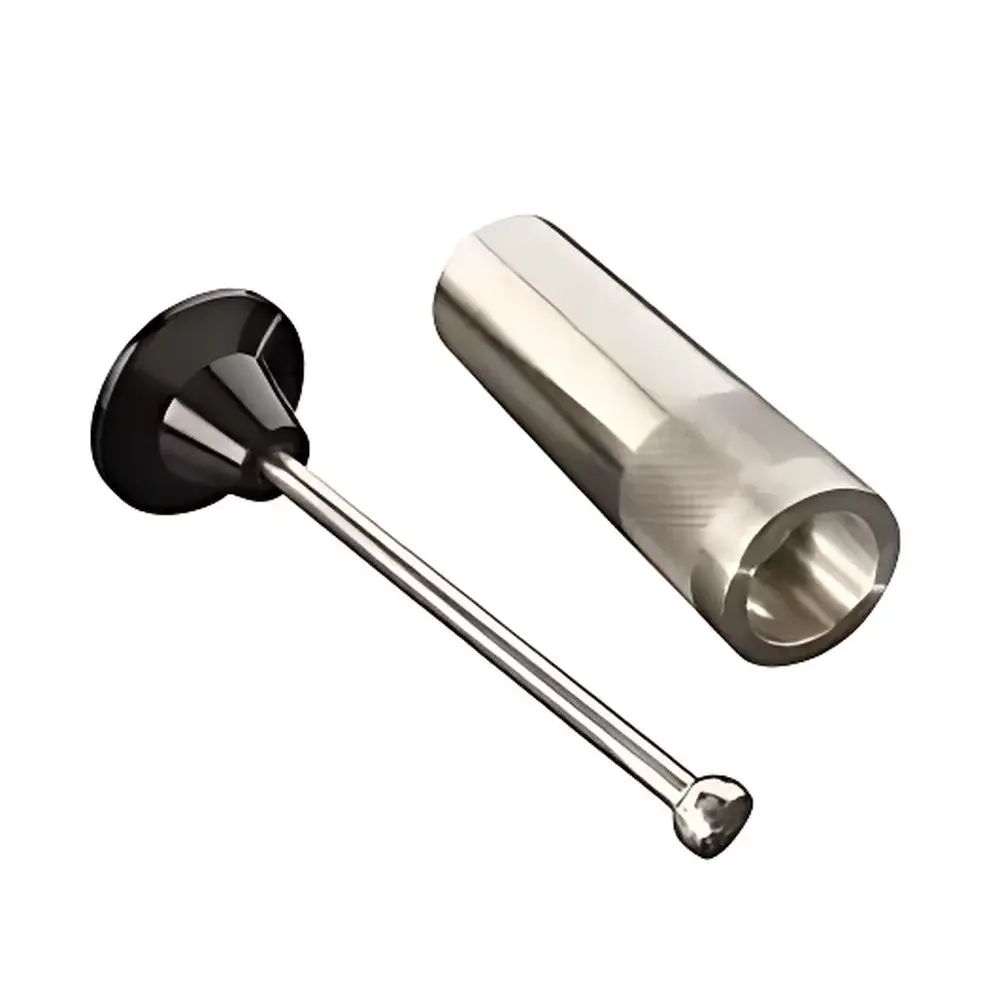
WHEATON Dura-Grind Stainless Steel Dounce Homogenizer
| Brand | SOCOREX |
|---|---|
| Origin | USA |
| Manufacturer Type | Authorized Distributor |
| Import Status | Imported |
| Model | Dura-Grind / Dounce |
| Instrument Category | Mechanical Cell Disruptor |
| Ultrasonic Power | 25 W |
| Operating Frequency | 50 Hz |
| Max Temperature Tolerance | 100 °C |
| Sample Volume Range | 1 mL |
| Throughput | Single-sample processing |
Overview
The WHEATON Dura-Grind Stainless Steel Dounce Homogenizer is a precision-engineered mechanical cell disruption tool designed for reproducible, low-shear homogenization of soft and semi-fibrous biological tissues. Unlike ultrasonic or high-pressure methods, the Dura-Grind operates on the classical Potter-Elvehjem principle—employing controlled clearance between a cylindrical pestle (pestle) and a matched glass or metal tube (homogenizer chamber) to achieve gentle yet effective cellular lysis through repeated piston-driven shearing forces. Its 316 stainless steel construction eliminates fragility concerns associated with traditional borosilicate glass Dounce homogenizers while maintaining dimensional stability under repeated manual or motorized actuation. This design is especially suited for viral particle isolation, nuclear extraction, and organelle purification where structural integrity of subcellular components must be preserved. The fixed 0.013 mm clearance between pestle and chamber ensures consistent shear stress across batches—critical for applications requiring high inter-assay reproducibility in molecular biology workflows.
Key Features
- Body and pestle machined from ASTM F138-certified 316 stainless steel for superior corrosion resistance, mechanical durability, and biocompatibility.
- Flat-bottomed homogenizer chamber enables stable upright positioning during operation and facilitates complete sample recovery.
- Precision-ground 0.013 mm annular clearance between pestle and chamber—optimized for efficient disruption of soft tissues (e.g., brain, liver, thymus) without excessive heat generation or foaming.
- No autoclave compatibility: surface passivation and dimensional tolerances are maintained at ambient conditions; sterilization is performed via ethanol immersion, hydrogen peroxide vapor (HPV), or ethylene oxide (EtO) per ISO 14937.
- Three standard volume configurations (7 mL, 15 mL, and 40 mL) accommodate diverse tissue mass inputs while preserving optimal pestle-to-chamber aspect ratio for uniform shear distribution.
- Interchangeable pestle sets available separately—enabling laboratory-specific calibration and long-term maintenance without full unit replacement.
Sample Compatibility & Compliance
The Dura-Grind is validated for use with mammalian, avian, and plant-derived soft tissues, including but not limited to brain, spleen, thymus, and cultured cell pellets. It is routinely employed in protocols compliant with ISO/IEC 17025-accredited laboratories for nucleic acid and protein extraction. While not intended for fibrous or calcified tissues (e.g., cardiac muscle, bone), its performance aligns with ASTM D5678–22 guidelines for mechanical homogenizer validation in life science applications. All units meet USP requirements for extractables and leachables when used within specified temperature and chemical exposure limits. Material certification includes EN 10204 3.1 documentation for traceability.
Software & Data Management
As a manually operated, non-electronic device, the Dura-Grind requires no embedded firmware or software interface. However, it integrates seamlessly into GLP- and GMP-regulated environments through documented SOPs and equipment logs. Users may assign unique asset IDs and record usage parameters—including pestle clearance verification dates, sterilization method, and batch-specific homogenization cycles—in LIMS platforms such as LabWare LIMS or Thermo Fisher SampleManager. Pestle wear monitoring follows ASTM E29–23 standards for measurement uncertainty reporting, ensuring continued compliance during audit inspections.
Applications
- Isolation of intact nuclei and mitochondria from fresh or snap-frozen tissues.
- Viral harvest from infected cell monolayers or organ explants—particularly where envelope integrity must be retained for downstream infectivity assays.
- Preparation of subcellular fractions prior to density gradient centrifugation (e.g., sucrose or iodixanol gradients).
- Routine lysis for RNA-seq library prep, where minimizing RNase activation and oxidative damage is essential.
- Homogenization step in ELISA and Western blot sample preparation workflows adhering to CLSI EP17-A2 sensitivity thresholds.
- Supporting FDA 21 CFR Part 11-compliant processes when paired with electronic lab notebooks (ELNs) that capture operator ID, timestamp, and homogenization cycle count.
FAQ
Can the Dura-Grind be autoclaved?
No. Due to thermal expansion differentials between stainless steel components and potential degradation of surface passivation, steam sterilization is not recommended. Alternative sterilization methods include 70% ethanol immersion (≥15 min), vaporized hydrogen peroxide (VHP), or ethylene oxide gas.
What is the maximum recommended tissue weight for the 40 mL model?
For optimal homogenization efficiency and pestle longevity, ≤1.5 g of fresh soft tissue is advised. Higher masses increase shear resistance and risk of inconsistent clearance engagement.
How often should pestle-to-chamber clearance be verified?
Initial verification is required upon installation. Subsequent checks should occur after every 200 operational cycles or quarterly—whichever comes first—using certified micrometer calipers traceable to NIST standards.
Is the Dura-Grind compatible with motorized homogenizer drives?
Yes. The standardized 12 mm outer diameter of the pestle shaft allows integration with third-party motorized actuators (e.g., Wheaton Motorized Pestle Drive or equivalent), provided rotational speed remains ≤60 rpm to prevent cavitation or localized heating.
Are replacement pestles and chambers sold separately?
Yes. Each component carries individual part numbers aligned with ISO 9001-certified manufacturing lot traceability, enabling modular replacement without compromising system-level calibration history.
Related Products