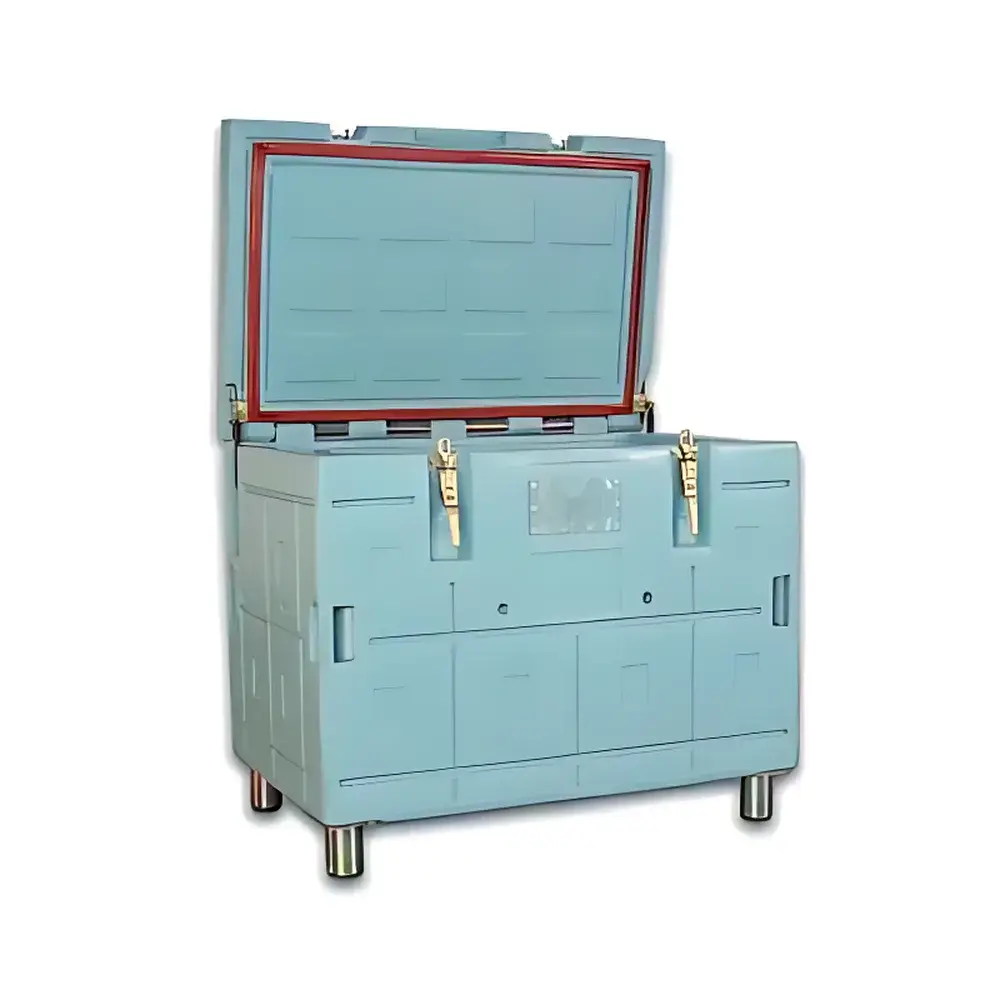
WIGGENS COB Series Large Insulated Transport and Storage Container
| Brand | WIGGENS |
|---|---|
| Origin | Germany |
| Manufacturer Type | Authorized Distributor |
| Origin Category | Imported |
| Model | COB |
| Price Range | USD 1,400 – 7,000 |
| Insulation Thickness | 60–90 mm Polyurethane Foam |
| Construction Material | High-Density Polyethylene (PE) |
| Evaporation Rate (CO₂) | 4.5–18 kg/day |
| Dimensions (L×W×H, mm) | 536×500×580 (COB55) to 1200×800×1050 (COB420) |
| Weight | 16–95 kg |
| Compliance | EN 13425 (IN-IR-RRC equivalent for cryogenic transport containers) |
Overview
The WIGGENS COB Series Large Insulated Transport and Storage Container is an engineered solution for the safe, compliant, and thermally stable handling of temperature-sensitive biological and clinical materials during extended storage and inter-facility transport. Designed in accordance with EN 13425 — the European standard governing the design, construction, and performance verification of insulated containers used for cryogenic transport — the COB series leverages high-performance polyurethane (PU) foam insulation (60–90 mm thickness) integrated into a monolithic high-density polyethylene (PE) shell. This architecture delivers exceptional thermal resistance (U-value ≤ 0.12 W/m²·K typical), minimizing heat ingress and enabling sustained low-temperature environments without active refrigeration. Unlike passive gel packs or dry ice-only systems, the COB container supports both dry ice (solid CO₂) and liquid nitrogen-compatible sample configurations, making it suitable for transporting viable cells, frozen plasma, mRNA vaccines, tissue biopsies, and other biospecimens requiring continuous sub-zero stability (−80 °C to −196 °C). Its structural integrity, pressure-relief safety system, and ergonomic handling features meet ISO 9001-certified manufacturing practices and support GLP-compliant logistics workflows.
Key Features
- Robust monocoque PE housing with seamless rotational molding — impact-resistant, non-corrosive, and chemically inert to common decontaminants (e.g., 70% ethanol, sodium hypochlorite)
- Optimized insulation geometry: 60–90 mm closed-cell polyurethane foam with <0.022 W/m·K thermal conductivity, applied under controlled pressure to eliminate voids and delamination
- Integrated spring-loaded lid with dual-latch sealing mechanism — ensures consistent compression force across the gasket interface for repeatable thermal barrier performance
- Pressure-equalizing vent valve (ISO 11607-compliant) — automatically releases excess CO₂ gas buildup while preventing moisture ingress and maintaining internal vacuum integrity
- Ergonomic lifting handles (reinforced with stainless steel inserts) and optional castor-mounted base (part no. 12618–130 / 12619–160) — certified for static load ≥ 3× rated capacity per EN 1728
- Traceable batch marking and CE/UKCA marking — each unit carries unique serial number, production date, and conformity statement aligned with EU Regulation (EU) 2016/425 PPE requirements
Sample Compatibility & Compliance
The COB series accommodates a wide range of primary and secondary containment formats: 2 mL cryovials (up to 1200 units in COB420), 50 mL conical tubes, cryoboxes (e.g., Nunc™, Thermo Scientific™), and custom aluminum or stainless-steel canisters. It is validated for use with dry ice payloads up to 35 kg (COB420) and compatible with vapor-phase liquid nitrogen shipping configurations when paired with approved inner baskets. All models comply with EN 13425:2021 (“Transport containers for cryogenic liquids — Performance requirements and test methods”), and support adherence to ISO 20387:2018 (Biobanking — General requirements for biobank operations) and ICH M10 (Bioanalytical Method Validation) cold chain documentation protocols. The PE material meets USP Class VI and FDA 21 CFR 177.1520 standards for food- and medical-grade plastics.
Software & Data Management
While the COB container is a passive thermal system, its integration into digital cold chain ecosystems is supported via third-party IoT monitoring platforms (e.g., Sensitech®, Controlant®, or ELPRO®). Each unit includes standardized mounting points and cavity geometry optimized for placement of Bluetooth-enabled temperature/humidity/pressure loggers (e.g., LogTag® TRIX-8 or OnAsset BioTrack™). Data from these devices may be synchronized to LIMS or QMS platforms supporting ASTM E2500-21 (Guide for Specification, Design, and Verification of Pharmaceutical and Biopharmaceutical Manufacturing Systems) and 21 CFR Part 11 audit-trail requirements. Optional QR-coded asset labels facilitate automated inventory tracking within enterprise CMMS systems.
Applications
- Clinical trial specimen transport between central labs and satellite collection sites
- Biorepository inter-site transfers of archived stem cell lines and organoid cultures
- Vaccine distribution logistics for ultra-cold-chain formulations (e.g., mRNA-LNP therapeutics)
- Food safety testing — preservation of microbiological reference standards and spoilage isolates
- Academic research — field-based cryopreservation of environmental samples (soil, water, marine biota)
- Regulated diagnostics — shipment of FFPE blocks and nucleic acid extracts under CAP/CLIA-aligned conditions
FAQ
What temperature range can the COB container maintain, and for how long?
The duration and minimum temperature depend on payload mass, ambient conditions, and dry ice loading. Under ISO 8573-1 Class 4 ambient (23 °C, 50% RH), COB55 maintains ≤ −70 °C for ≥ 48 h with 8 kg dry ice; COB420 sustains ≤ −80 °C for ≥ 120 h with 30 kg dry ice. Validation reports available upon request.
Is the COB container certified for air transport of dry ice?
Yes — all COB models are UN 2212-compliant and approved for IATA Section 5.1.2.1 carriage when equipped with functional pressure-relief valves and labeled per PI 954. Documentation package includes IATA Dangerous Goods Declaration templates.
Can the container be cleaned and sterilized between uses?
The PE shell is compatible with autoclaving at 121 °C for 15 min (without lid or valve assembly). Surface disinfection may be performed using 70% isopropanol, 0.5% hydrogen peroxide, or EPA-registered sporicidal agents. Avoid chlorine-based cleaners above 500 ppm concentration.
Do you offer validation support for GxP environments?
WIGGENS provides IQ/OQ documentation templates and supports user qualification per ASTM F2697-22 (Standard Practice for Qualification of Passive Shipping Systems). Third-party PQ services are coordinated through authorized partners in Europe and North America.
Related Products