
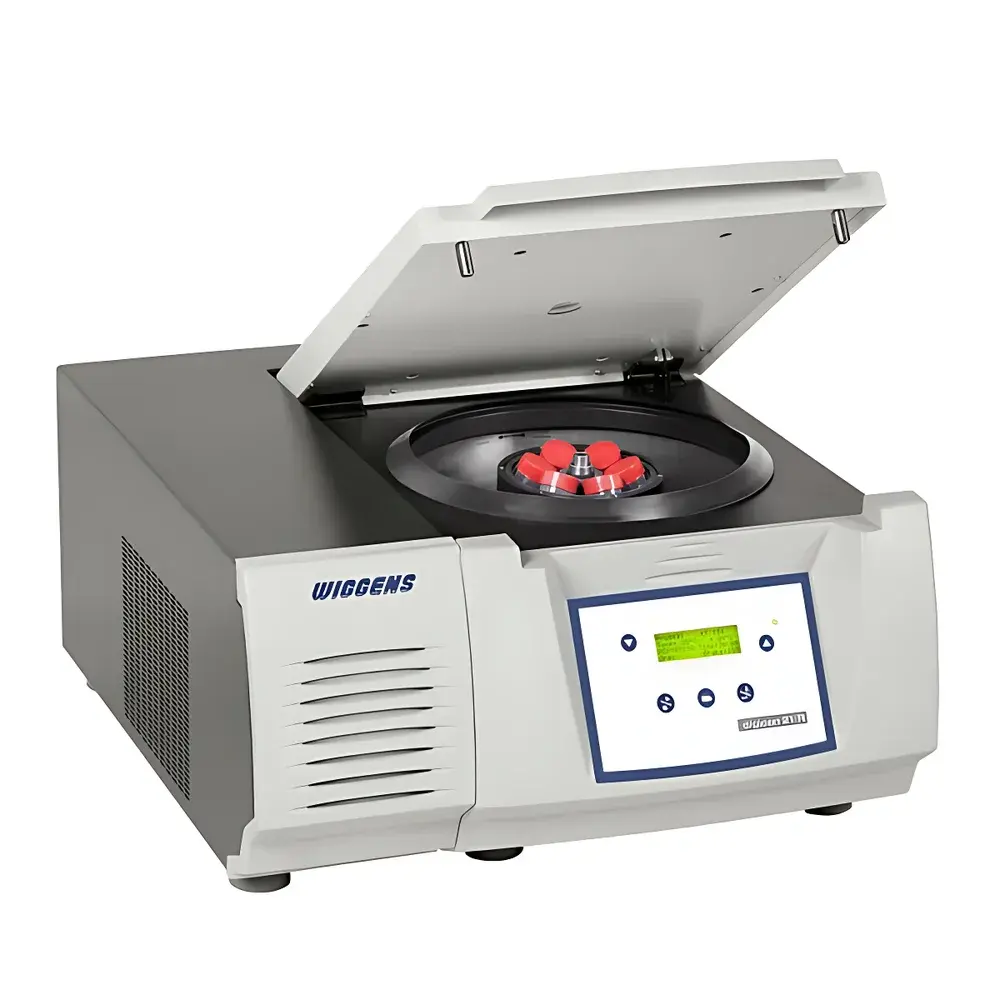
WIGGENS DIGICEN 21R Programmable Refrigerated Benchtop Centrifuge
| Brand | WIGGENS |
|---|---|
| Origin | Germany |
| Model | DIGICEN 21R |
| Instrument Type | Benchtop Centrifuge |
| Category | High-Speed Refrigerated Centrifuge |
| Max. Speed | 16500 rpm |
| Max. RCF | 26480 × g |
| Max. Capacity | 4 × 100 mL (horizontal rotor) |
| Temperature Range | −20 °C to +40 °C |
| Temp. Control Resolution | 1 °C |
| Refrigerant | R449A (CFC-free) |
| Dimensions (W×D×H) | 590 × 680 × 320 mm |
| Net Weight | 67 kg |
| Power Supply | 220–230 V, 50–60 Hz |
| Power Consumption | 700 W |
| Noise Level | < 60 dB(A) |
| Safety Compliance | EN 61010-1, EN 61010-2-020, EN 61326-1 |
| EU Directives | 98/79/EC, 2006/95/EC, 2004/108/EC, 2011/65/EU, 2012/19/EU |
| Environmental Regulations | 1005/2009 & 842/2006 |
Overview
The WIGGENS DIGICEN 21R is a high-performance programmable refrigerated benchtop centrifuge engineered for precision separation in demanding laboratory environments. Utilizing brushless DC motor technology and advanced microprocessor-based control architecture, it delivers stable rotational dynamics across its full operational range—from gentle pelleting at low speeds to high-resolution subcellular fractionation at up to 16,500 rpm (26,480 × g). Its dual-mode temperature regulation system—featuring pre-cooling, active cavity cooling during operation, and post-run hold functionality—ensures thermal integrity of thermolabile samples including nucleic acids, proteins, organelles, and primary cell suspensions. Designed and manufactured under German engineering standards, the DIGICEN 21R meets stringent international safety and electromagnetic compatibility requirements, making it suitable for use in GLP-compliant laboratories, clinical diagnostics facilities, and academic research settings where reproducibility, traceability, and regulatory adherence are critical.
Key Features
- Programmable multi-step protocols with up to 16 user-defined methods, each supporting variable speed, time, temperature, acceleration/deceleration profiles, and hold steps
- PCBS (Progressive Control Braking System) with 175 selectable ramp slopes to minimize sample resuspension and preserve gradient integrity during deceleration
- Real-time display of rpm, RCF, elapsed time, remaining time, cavity temperature, and status alerts via high-contrast LCD interface
- Intelligent rotor recognition and memory function: automatically detects installed rotor type and recalls optimal parameters for that configuration
- Integrated mechanical lid lock with emergency release, automatic imbalance detection (shuts down within milliseconds), and impact-resistant transparent viewing window
- Stainless-steel centrifuge chamber with seamless welds and removable rotor carrier for autoclave-compatible sterilization of rotors and adapters (121 °C, 20 min)
- Energy-efficient refrigeration using R449A—a low-GWP, non-ozone-depleting refrigerant compliant with EU F-Gas Regulation (No. 517/2014)
- Low-noise operation (<60 dB[A]) enabled by vibration-dampened suspension, balanced rotor design, and optimized airflow management
Sample Compatibility & Compliance
The DIGICEN 21R supports broad sample format versatility through interchangeable horizontal and fixed-angle rotors—including RT267 (28 × 15 mL), RT143 (4 × 50 mL), RT138 (4 × 100 mL), RT150 (microplate carrier), and RT183 (32 × 0.2 mL PCR tubes). Adapters accommodate conical-bottom tubes, cryovials, capillary tubes, hematocrit tubes, and standard microcentrifuge formats (0.2–100 mL). All rotors and adapters are certified for steam sterilization per ISO 17665-1, ensuring compatibility with biosafety Level 2+ workflows. The instrument complies with IEC/EN 61010-1 (safety of laboratory equipment), EN 61010-2-020 (particular requirements for centrifuges), and EN 61326-1 (EMC for laboratory use). It is CE-marked under Directive 2006/95/EC (Low Voltage), 2004/108/EC (EMC), and 2011/65/EU (RoHS), and conforms to environmental regulations 1005/2009 and 842/2006 concerning ozone-depleting substances.
Software & Data Management
While the DIGICEN 21R operates as a standalone instrument with embedded firmware, its parameter logging and event history support audit-ready documentation per FDA 21 CFR Part 11 principles. All run logs—including start/stop timestamps, setpoints, actual values, error codes, and door-open events—are stored internally and retrievable via front-panel navigation. Optional RS-232 or USB interfaces (available upon request) enable integration into LIMS or ELN platforms for automated data export. The system enforces password-protected access levels for operator, supervisor, and administrator roles—supporting role-based parameter editing, method locking, and electronic signature capture where required by GxP frameworks.
Applications
The DIGICEN 21R serves diverse applications across life sciences and industrial R&D: isolation of extracellular vesicles and exosomes from serum/plasma; purification of plasmid DNA and viral vectors; preparation of mitochondrial and nuclear fractions; clarification of bacterial lysates; concentration of monoclonal antibodies; density gradient centrifugation (e.g., Percoll®, Ficoll®); blood component separation (RBC/WBC/platelet isolation); and high-throughput microplate processing for ELISA and cell-based assays. Its precise temperature maintenance at maximum speed (4 °C ± 0.5 °C) enables reproducible cold centrifugation protocols essential for enzyme activity preservation and RNA integrity.
FAQ
Does the DIGICEN 21R support continuous operation at maximum speed and minimum temperature?
Yes—the unit maintains ≤4 °C in the chamber at 16,500 rpm, verified per ISO 21738:2021 thermal stability testing.
Can rotors be sterilized in an autoclave?
All WIGGENS-certified rotors and adapters are rated for autoclaving at 121 °C for 20 minutes; refer to individual rotor datasheets for cycle validation details.
Is imbalance detection performed dynamically during rotation?
Yes—vibration sensors continuously monitor radial displacement and trigger immediate shutdown if deviation exceeds ISO 1940-1 G2.5 tolerance thresholds.
What is the calibration interval recommendation for routine use?
Annual verification of speed accuracy (±10 rpm), temperature uniformity (±0.5 °C across chamber), and RCF consistency is advised per ISO/IEC 17025 guidelines.
Are rotor lifetime logs tracked by the instrument?
Rotor usage hours and max-speed cycles are recorded in non-volatile memory; these values are accessible via service menu and support predictive maintenance scheduling.



