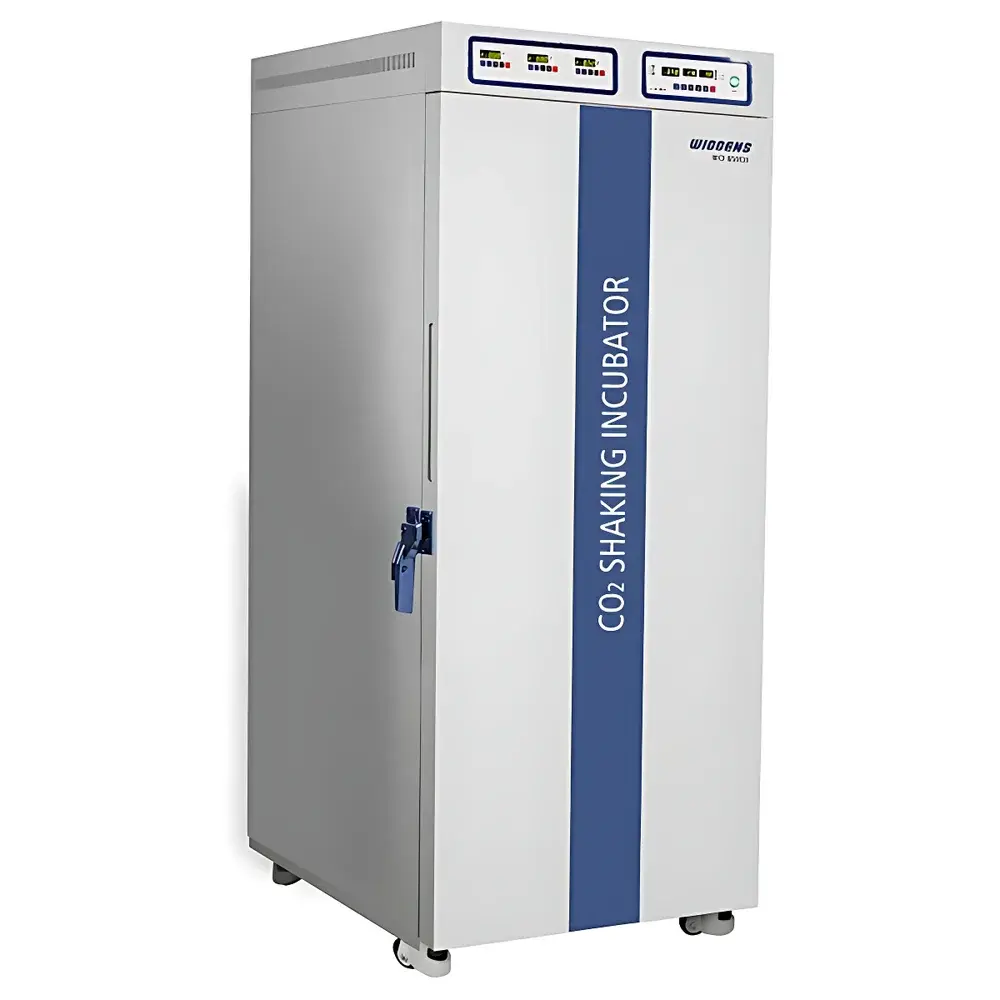
WIGGENS WCI-650CH CO₂ Incubator Shaker Cabinet
| Brand | WIGGENS |
|---|---|
| Origin | Germany |
| Model | WCI-650CH |
| Timer Range | 1 min – 99 h 59 min |
| Oscillation Frequency | 30–300 rpm |
| Amplitude | 25 mm |
| Temperature Range | Ambient +5°C to 60°C |
| Number of Shaking Platforms | 3 |
| CO₂ Range | 0–20% |
| CO₂ Sensing | Dual-beam infrared sensor |
| Temperature Uniformity | ±1°C at 37°C |
| Humidity | ≥70% RH at 37°C |
| Heating System | Air-jacketed, 6-sided heating |
| Filtration | HEPA sterilizing filter |
| UV Sterilization | 4 W UV lamp |
| Platform Dimensions | 520 × 520 mm |
| Internal Dimensions | 700 × 650 × 1430 mm |
| Weight | 323 kg |
| Power Supply | 220 V, 50/60 Hz |
Overview
The WIGGENS WCI-650CH CO₂ Incubator Shaker Cabinet is an integrated life science platform engineered for high-fidelity suspension cell culture under tightly controlled physiological conditions. It combines precise CO₂-regulated humidified incubation with independent orbital shaking across three physically isolated chambers—each equipped with a dedicated motor-driven shaker platform, sealed glass door, and localized environmental control. The system operates on the principle of orbital agitation (25 mm amplitude) within a thermally stabilized air-jacketed chamber (6-sided heating), ensuring uniform temperature distribution (±1°C at 37°C) and rapid recovery (<3 min) after door opening. Dual-beam infrared CO₂ sensing enables stable gas concentration control (0–20%, ±0.3% accuracy at 5% CO₂, 37°C), while continuous humidity maintenance (≥70% RH at 37°C) is achieved via integrated water reservoirs and HEPA-filtered recirculation. Designed for GMP-aligned workflows, its 304 stainless-steel interior—including platforms, tracks, and chamber walls—supports autoclave-compatible cleaning protocols and minimizes microbial adhesion risk.
Key Features
- Triple-chamber architecture with fully independent temperature, CO₂, and shaking control per zone—enabling parallel experiments under distinct culture conditions.
- Orbital shaking driven by hermetically sealed magnetic induction coils: zero mechanical wear, no heat generation, no external vibration transmission, and long-term rotational stability (±1 rpm accuracy, 1 rpm step resolution).
- Air-jacketed thermal design with six-point heating elements ensures minimal thermal gradient across the 650 L internal volume (700 × 650 × 1430 mm), validated per ISO 13485 environmental uniformity requirements.
- Integrated 4 W UV-C lamp and class H14 HEPA sterilizing filter provide in-situ decontamination of air pathways and chamber surfaces—critical for low-bioburden mammalian cell culture applications.
- Intelligent door interlock system: automatic oscillation halt upon opening any single chamber door; immediate resumption upon closure—eliminating manual intervention and preserving experimental integrity.
- Full power-loss recovery: system restores pre-interruption setpoints and operational state following unexpected mains failure—essential for unattended overnight or multi-day cultures.
Sample Compatibility & Compliance
The WCI-650CH accommodates standard bioreactor vessels (Erlenmeyer flasks up to 5 L, roller bottles, cell culture bags) and custom-format suspension culture containers on three removable 520 × 520 mm stainless-steel platforms. Each platform slides independently on corrosion-resistant 304 stainless rails, enabling ergonomic sample loading without cross-contamination between zones. The chamber’s non-porous, electropolished interior meets ISO 14644-1 Class 5 cleanroom surface requirements and supports validation per FDA 21 CFR Part 11 Annex 11 for electronic records and signatures. All environmental parameters (temperature, CO₂, humidity, rpm, timer) are logged with timestamped audit trails, supporting GLP/GMP documentation and regulatory submissions for biopharmaceutical process development.
Software & Data Management
The LED interface provides real-time monitoring and local adjustment of all critical parameters, with optional RS-485/Modbus RTU connectivity for integration into centralized laboratory information management systems (LIMS) or SCADA environments. Data logging intervals are configurable from 1 second to 60 minutes; stored records include min/max/mean values per parameter, event timestamps (door openings, power cycles, alarm triggers), and calibration history. Export formats include CSV and PDF reports compliant with ISO/IEC 17025 analytical data traceability standards. Firmware supports over-the-air updates verified via SHA-256 digital signature to ensure data integrity and cybersecurity compliance.
Applications
This system is routinely deployed in upstream bioprocess development for scalable suspension culture of adherent-to-suspension adapted mammalian cell lines—including CHO-K1, HEK293, and HeLa—under physiologically relevant CO₂ (5%), temperature (37°C), and humidity conditions. Its triple-zone capability supports comparative studies in protein expression optimization, monoclonal antibody titer enhancement, viral vector production (AAV, lentivirus), and crystallization screening of membrane proteins. In academic settings, it serves structural biology labs conducting time-resolved crystal growth assays and genomics facilities performing high-yield plasmid amplification in liquid culture. Regulatory-grade validation packages (IQ/OQ/PQ) are available to support qualification under USP , ASTM E2500, and EU GMP Annex 15.
FAQ
Can the WCI-650CH operate without CO₂ supply?
Yes—the incubator shaker functions as a high-capacity orbital shaker with full temperature and humidity control even when CO₂ is disconnected or set to 0%.
Is remote monitoring supported out of the box?
Local LED display is standard; RS-485 Modbus RTU communication is built-in for third-party SCADA or LIMS integration—no additional hardware required.
What is the maximum flask size supported per platform?
Each 520 × 520 mm platform accommodates up to four 2 L Erlenmeyer flasks or two 5 L flasks using optional universal clamping fixtures.
How often does the CO₂ sensor require recalibration?
Dual-beam infrared sensors exhibit drift <0.05% per year; WIGGENS recommends annual verification against NIST-traceable CO₂ reference gas per ISO 8573-1.
Does the system meet electromagnetic compatibility (EMC) requirements for lab environments?
Yes—certified to IEC 61326-1:2013 (industrial environment) and EN 61000-6-3:2007 for radiated emissions, ensuring co-location with sensitive analytical instruments such as mass spectrometers and patch-clamp rigs.
Related Products