
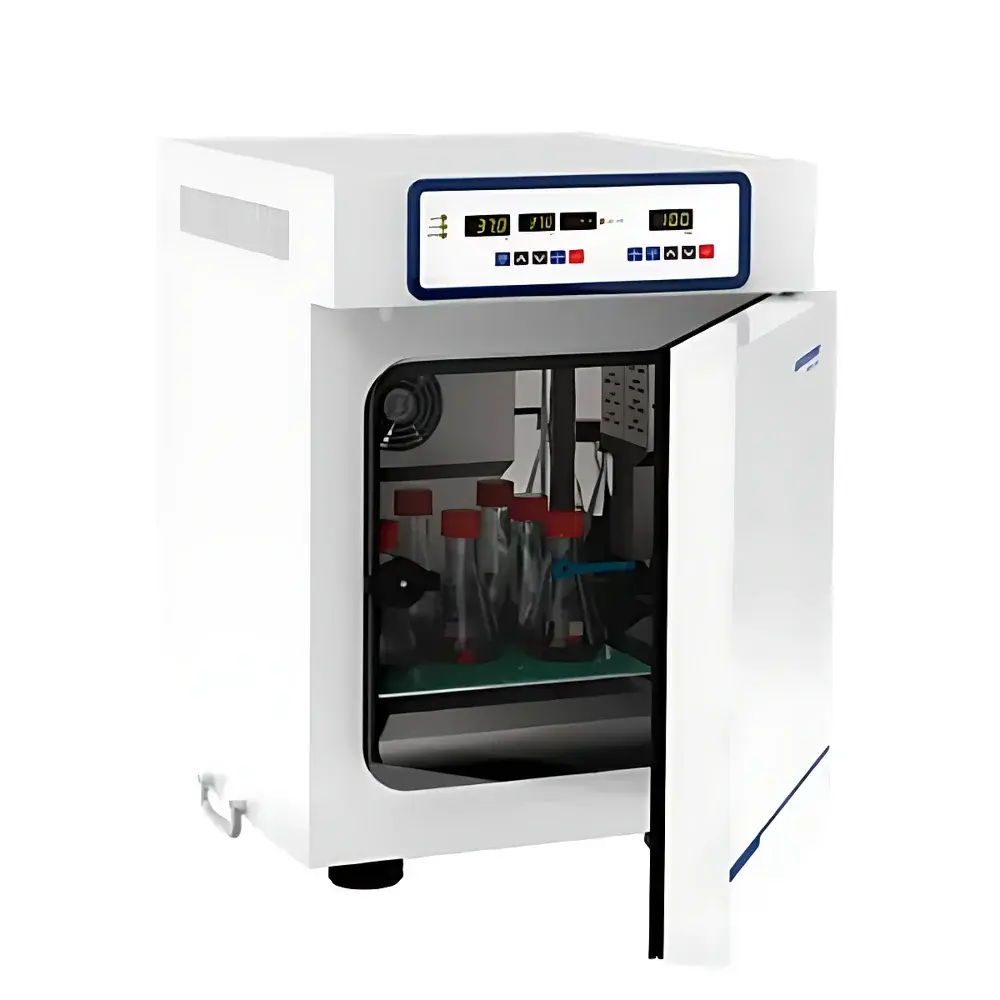
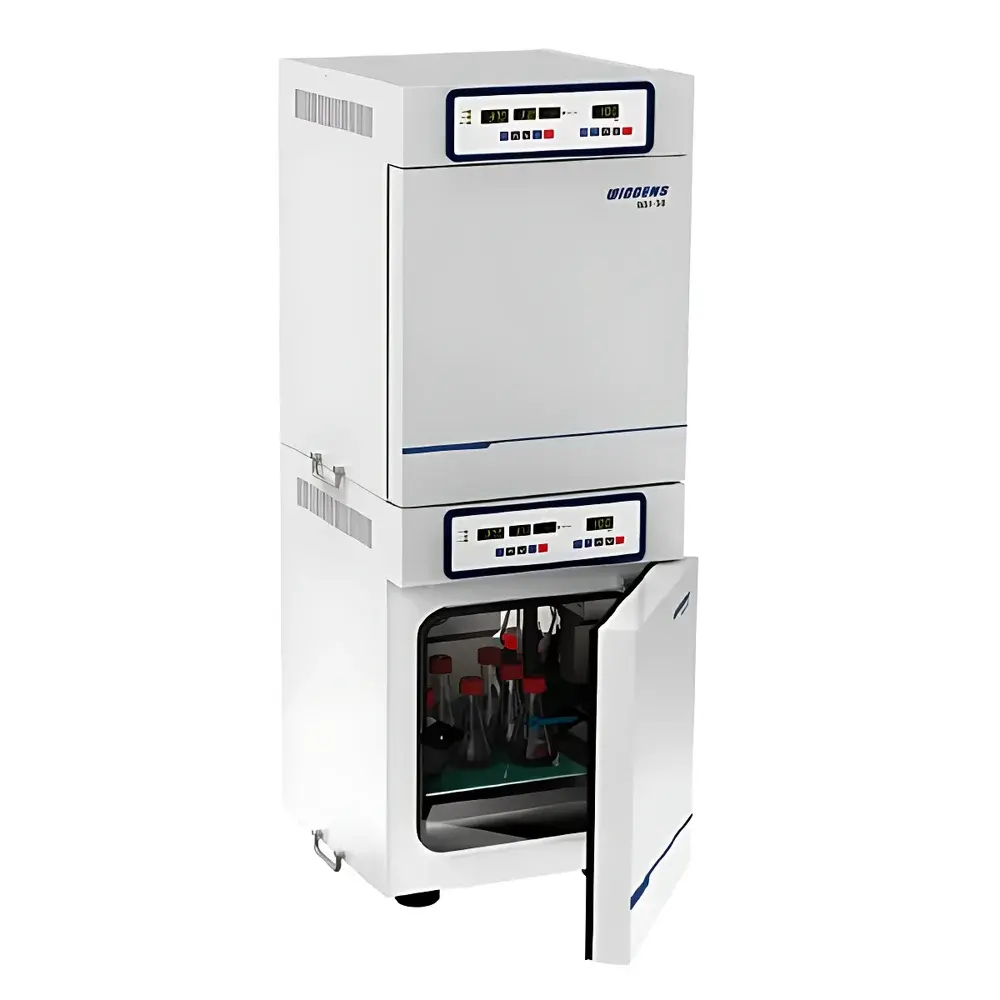
WIGGENS WSI-50 Ambient-Temperature Stackable Orbital Shaking Incubator
| Brand | WIGGENS |
|---|---|
| Origin | Germany |
| Model | WSI-50 |
| Instrument Type | Constant-Temperature Orbital Shaking Incubator |
| Drive Mechanism | Electromagnetic Drive |
| Speed Range | 20–300 rpm |
| Speed Accuracy | ±1% FS |
| Orbit Diameter | 25 mm |
| Temperature Range | RT+7°C to 60°C |
| Temperature Fluctuation | ±0.1°C |
| Temperature Uniformity | ±0.5°C |
| Chamber Volume | 71 L |
| Dimensions (Single Unit) | 400 × 600 × 618 mm (W × D × H) |
| Dimensions (Dual-Stacked) | 400 × 600 × 1236 mm (W × D × H) |
| Shelf Dimensions | 300 × 330 mm (W × D) |
| Max Flask Capacity | ≤2 L per platform |
| Safety Features | Door-Interlocked Oscillation Stop, Dual Independent Temperature Monitoring, Audible/Visual Alarm for Temp/Speed Deviation or Door Open |
Overview
The WIGGENS WSI-50 Ambient-Temperature Stackable Orbital Shaking Incubator is an engineered solution for laboratories requiring precise, reproducible environmental control during dynamic cell and microbial cultivation. Designed around orbital shaking mechanics—where a circular motion (25 mm orbit diameter) induces gentle yet effective suspension mixing—it integrates electromagnetic drive technology to eliminate mechanical wear, reduce operational noise (<55 dB(A)), and ensure long-term speed stability across the full 20–300 rpm range. Unlike conventional belt- or eccentric-cam-driven systems, the electromagnetic actuator delivers direct torque transfer with minimal vibration transmission to adjacent equipment—a critical advantage in shared benchtop environments. Its temperature regulation system employs PID-controlled resistive heating combined with internal forced-air circulation via a stainless-steel-shrouded axial fan, achieving ±0.1°C fluctuation and ±0.5°C uniformity across the 71 L stainless-steel chamber (AISI 304, electropolished finish). The unit operates within a practical ambient-referenced range of RT+7°C to 60°C, making it suitable for mesophilic bacterial growth, yeast propagation, recombinant protein expression in E. coli, and mammalian suspension culture—all without cryogenic compression hardware.
Key Features
- Modular stackability: Two identical WSI-50 units can be vertically integrated using factory-supplied alignment brackets and reinforced support columns—no external frame required. Total footprint remains 400 × 600 mm, optimizing floor-to-volume ratio in space-constrained labs.
- Electromagnetic orbital drive: Contactless actuation eliminates gear backlash, belt slippage, and lubrication needs—ensuring consistent rotational fidelity and reducing maintenance intervals.
- Bidirectional door hinge: Factory-configured left-swinging door can be reoriented onsite to right-swinging configuration to accommodate bench layout, fume hood adjacency, or ergonomic workflow requirements.
- Observation-optimized chamber: Dual-layer tempered glass door with anti-fog coating and integrated LED lighting (cool-white, 4000 K CCT) provides distortion-free visual monitoring without thermal leakage or UV exposure.
- Process safety architecture: Independent overtemperature cutoff circuit (separate from main PID controller), door-open oscillation interlock, and real-time deviation alarms (audible + visual) for temperature, speed, or lid status comply with ISO 13485-aligned risk management principles.
- Hygienic chamber design: Seamless 304 stainless-steel interior with radius-curved corners, sloped floor drainage channel, and removable perforated stainless steel shelf facilitate validated cleaning protocols per cGMP Annex 1 and USP .
Sample Compatibility & Compliance
The WSI-50 accommodates standard laboratory vessels up to 2 L volume—including Erlenmeyer flasks (100–2000 mL), baffled bottles, and single-use bioreactor bags mounted on custom clamps. Its 300 × 330 mm platform supports common configurations: 16 × 100 mL, 9 × 250 mL, 5 × 500 mL, 4 × 1000 mL, or 1 × 2000 mL. All materials in contact with the sample environment meet USP Class VI biocompatibility requirements. Temperature performance is verified per ASTM E2234–22 (Standard Practice for Performance Verification of Environmental Chambers), while electromagnetic compatibility conforms to IEC 61326-1:2022 for laboratory equipment. Optional traceable calibration certificates (NIST-traceable RTD probes) are available for GLP/GMP-regulated workflows requiring documented metrological traceability.
Software & Data Management
The WSI-50 operates via an embedded microcontroller with a membrane keypad interface and dual-line LCD display showing real-time setpoint/actual values for temperature and RPM. While it does not feature Ethernet or USB data logging as standard, analog output (0–10 V DC) is provided for external recording systems. For regulated environments, optional firmware upgrade enables audit trail functionality compliant with FDA 21 CFR Part 11—recording operator ID, parameter changes, alarm events, and door openings with timestamped entries stored in non-volatile memory. All configuration parameters retain settings after power interruption, eliminating reprogramming during routine lab shutdowns.
Applications
- Microbial fermentation: Optimization of aerobic growth kinetics for Bacillus subtilis, Pseudomonas putida, and industrial yeast strains under controlled dissolved oxygen surrogates.
- Suspension-adapted mammalian cell culture: Maintenance of CHO-S, HEK293, and hybridoma lines in serum-free media with shear-sensitive viability preservation.
- Enzyme assay development: Homogeneous mixing during kinetic profiling of thermostable polymerases or proteases across temperature gradients.
- Antibiotic susceptibility testing: Standardized broth microdilution protocols per CLSI M07-A11 requiring reproducible agitation at sub-inhibitory concentrations.
- Environmental microbiology: Soil extract enrichment and waterborne pathogen recovery using defined orbital parameters aligned with ISO 9308-1.
FAQ
Can the WSI-50 be operated in a cold room or low-ambient environment?
Yes—the unit is rated for operation in ambient conditions between 15°C and 32°C. Below 15°C, heater duty cycle increases significantly; below 10°C, condensation risk rises and is not covered under warranty.
Is the oscillation platform compatible with orbital shakers from other manufacturers?
No—the electromagnetic actuator and mounting interface are proprietary to WIGGENS WSI-series incubators. Third-party platforms are mechanically and electrically incompatible.
Does the dual-stack configuration require additional power supply or cooling infrastructure?
No—each unit retains its independent 230 V / 50 Hz input and passive rear-panel heat dissipation. Stacking does not alter electrical load or thermal output specifications.
What validation documentation is supplied with the instrument?
Factory-installed IQ/OQ documentation package includes installation checklist, operational verification protocol, temperature mapping report (9-point grid), and speed accuracy test record—fully editable for site-specific PQ execution.
Can humidity be controlled inside the chamber?
No—humidity control is not implemented. Users requiring >60% RH should consider supplemental humidification via open-water reservoirs or integrate with external humidified incubator cascades.





