
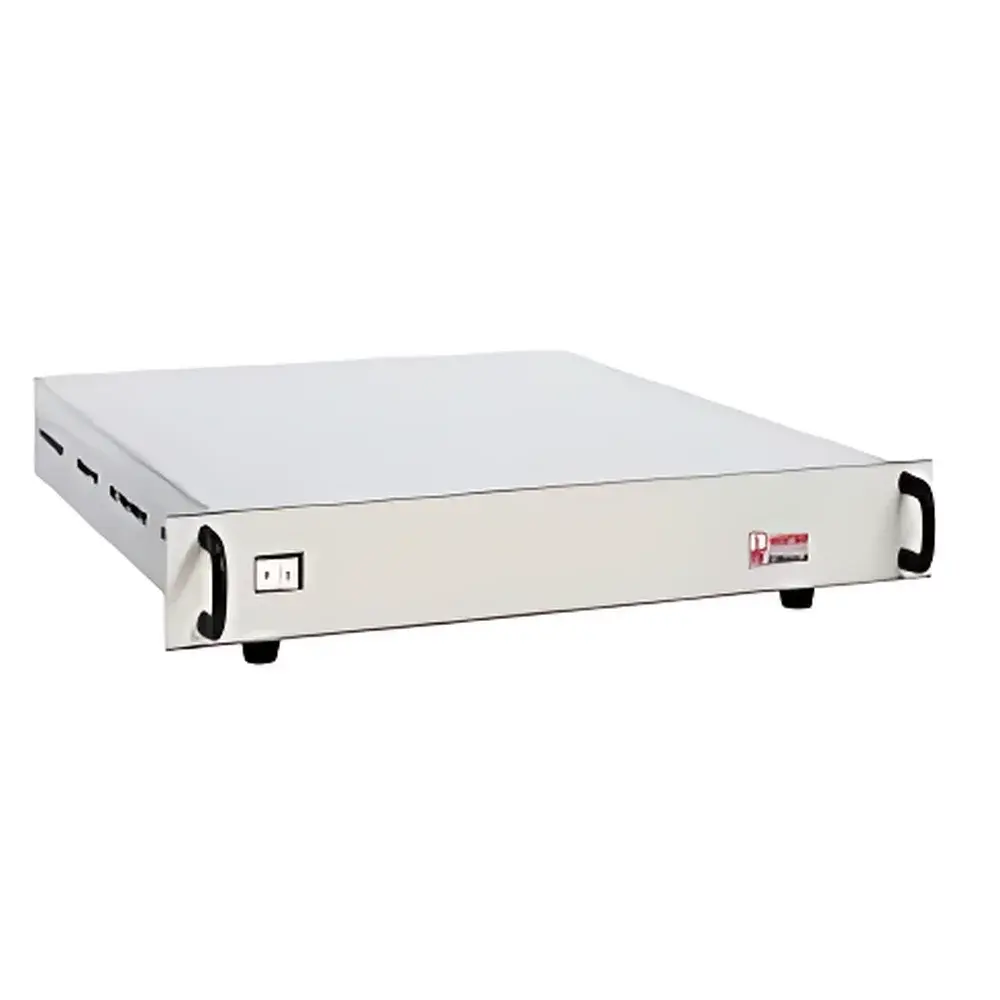
Wisman AME ±4 kV / 80 W High-Voltage Power Amplifier
| Brand | Wisman |
|---|---|
| Model | AME |
| Output Voltage Range | ±4 kV DC or AC peak |
| Output Power | 80 W |
| Output Current Range | ±20 mA DC or AC peak |
| Gain | 1000 V/V (DC) |
| Gain Accuracy | Better than 0.1% of full scale |
| Slew Rate | >35 V/μs (10%–90%) |
| Small-Signal Bandwidth | DC to 35 kHz (−3 dB) |
| Large-Signal Bandwidth | DC to 600 Hz (1% THD), DC to 13 kHz (−3 dB) |
| Output Noise | <50 mV RMS (voltage), <2 mV RMS (voltage monitor), <10 mV RMS (current monitor) |
| Stability | <50 ppm/h (non-cumulative) |
| Temperature Coefficient | <25 ppm/°C |
| Operating Temperature | 0–40 °C |
| Relative Humidity | ≤85% RH, non-condensing |
| Altitude Limit | ≤2000 m |
| Dimensions | 88 mm H × 432 mm W × 439 mm D |
| Weight | 7 kg |
| Input | 220 VAC ±10%, 1 A |
| Input Impedance (non-inverting) | 25 kΩ |
| Output Impedance | 47 Ω |
| Voltage Monitor Scale | 1000:1, accuracy >0.1% FS, offset <±2 mV |
| Current Monitor Scale | 1 V / 0.8 mA, accuracy >0.5% FS, offset <±5 mV |
| Quadrant Operation | Four-quadrant active output (source/sink) |
| Load Compatibility | Resistive, capacitive, and reactive loads |
| Protection | Short-circuit protected, over-temperature shutdown, current limiting |
Overview
The Wisman AME ±4 kV / 80 W High-Voltage Power Amplifier is a precision-engineered, fully solid-state high-voltage instrumentation amplifier designed for demanding laboratory and industrial applications requiring stable, low-noise, and dynamically responsive bipolar high-voltage excitation. Based on a four-quadrant active output architecture, the AME amplifier delivers both sourcing and sinking capability across its full ±4 kV output range—enabling precise control of highly capacitive, inductive, or complex-impedance loads without signal distortion or phase lag. Its core design adheres to rigorous electrostatic and dielectric insulation standards, with reinforced creepage and clearance distances compliant with IEC 61010-1 for measurement category CAT II environments. Unlike transformer-based or switched-mode HV sources, the AME employs linear amplification topology, ensuring ultra-low harmonic distortion (<1% THD at 600 Hz), exceptional DC stability (<50 ppm/h), and minimal residual noise (<50 mV RMS)—critical parameters for applications such as mass spectrometer ion optics biasing, ferroelectric hysteresis characterization, and electro-optic modulator drive.
Key Features
- Four-quadrant active output: Simultaneous voltage sourcing and current sinking up to ±20 mA, essential for driving reactive loads including piezoelectric actuators, electrophoretic cells, and plasma discharge electrodes.
- High dynamic performance: Slew rate exceeding 35 V/μs (10–90%) and small-signal bandwidth >35 kHz (−3 dB) support fast transient response in closed-loop feedback systems.
- Ultra-low output noise: <50 mV RMS broadband noise ensures minimal interference in sensitive detection pathways—particularly vital when biasing quadrupole or time-of-flight mass spectrometer lenses.
- Programmable DC stability: Drift <50 ppm/h (non-cumulative) and temperature coefficient <25 ppm/°C enable long-duration experiments under ambient lab conditions without recalibration.
- Integrated monitoring and protection: Dual calibrated analog monitors (voltage and current) with 1000:1 and 1 V/0.8 mA scaling respectively; short-circuit protection, thermal shutdown, and current limiting safeguard connected instrumentation.
- Robust mechanical and electrical design: Fully enclosed aluminum chassis (7 kg), conformal-coated PCBs, and reinforced high-voltage insulation rated for continuous operation at 2000 m altitude and 85% RH (non-condensing).
Sample Compatibility & Compliance
The AME amplifier is routinely deployed in configurations requiring precise, programmable, and galvanically isolated high-voltage biasing—including but not limited to: electrospray ionization (ESI) and matrix-assisted laser desorption/ionization (MALDI) source potentials, electrostatic lens arrays in TOF-MS systems, dielectric barrier discharge (DBD) reactors, and ferroelectric polarization loops (P–E hysteresis). It meets functional safety requirements per IEC 61010-1 (Edition 3.1) for laboratory use and supports traceable calibration workflows aligned with ISO/IEC 17025 principles. While not FDA 21 CFR Part 11–certified out-of-the-box, its analog monitoring outputs and stable analog control interface facilitate integration into GLP/GMP-compliant data acquisition systems when paired with validated DAQ hardware and audit-trail-enabled software.
Software & Data Management
The AME operates as an analog-controlled instrument: it accepts standard ±10 V input signals for voltage setpoint and features buffered analog monitor outputs compatible with third-party data acquisition systems (e.g., National Instruments PXI, Keysight DAQ970A, or LabVIEW-based custom platforms). No proprietary driver or firmware update is required. All operational parameters—including gain, offset, and monitor scaling—are factory-trimmed and documented in the supplied calibration certificate. For automated test sequencing, users integrate the AME into SCPI- or Modbus-enabled control racks via external DAC modules. The absence of embedded digital control logic eliminates firmware-related validation overhead—a key advantage in regulated QC laboratories performing USP analytical instrument qualification.
Applications
- Mass spectrometry: DC and AC-coupled biasing of ion guides, collision cells, and detector multipliers.
- Materials science: Polarization cycling of ferroelectrics, electromechanical testing of relaxor ceramics, and dielectric spectroscopy of polymers.
- Plasma physics: Sustained voltage control in atmospheric-pressure plasma jets and DBD ozone generators.
- Electrophoresis & microfluidics: High-voltage switching for capillary electrophoresis (CE) and droplet-based digital microfluidics.
- Electro-optics: Driving lithium niobate (LiNbO₃) modulators and spatial light modulators (SLMs) requiring sub-mV stability.
- Particle beam control: Steering and focusing of low-energy ion beams in compact accelerator test benches.
FAQ
Is the AME amplifier compatible with standard mass spectrometer control systems?
Yes—the AME accepts analog ±10 V input for setpoint control and provides isolated, calibrated voltage and current monitor outputs, enabling seamless integration with OEM mass spec control units equipped with analog I/O expansion modules.
Can the AME drive highly capacitive loads (>10 nF) without oscillation?
Yes—its four-quadrant active output stage and optimized compensation network maintain stability across load capacitances up to 100 nF, verified per manufacturer’s load-step transient testing report.
Does the unit include NIST-traceable calibration documentation?
Each AME amplifier ships with a factory calibration certificate listing measured gain error, offset, noise floor, and stability metrics—traceable to national standards via Wisman’s ISO/IEC 17025-accredited calibration laboratory.
What is the recommended maintenance schedule?
As a fully solid-state, convection-cooled design with no consumables or moving parts, the AME requires no scheduled maintenance; periodic verification of output accuracy (annually or per internal QA protocol) is advised.
Is remote monitoring supported via Ethernet or USB?
No—the AME is an analog-only instrument. Digital communication requires interfacing through external DAQ hardware; this architecture enhances electromagnetic compatibility (EMC) in RF-sensitive environments such as adjacent mass spectrometry labs.



