
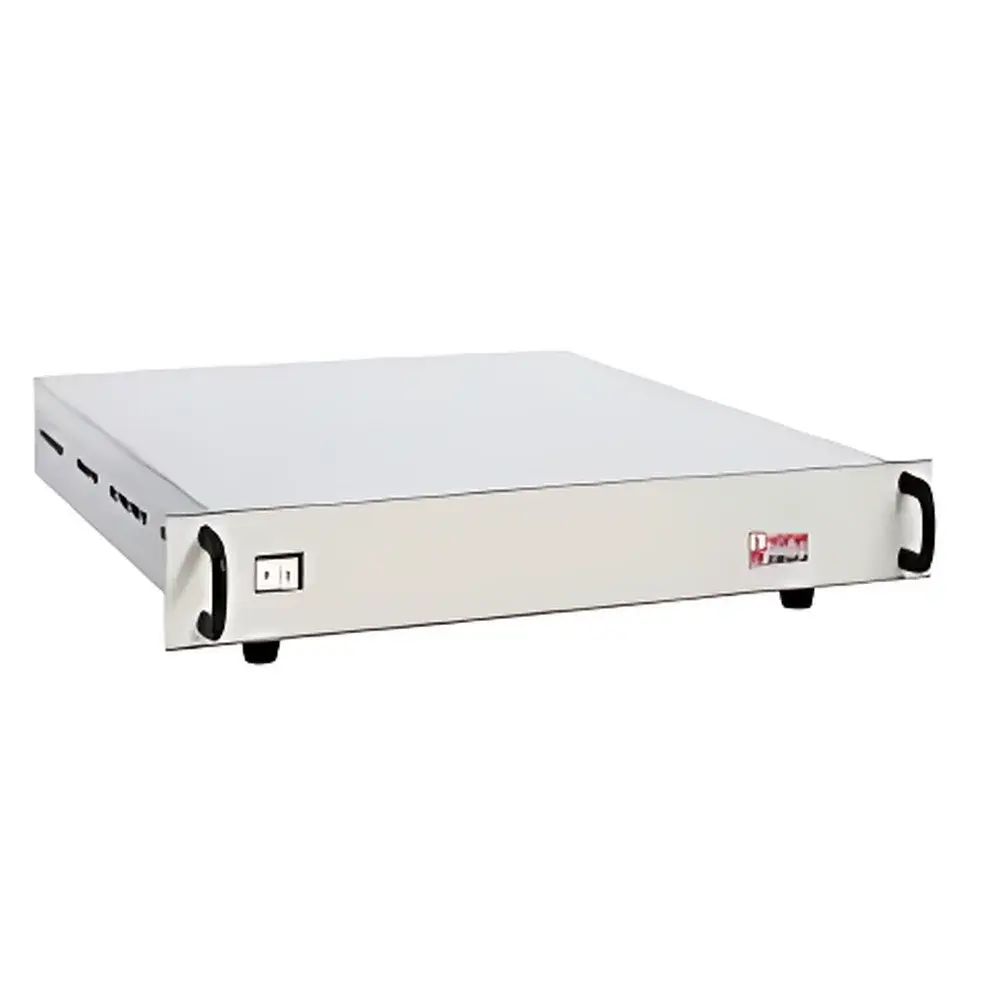
Wisman AMR ±20 kV / 20 W High-Voltage Power Amplifier
| Brand | Wisman |
|---|---|
| Model | AMR |
| Output Voltage Range | ±20 kV (DC or AC peak) |
| Output Power | 20 W |
| Output Current Range | ±2 mA (DC or AC peak) |
| Input Voltage | 220 VAC ±10% |
| Input Current | 1 A |
| DC Voltage Gain | 1000 V/V |
| Gain Accuracy | < 0.1% of full scale |
| Output Noise | < 2 mV RMS (voltage), < 10 mV RMS (current) |
| Slew Rate | > 35 V/µs (10%–90%) |
| Small-Signal Bandwidth | DC to 10 kHz (−3 dB) |
| Large-Signal Bandwidth | DC to 1.2 kHz (1% THD) |
| Stability | < 50 ppm/hr (non-cumulative) |
| Temperature Coefficient | < 25 ppm/°C |
| Operating Temperature | 0–40 °C |
| Relative Humidity | ≤85% RH (non-condensing) |
| Altitude Rating | ≤2000 m |
| Dimensions | 88 mm H × 432 mm W × 439 mm D |
| Weight | 7 kg |
| Input Impedance | 25 kΩ (non-inverting input) |
| Output Impedance | 47 Ω |
| Voltage Display Scale | 1000:1 (accuracy < 0.1% FS) |
| Current Display Scale | 1 V / 0.8 mA (accuracy < 0.5% FS) |
| Short-Circuit Protection | Active, programmable |
| Quadrants | Four-quadrant active output (sourcing & sinking) |
| Load Compatibility | Resistive, capacitive, and reactive loads |
| Compliance | CE-marked |
Overview
The Wisman AMR ±20 kV / 20 W High-Voltage Power Amplifier is a precision-engineered, fully solid-state instrument designed for demanding laboratory and industrial applications requiring stable, low-noise, high-slew-rate bipolar high-voltage excitation. Based on a four-quadrant active output architecture, the AMR amplifier delivers both sourcing and sinking current across its full ±20 kV output range—enabling precise control of dynamic, reactive, and highly capacitive loads typical in electro-optic modulation, ion beam steering, dielectric barrier discharge, and mass spectrometry interfaces. Unlike passive or transformer-based HV supplies, the AMR employs direct-coupled, wide-bandwidth operational topology with integrated feedback control, ensuring minimal phase lag and exceptional transient fidelity. Its design prioritizes long-term DC stability (< 50 ppm/hr), low thermal drift (< 25 ppm/°C), and robust immunity to load-induced oscillation—critical attributes for closed-loop polarization studies, ferroelectric hysteresis characterization, and time-resolved electrophoretic actuation.
Key Features
- Four-quadrant active output stage enabling bidirectional current flow (±2 mA) across the entire ±20 kV voltage range—essential for driving capacitive and reactive loads without external clamping or energy-dissipating circuits.
- Ultra-low output noise: < 2 mV RMS (voltage channel) and < 10 mV RMS (current monitoring channel), supporting high-fidelity signal reproduction in sensitive detection environments such as time-of-flight mass spectrometer ion optics.
- High slew rate (>35 V/µs, 10%–90%) combined with a small-signal bandwidth extending to 10 kHz (−3 dB) and large-signal bandwidth to 1.2 kHz (1% THD), facilitating accurate replication of fast-rising waveforms including square, ramp, and pulsed DC profiles.
- Programmable short-circuit protection with real-time current limiting—prevents damage during arcing events common in atmospheric plasma generation or dielectric testing.
- Integrated analog monitoring outputs for voltage (1000:1 scaling, <0.1% FS accuracy) and current (1 V / 0.8 mA scaling, <0.5% FS accuracy), compatible with data acquisition systems compliant with IEEE 1149.4 and IEC 61000-4-30 standards.
- Compact 19-inch rack-mountable chassis (7 kg, 88 × 432 × 439 mm) with forced-air cooling and conformal-coated PCBs for reliable operation at up to 2000 m altitude and 85% RH non-condensing humidity.
Sample Compatibility & Compliance
The AMR amplifier is routinely deployed in configurations requiring strict adherence to analytical instrument interface specifications—including OEM integration into quadrupole and time-of-flight mass spectrometer high-voltage subsystems (e.g., lens biasing, detector dynode chains, and collision cell potentials). Its output stability, low ripple, and programmable current limiting align with ASTM E2682-22 (Standard Practice for Calibration of High-Voltage Sources Used in Mass Spectrometry) and support traceable calibration under ISO/IEC 17025-accredited laboratories. The unit complies with CE marking requirements per EN 61326-1 (EMC) and EN 61010-1 (safety), and its analog I/O architecture supports audit-ready logging when interfaced with FDA 21 CFR Part 11–compliant SCADA platforms via optional digital control modules (e.g., RS-485 or Ethernet/IP).
Software & Data Management
While the AMR operates as a stand-alone analog amplifier, it is fully compatible with third-party control ecosystems via its 0–10 V analog input and calibrated monitor outputs. Users may integrate it into LabVIEW™, MATLAB® Data Acquisition Toolbox, or Python-based control frameworks using standard NI USB-6009 or similar DAQ hardware. Voltage and current monitor signals are referenced to chassis ground and isolated to ±500 V common-mode—enabling safe digitization in mixed-signal test benches. For regulated environments, the amplifier’s analog outputs can be logged with timestamped metadata (via NTP-synced DAQ systems) to satisfy GLP audit trails. No proprietary software or drivers are required; configuration is performed entirely through front-panel potentiometers and DIP-switch selectable gain modes.
Applications
- Mass spectrometry: Precision biasing of electrostatic lenses, reflectrons, and electron multipliers in benchtop and portable MS platforms.
- Ferroelectric and piezoelectric material characterization: Application of controlled bipolar fields for polarization-electric field (P–E) loop acquisition and domain switching analysis.
- Electro-optic modulation: Driving LiNbO₃ and PLZT modulators requiring fast, low-noise ±kV-level signals with sub-microsecond edge fidelity.
- Atmospheric pressure plasma sources: Sustaining dielectric barrier discharges (DBD) and plasma jets with programmable AC/DC superposition waveforms.
- Electrophoresis and microfluidics: High-voltage sequencing for chip-based capillary electrophoresis and droplet actuation in digital microfluidic arrays.
- Particle accelerator subsystems: Beam steering electrode excitation in compact ion trap and linear accelerator test stands.
FAQ
Is the AMR amplifier suitable for continuous DC operation at ±20 kV?
Yes—the AMR is rated for continuous DC output at full ±20 kV with active thermal management and current-limiting safeguards. Derating is not required below 40 °C ambient.
Can the AMR drive highly capacitive loads (e.g., >10 nF)?
Yes. Its four-quadrant output stage and >35 V/µs slew rate ensure stable step response into capacitive loads up to 100 nF, provided appropriate series resistance is used per application-specific arc mitigation guidelines.
Does the unit support remote digital control (e.g., via USB or Ethernet)?
The base model features analog-only interface. Optional digital interface modules (RS-485, Ethernet/IP) are available for OEM integration and require separate ordering.
What safety certifications does the AMR hold?
It carries CE marking per EN 61010-1 (measurement category II, pollution degree 2) and EN 61326-1. UL/cUL listing is available upon request for North American deployments.
How is calibration traceability maintained?
Voltage and current monitor outputs are factory-calibrated against NIST-traceable HV dividers and transimpedance standards. Calibration certificates with uncertainty budgets (k=2) are supplied with each unit.



