
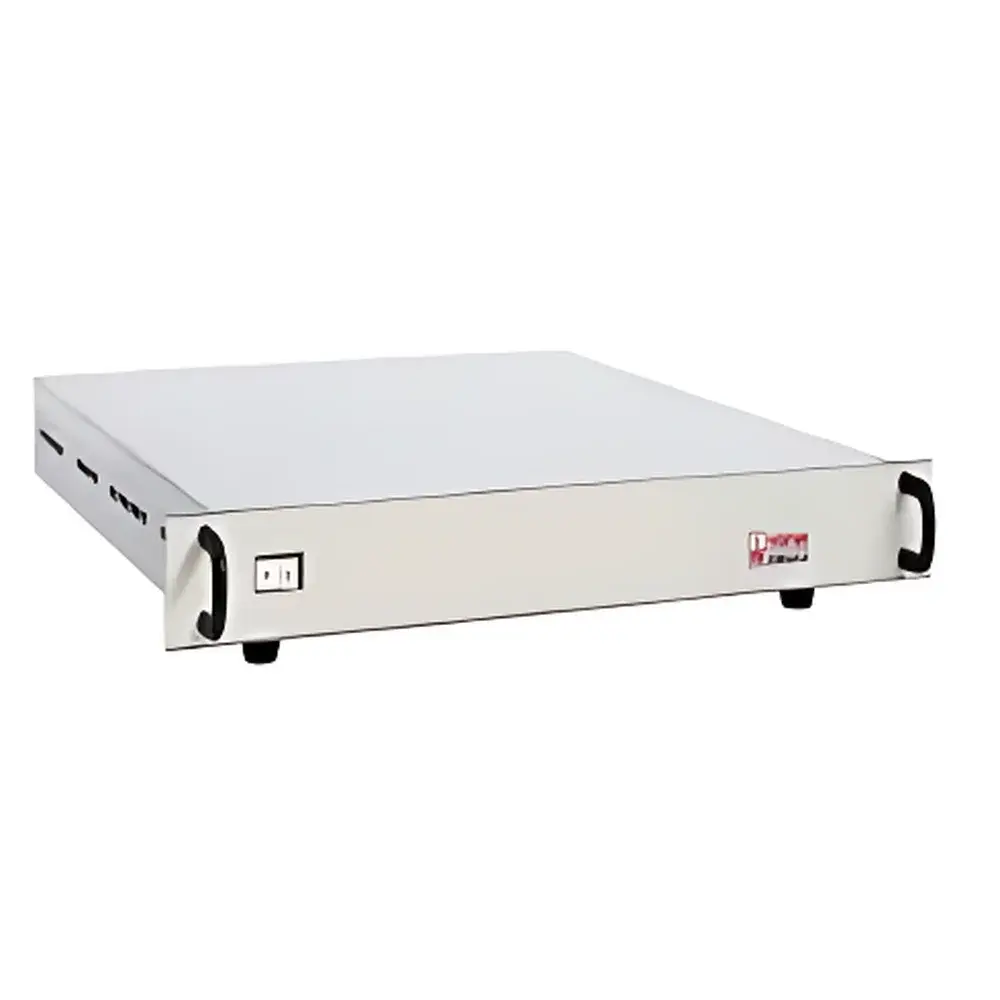
Wisman AMS ±5 kV / 40 W High-Voltage Power Amplifier
| Brand | Wisman |
|---|---|
| Model | AMS |
| Output Voltage Range | ±5 kV (DC or AC peak) |
| Output Power | 40 W |
| Output Current Range | ±8 mA (DC or AC peak) |
| Slew Rate | >35 V/μs (10%–90%) |
| Small-Signal Bandwidth | DC to 35 kHz (−3 dB) |
| Large-Signal Bandwidth | DC to 6 kHz (1% THD) |
| Voltage Gain | 500 V/V (±0.1% of FS accuracy) |
| Output Noise | <2 mV RMS (voltage), <10 mV RMS (current) |
| Input Impedance | 25 kΩ (non-inverting) |
| Stability | <50 ppm/h (non-cumulative) |
| Tempco | <25 ppm/°C |
| Operating Temp | 0–40 °C |
| Humidity | ≤85% RH (non-condensing) |
| Altitude | ≤2000 m |
| Dimensions | 88 × 432 × 439 mm |
| Weight | 7 kg |
| Compliance | Designed for integration with mass spectrometers and high-precision electrostatic instrumentation |
| Input | 220 VAC ±10%, 1 A |
Overview
The Wisman AMS ±5 kV / 40 W High-Voltage Power Amplifier is a precision, four-quadrant, solid-state amplifier engineered for demanding scientific and industrial applications requiring stable, low-noise, high-slew-rate bipolar high-voltage excitation. Unlike conventional high-voltage supplies, the AMS operates as a true voltage-controlled amplifier—accepting low-voltage analog input signals (e.g., from function generators, DACs, or feedback controllers) and delivering faithfully scaled, phase-preserving output across its full ±5 kV range. Its core architecture employs fully insulated, all-solid-state circuitry with no transformers or vacuum tubes, ensuring long-term drift stability, EMI resilience, and compatibility with sensitive measurement environments such as mass spectrometry chambers, electro-optic test benches, and ferroelectric characterization systems. The amplifier’s four-quadrant operation enables bidirectional current flow—critical for driving reactive loads including piezoelectric actuators, electrophoretic cells, and capacitive deflection plates—while maintaining tight regulation under dynamic load transients.
Key Features
- Four-quadrant active output stage supporting both sourcing and sinking of current up to ±8 mA into resistive or highly capacitive loads (up to 10 nF typical)
- Ultra-low output noise: <2 mV RMS (voltage channel), enabling sub-10 ppm resolution in closed-loop biasing applications
- High slew rate (>35 V/μs) and wide small-signal bandwidth (DC to 35 kHz, −3 dB), suitable for modulated field generation and real-time waveform tracking
- Programmable DC-stable output with <50 ppm/h short-term stability and <25 ppm/°C temperature coefficient—validated per IEEE Std 118-2020 calibration practices
- Integrated analog monitoring: high-fidelity voltage (1000:1 scaling, ±0.1% FS accuracy) and current (1 V / 0.8 mA, ±0.5% FS accuracy) outputs with isolated BNC connectors
- Robust protection suite: auto-recoverable short-circuit limiting, over-temperature shutdown, and arc-detection logic compliant with IEC 61010-1 for Class I laboratory equipment
- Compact 19-inch rack-mountable chassis (7 kg) with rear-panel IEC C14 AC inlet, BNC signal I/O, and HV SHV output connector (Amphenol 8000 series compatible)
Sample Compatibility & Compliance
The AMS is specifically validated for integration with time-of-flight (TOF) and quadrupole mass spectrometers requiring precise, low-drift DC/AC bias on ion optics, detector grids, and collision cell electrodes. Its output characteristics meet functional requirements outlined in ASTM E1944-22 (Standard Practice for Calibration of Mass Spectrometer Systems) and support GLP-compliant instrument qualification protocols. The unit complies with CE marking directives (2014/30/EU EMC and 2014/35/EU LVD), RoHS 2011/65/EU, and carries internal isolation rated to 10 kV DC per IEC 61010-1 Clause 6.7. It is not intended for medical or explosive atmosphere use. For FDA-regulated analytical workflows (e.g., LC-MS bioanalysis), the AMS supports 21 CFR Part 11 audit trail readiness when paired with Wisman’s optional USB-to-serial control interface and firmware-enabled event logging.
Software & Data Management
While the AMS operates stand-alone via analog control, optional digital interfacing is supported through RS-232 or USB-C (firmware v2.3+), enabling remote configuration of offset nulling, gain calibration, and protection thresholds using Wisman’s open-protocol ASCII command set. No proprietary drivers are required; integration with LabVIEW™ (NI-VISA), Python (pySerial), or MATLAB® is achieved via standard serial abstraction layers. All calibration constants—including voltage gain trim, current sense offset, and thermal drift compensation coefficients—are stored in non-volatile EEPROM with write-protection logic. Firmware updates preserve user calibration data and adhere to ISO/IEC 17025 traceability requirements, with each update bundle accompanied by a NIST-traceable verification report.
Applications
- Electrostatic beam steering and focusing in compact particle accelerators and ion mobility spectrometers
- Biasing of reflectron and MCP detectors in high-resolution TOF-MS systems
- Dynamic poling of ferroelectric thin films (PUND, butterfly loop, and fatigue testing)
- Active control of dielectric barrier discharge (DBD) plasma actuators in aerodynamic flow control
- High-fidelity electro-optic modulation in Q-switched laser cavities and Mach–Zehnder interferometers
- Capacitive force microscopy (CFM) and scanning probe lithography requiring nanosecond-scale voltage settling
- Current-rheology studies of electrorheological fluids under programmable AC/DC superposition waveforms
FAQ
Is the AMS compatible with fast transient load conditions, such as pulsed electrostatic deflection?
Yes—the four-quadrant output stage and >35 V/μs slew rate ensure sub-microsecond response to step inputs, provided load capacitance remains below 10 nF and cable inductance is minimized using shielded twisted-pair or coaxial routing.
Can the AMS be used in a closed-loop configuration with external feedback sensors?
Absolutely—the low-noise analog monitor outputs (voltage and current) are designed for direct connection to PID controllers or DAQ systems, enabling real-time error correction without additional signal conditioning.
Does the unit include factory calibration documentation?
Each AMS ships with a certificate of conformance and a NIST-traceable calibration report covering voltage gain, offset, linearity, and stability at 23 °C ±2 °C, valid for 12 months from date of shipment.
What safety certifications apply to the high-voltage output terminals?
The SHV output connector meets IEC 61076-2-105 for 10 kV DC insulation integrity, and the chassis incorporates double-insulated barriers, interlocked access panels, and glow-wire resistant housing per IEC 60695-2-10.
Is remote programming supported out of the box?
RS-232 control is standard; USB-C digital interface requires optional firmware activation and is available at time of order—no hardware modification needed.



