
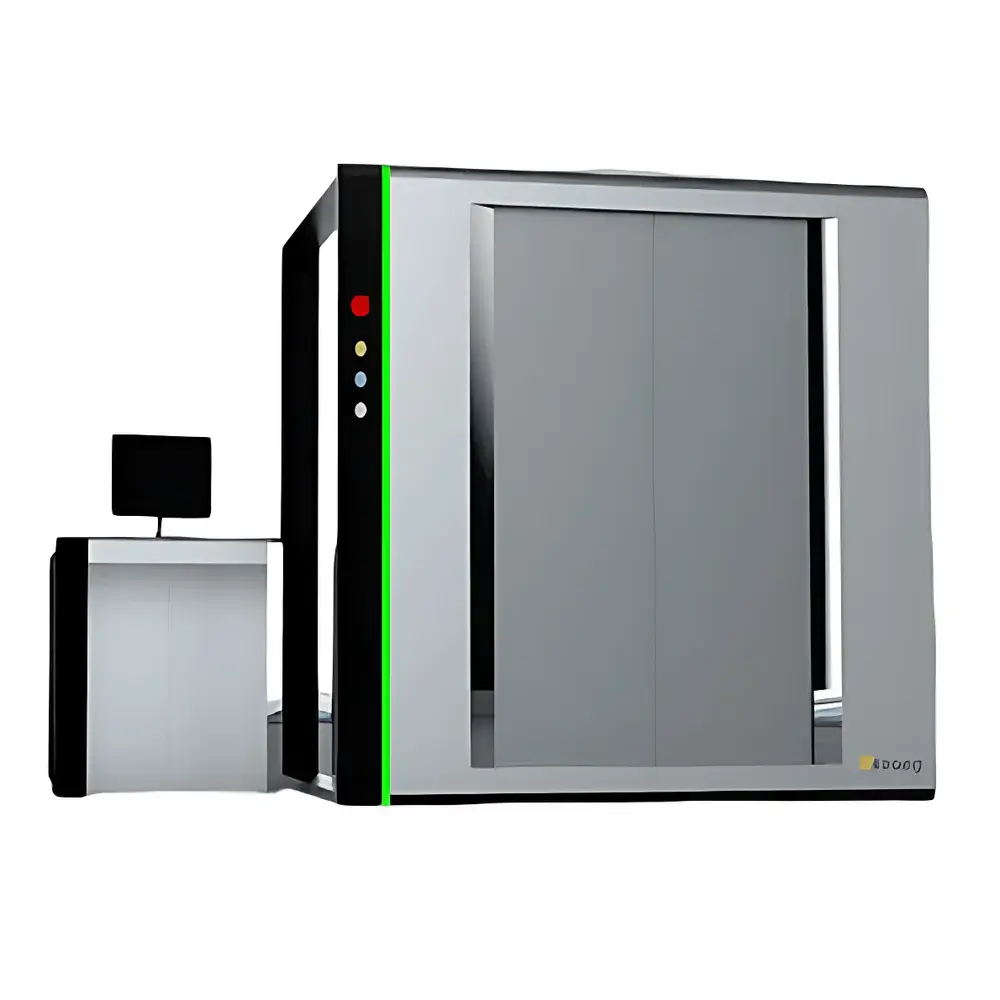
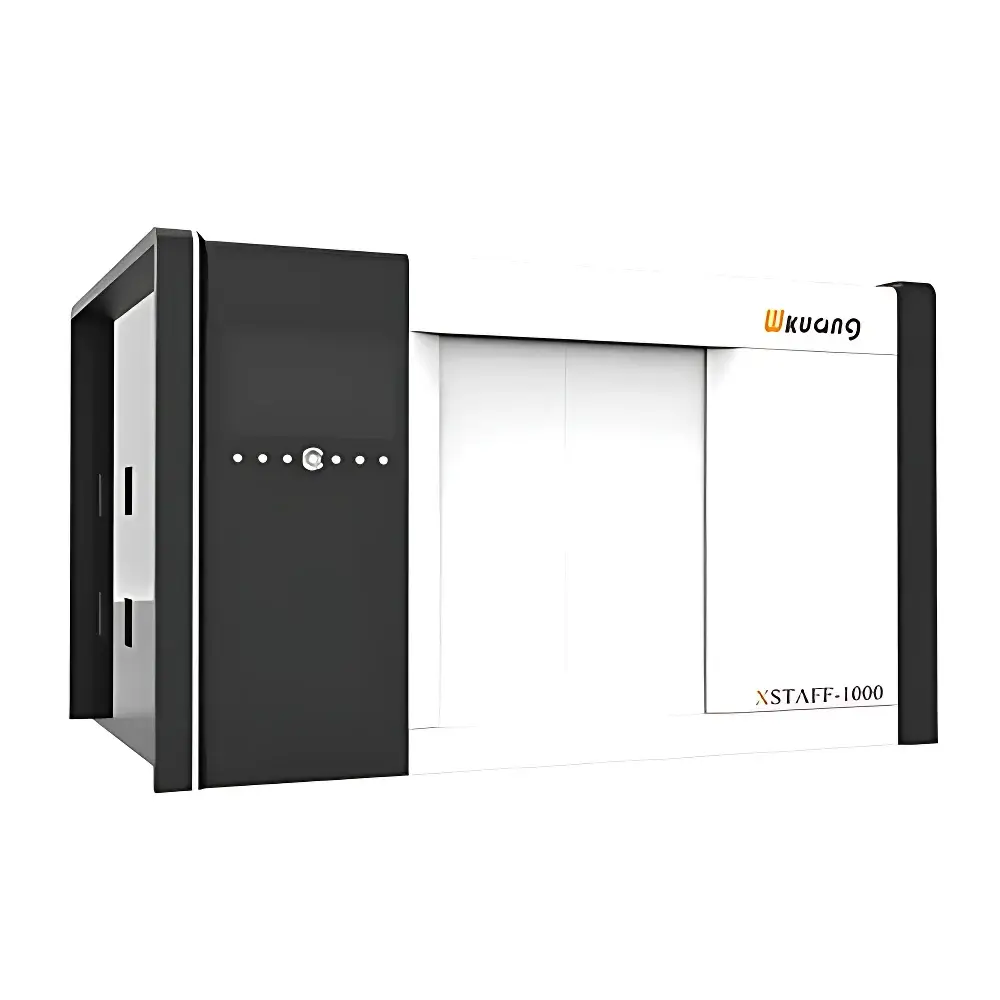
Wkuang XSTAFF-1000 Industrial Micro-CT System
| Brand | Wkuang |
|---|---|
| Origin | Jiangsu, China |
| Manufacturer Type | Authorized Distributor |
| Country of Origin | China |
| Model | XSTAFF-1000 |
| Quotation | Upon Request |
| Spatial Resolution | ≥3 µm |
| Maximum Sample Dimensions | Ø400 mm × H400 mm |
| Maximum Sample Weight | 50 kg |
Overview
The Wkuang XSTAFF-1000 is a high-performance industrial micro-computed tomography (micro-CT) system engineered for non-destructive, high-fidelity 3D volumetric imaging of medium-to-high density components. It operates on the principle of cone-beam X-ray computed tomography, utilizing a high-stability microfocus X-ray source (<5 µm focal spot size) and a high-dynamic-range flat-panel detector to acquire projection data from multiple angular positions. Reconstruction is performed via filtered back-projection (FBP) or iterative algorithms (e.g., SART, OS-SART), delivering isotropic voxel resolutions down to ≤3 µm — enabling sub-surface defect characterization, pore network analysis, and dimensional metrology traceable to ISO 12716 and ASTM E1441 standards. Designed for integration into production-integrated quality assurance workflows, the system supports both offline inspection and inline-capable deployment in R&D labs and Tier-1 manufacturing environments.
Key Features
- Microfocus X-ray source with <5 µm focal spot size and stable kV/mA output for consistent contrast across dense materials (e.g., aluminum alloys, sintered ceramics, packaged ICs)
- Spatial resolution ≥3 µm (measured per ISO 15739:2013 using line-pair test objects under optimal geometry)
- Large-format sample chamber accommodating specimens up to Ø400 mm × 400 mm height and 50 kg mass — compatible with castings, battery modules, composite laminates, and orthopedic implants
- Multi-mode acquisition architecture supporting fast 2D radiography, 2.5D laminography, and full 3D helical/step-and-shoot CT scanning
- Modular mechanical platform with standardized flanges and I/O interfaces for seamless integration of in situ loading stages (tensile/compressive, thermal, electrochemical)
- Onboard AI-powered defect detection engine trained on domain-specific datasets — including porosity, inclusions, delamination, and solder voids — compliant with ISO/IEC 17025 data integrity requirements
Sample Compatibility & Compliance
The XSTAFF-1000 accommodates a broad spectrum of industrial samples without requiring destructive sectioning or conductive coating. Verified compatibility includes: die-cast aluminum housings (A380, ADC12), lithium-ion pouch and prismatic cells (NMC, LFP chemistries), SiC power modules, polymer-based medical devices (PEEK spinal cages), and additively manufactured Ti-6Al-4V lattice structures. All system firmware and reconstruction pipelines comply with ISO 10360-8 (CT-based dimensional measurement accuracy) and support audit-ready operation under GLP and GMP frameworks. Radiation safety conforms to IEC 61000-6-4 (EMC) and national Class II X-ray device licensing requirements (China NMPA, equivalent to FDA 21 CFR 1020.40).
Software & Data Management
Control, reconstruction, and analysis are unified within Wkuang’s proprietary CTStudio v4.x software suite — a Windows-based application certified for 64-bit multi-threaded processing and GPU-accelerated FDK reconstruction. The software provides DICOM 3.0 export, VGStudio MAX-compatible project interchange, and native support for ISO/IEC 17025-compliant metadata embedding (including operator ID, calibration timestamp, exposure parameters). Audit trail functionality logs all user actions, parameter changes, and reconstruction events with SHA-256 hashing and optional LDAP/Active Directory authentication. Raw projection data is stored in HDF5 format with embedded EXIF-style headers, ensuring long-term FAIR (Findable, Accessible, Interoperable, Reusable) compliance.
Applications
- Failure analysis of automotive powertrain castings — quantifying shrinkage porosity distribution relative to fatigue crack initiation sites (ASTM E1559)
- Electrode-level structural integrity assessment in EV battery cells — measuring calendering-induced density gradients and separator wrinkling under compression
- Dimensional validation of microfluidic PDMS devices and MEMS packaging — achieving ±(2.5 + L/100) µm uncertainty (L in mm) per VDI/VDE 2630-2.1
- In situ 4D-CT studies: real-time monitoring of crack propagation in nickel superalloys at 800°C using integrated furnace stage; stress-corrosion cracking evolution in stainless steel under simulated PWR coolant chemistry
- Reverse engineering of legacy aerospace components where CAD data is unavailable — generating watertight STL meshes with <0.02 mm surface deviation
FAQ
What is the minimum detectable feature size for metallic samples?
Under optimized scan geometry (magnification ≥2.5×, integration time ≥200 ms/projection), the system resolves features ≥3 µm in Al-alloy samples and ≥5 µm in stainless steel (316L) at 180 kV.
Does the system support automated batch scanning for production QA?
Yes — CTStudio includes scriptable workflow automation (Python API) and barcode-triggered job queues, enabling unattended overnight scanning of up to 24 parts per run.
Is raw projection data accessible for third-party reconstruction?
All sinogram data is exported in open HDF5 format with complete geometric calibration metadata, fully compatible with commercial (e.g., Thermo Scientific Avizo, Bruker SkyScan CTAn) and open-source (TomoPy, ASTRA Toolbox) reconstruction platforms.
Can the system be upgraded to support in situ mechanical testing?
Yes — the base platform includes pre-aligned mounting interfaces and 12 V/5 A auxiliary power rails; Wkuang’s certified in situ stages (tensile up to 50 kN, thermal up to 1200°C) are field-installable with factory recalibration.
How is measurement traceability maintained?
Each system ships with NIST-traceable step wedges and sphere phantoms; annual verification follows ISO/IEC 17025 procedures documented in the supplied Certificate of Conformance and Measurement Uncertainty Report.



