
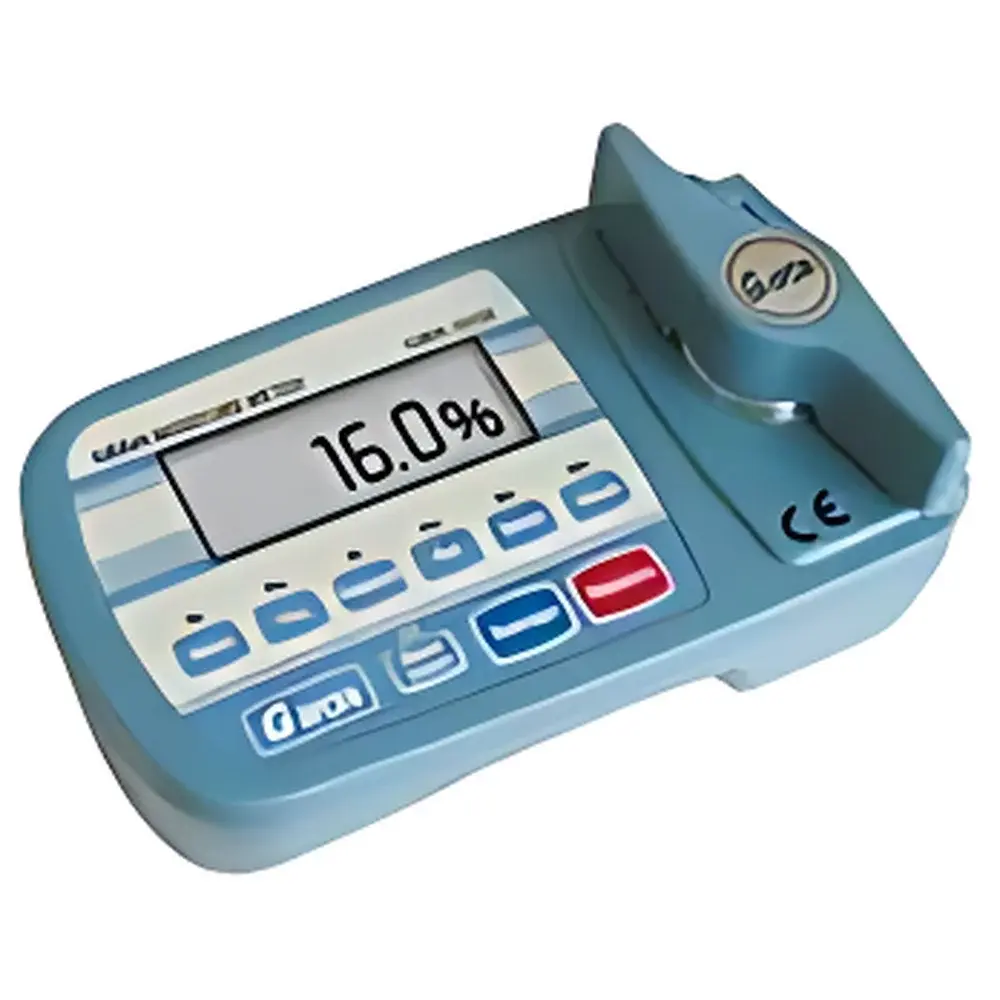
G-WON GMK-303A Capacitance-Based Grain Moisture Analyzer
| Brand | G-WON |
|---|---|
| Origin | South Korea |
| Model | GMK-303A |
| Measurement Principle | Capacitance Method |
| Sample Types | Rice, Paddy, Dried Paddy, Soybean, Barley, Wheat, Corn/Maize |
| Moisture Range (by crop) | Rice: 8.3–26.0% |
| Paddy | 8.5–40.0% |
| Dried Paddy | 6.8–29.8% |
| Soybean | 8.5–21.5% |
| Barley | 8.3–35.0% |
| Wheat | 8.5–35.0% |
| Corn/Maize | 8.7–22.8% |
| Accuracy | ±0.5% w/w |
| Display | Digital LCD |
| Temperature Compensation | Automatic |
| Power Supply | 4 × 1.5 V AA batteries |
| Dimensions | 164 × 94 × 40 mm (L × W × H) |
| Weight | ~1.5 kg |
Overview
The G-WON GMK-303A Capacitance-Based Grain Moisture Analyzer is a portable, field-deployable instrument engineered for rapid, non-destructive moisture quantification in bulk cereal grains and oilseeds. It operates on the dielectric principle—measuring changes in capacitance induced by water content within the grain matrix—enabling real-time assessment without sample grinding or oven drying. Unlike loss-on-drying (LOD) methods, the GMK-303A delivers results in under 10 seconds per measurement, supporting high-throughput decision-making at grain receiving points, storage facilities, and farm-level quality checkpoints. Its design adheres to fundamental metrological requirements for agricultural moisture testing, with calibration traceability aligned to reference gravimetric procedures per ISO 712:2022 (Cereals and cereal products — Determination of moisture content — Reference method). The instrument is not intended for regulatory submission of final compliance data but serves as a validated screening tool for process control and pre-shipment verification.
Key Features
- Capacitance sensing architecture optimized for heterogeneous grain kernels—minimizing density and particle-size interference through multi-frequency signal processing
- Auto-ranging calibration curves preloaded for seven major commodities: rice, paddy, dried paddy, soybean, barley, wheat, and corn/maize
- Integrated temperature compensation algorithm correcting for ambient thermal drift across 0–40 °C operating range
- Digital LCD display with backlight for low-light field conditions; intuitive single-button operation with audible confirmation tone
- Robust ABS housing rated IP54 for dust and splash resistance; ergonomic form factor designed for one-handed use during silo sampling or truck-side inspection
- Battery-powered operation (4 × AA, 1.5 V) enabling >2,000 measurements per set with low-power sleep mode and auto-shutdown after 2 minutes of inactivity
Sample Compatibility & Compliance
The GMK-303A is validated for intact, unground kernels meeting standard grading criteria (e.g., USDA FGIS or ISO 7216 for grain sizing). It is unsuitable for milled flour, cracked grain, or mixed-species batches unless recalibrated using representative composite standards. While not certified to ISO/IEC 17025 for accredited testing laboratories, its performance aligns with the repeatability requirements of ASTM D4940-21 (Standard Guide for Conducting Moisture Testing in Field Applications) when used per manufacturer-specified sampling protocols—including minimum fill volume (≥80 mL), consistent compaction, and avoidance of surface moisture contamination. No regulatory filings (e.g., FDA 510(k), CE marking under EU MDR) apply, as the device falls outside medical or safety-critical instrumentation scope.
Software & Data Management
The GMK-303A is a standalone hardware unit with no embedded memory, USB interface, or wireless connectivity. All measurements are displayed in real time only; no data logging, export, or audit trail functionality is provided. This architecture intentionally supports GLP-aligned environments where measurement integrity relies on operator documentation—users are expected to record readings manually in bound logbooks or LIMS-integrated forms. For traceability, each unit ships with a factory calibration certificate listing nominal moisture values for five reference grain lots, verified against AOAC 985.22-compliant oven-dry validation.
Applications
- Pre-storage moisture verification to prevent mold proliferation and mycotoxin formation during bulk warehousing
- Buyer–seller settlement at elevator intake, ensuring contractual moisture limits (e.g., ≤14.0% for U.S. No. 2 wheat) are met prior to weighing
- On-farm drying optimization—monitoring grain exiting continuous-flow dryers to minimize energy overuse and kernel fissuring
- Quality assurance during feed mill ingredient receipt, particularly for soybean and corn lots susceptible to rancidity at elevated moisture
- Extension service support for smallholder cooperatives requiring rapid, battery-operated tools compatible with off-grid infrastructure
FAQ
Does the GMK-303A require periodic recalibration?
Yes—annual verification against gravimetric standards is recommended. Users should perform daily zero checks using the supplied dry-air reference capsule and revalidate calibration curves every 90 days if used >50 times per week.
Can it measure moisture in frozen or chilled grain?
No. Measurements below 0 °C invalidate temperature compensation and introduce condensation artifacts. Samples must be equilibrated to ambient temperature (15–35 °C) prior to analysis.
Is the instrument suitable for organic-certified operations?
Yes—the device introduces no chemical reagents, heat, or physical alteration; it complies with NOP (7 CFR Part 205) and EU Organic Regulation (EC No. 834/2007) requirements for non-invasive quality monitoring.
What maintenance is required?
Routine cleaning of the sensor chamber with a dry, lint-free cloth after each use; battery replacement every 6–12 months depending on usage frequency; no lubrication or internal servicing is permitted.
How does capacitance-based measurement compare to NIR analyzers?
Capacitance offers superior robustness in high-dust, high-humidity environments and lower acquisition cost, though NIR provides broader multi-parameter capability (protein, oil, starch). The GMK-303A prioritizes ruggedness and simplicity over spectral versatility.






