
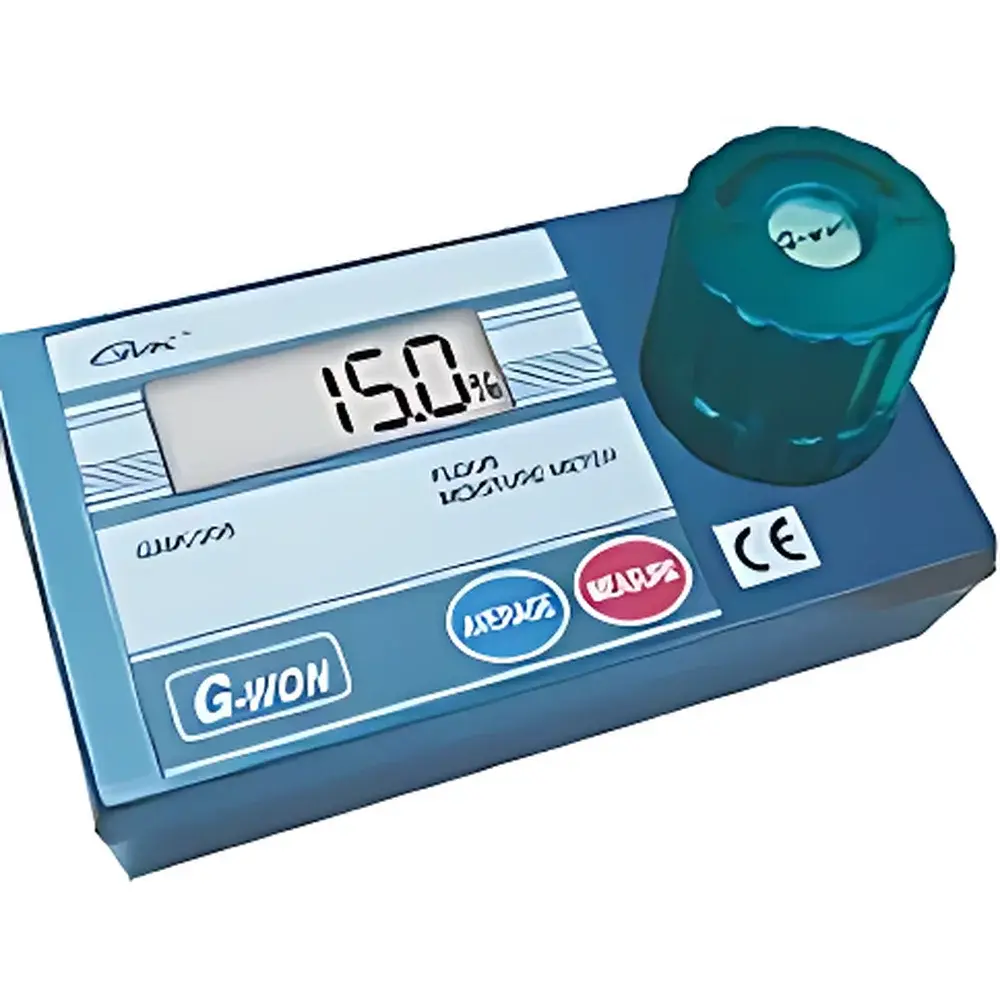
G-WON GMK-308 Capacitance-Based Flour Moisture Analyzer
| Brand | G-WON |
|---|---|
| Origin | South Korea |
| Model | GMK-308 NEW |
| Measurement Principle | Capacitance Dielectric Sensing |
| Target Matrices | Wheat flour, cassava starch, chili powder, sweet potato starch, potato starch, corn starch |
| Moisture Range (w/w%) | 8.5–23.5% (wheat), 10.5–23.0% (cassava), 8.5–21.5% (chili powder), 9.5–21.0% (sweet potato starch), 12.5–23.1% (potato starch), 13.5–22.7% (corn starch) |
| Resolution | 0.1% |
| Accuracy | ±0.5% |
| Power Supply | 4 × 1.5 V AA batteries |
Overview
The G-WON GMK-308 Capacitance-Based Flour Moisture Analyzer is a handheld, field-deployable instrument engineered for rapid, non-destructive moisture quantification in dry particulate food matrices. It operates on the principle of dielectric capacitance sensing—measuring changes in the material’s relative permittivity (εr) induced by water content, which correlates linearly with moisture mass fraction within calibrated ranges. Unlike oven-drying or Karl Fischer titration, this method delivers results in under 10 seconds without sample preparation, heating, or chemical reagents. Designed specifically for grain millers, starch processors, spice blenders, and QC laboratories handling high-volume inbound/outbound raw materials, the GMK-308 supports routine compliance checks against internal specifications and industry benchmarks such as ISO 712:2022 (Cereals and cereal products — Determination of moisture content — Reference method) and AACC Method 44-15A (Moisture—Air-Oven Method), though it is not intended as a primary reference method. Its robust mechanical design, sealed keypad, and low-power architecture ensure reliable operation in ambient factory, warehouse, or mobile inspection environments.
Key Features
- Capacitance-based dielectric measurement with factory-calibrated curves for six major commodity powders: wheat flour, cassava starch, chili powder, sweet potato starch, potato starch, and corn starch.
- Automatic temperature compensation algorithm integrated into firmware to minimize drift across ambient conditions (10–35 °C operating range).
- Self-diagnostic startup sequence verifies sensor integrity, battery voltage, and internal calibration stability prior to each measurement cycle.
- One-touch measurement initiation with automatic endpoint detection and hold function—no user timing or interpretation required.
- On-device statistical processing: calculates and displays mean moisture value across up to 9 sequential readings with standard deviation indication.
- Intelligent power management including auto-sleep after 60 seconds of inactivity and low-battery warning with dedicated indicator icon.
- Compact, ergonomic housing with IP54-rated ingress protection against dust and splashing water—suitable for production floor use.
Sample Compatibility & Compliance
The GMK-308 is validated for homogeneous, free-flowing, low-fat (<2% w/w), low-salt (<0.5% w/w), and low-fiber (<3% w/w) milled products. Performance accuracy (±0.5% w/w) assumes uniform particle size distribution (D50 5% oil content or salted seasonings). While not certified to GLP or FDA 21 CFR Part 11, its audit-ready features—including timestamped measurement logs (via optional PC interface), traceable calibration history, and tamper-evident diagnostics—support alignment with HACCP prerequisite programs and internal quality system requirements per ISO 22000. Users are advised to perform periodic verification using gravimetric reference measurements per AOAC 950.46 or local regulatory equivalents.
Software & Data Management
The GMK-308 operates as a standalone instrument with no embedded memory or wireless connectivity. All measurement data remains on-device only during active session; no persistent storage is implemented to maintain simplicity and reduce validation burden. Optional RS-232 serial output (via accessory cable) enables real-time transmission of moisture values, timestamps, and batch IDs to external LIMS or SCADA systems. Compatible terminal software (Windows-based, provided separately) supports CSV export, trend charting, and basic SPC analysis (X-bar/R charts). Firmware updates are delivered via proprietary USB-to-serial adapter and require authorized service technician access—ensuring configuration integrity in regulated environments.
Applications
- Pre-shipment verification of flour moisture before bagging or bulk loading to prevent caking and microbial risk during transit.
- In-process monitoring of starch drying lines to optimize energy consumption and avoid over-drying-induced viscosity loss.
- Receiving inspection of imported chili powder to flag non-conforming lots exceeding 21.5% moisture—associated with mold growth and aflatoxin risk.
- Storage stability assessment of sweet potato starch stored under variable humidity conditions.
- Batch release testing in contract manufacturing facilities producing gluten-free baked goods where moisture affects dough rheology and shelf life.
- Field audits conducted by third-party certification bodies (e.g., BRCGS, FSSC 22000) requiring rapid, repeatable moisture screening at point-of-origin.
FAQ
Is the GMK-308 compliant with ISO/IEC 17025 for accredited testing?
No—the instrument is designed for process control and specification screening, not as a reference-grade analytical tool. Accredited labs must validate its performance against their own uncertainty budgets and documented SOPs.
Can I add custom calibration curves for other materials?
No—calibration parameters are fixed and factory-programmed. Only the six preloaded matrices are supported; no user-editable curve functionality exists.
What is the recommended calibration verification frequency?
Perform daily verification using a stable, low-moisture reference standard (e.g., anhydrous sodium sulfate) before first use and after any environmental shock or battery replacement.
Does the device require annual recalibration by the manufacturer?
G-WON recommends biennial verification against NIST-traceable moisture standards at an authorized service center; full recalibration is not typically required unless diagnostic faults are reported.
How does capacitance-based measurement compare to near-infrared (NIR) analyzers?
Capacitance offers superior repeatability for dense, low-porosity powders but lacks NIR’s multi-analyte capability (e.g., protein, ash); NIR requires more complex modeling and is sensitive to particle size heterogeneity.
Related Products






