
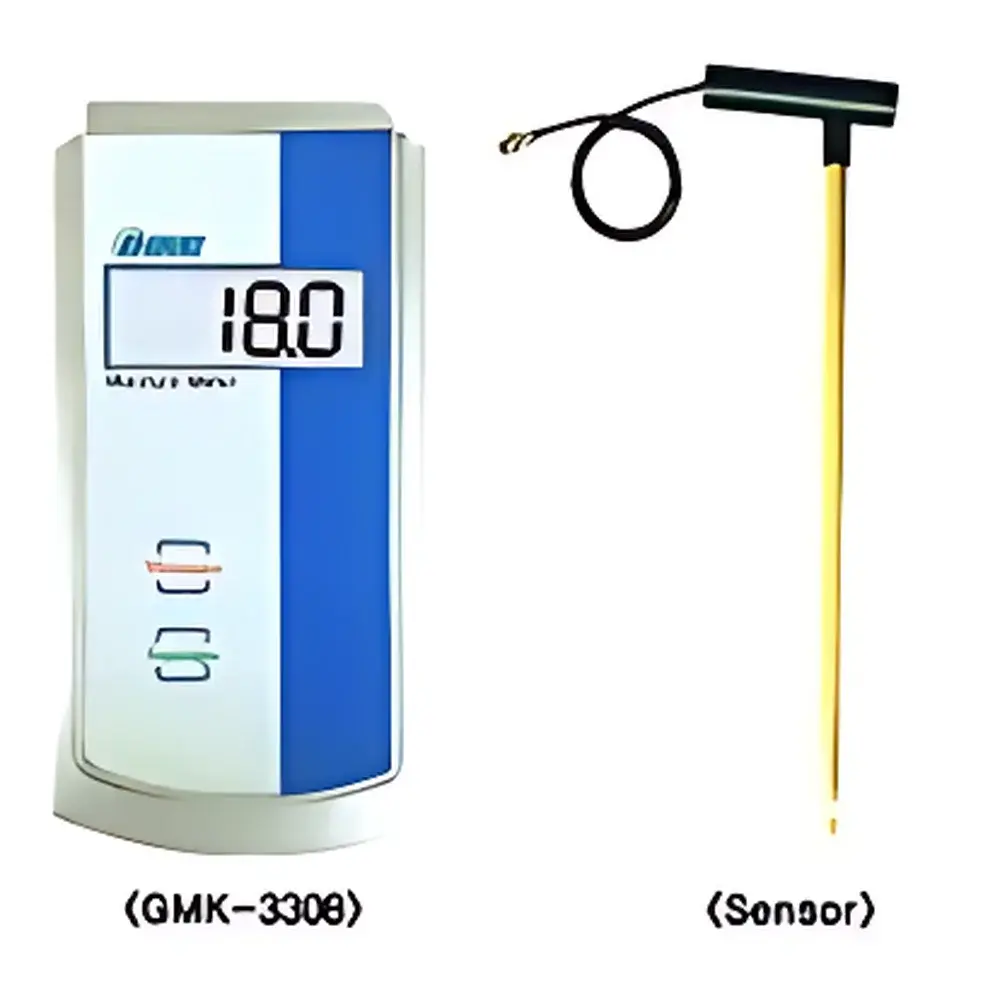
G-WON GMK-3308 Advanced Capacitance-Based Hay Moisture Analyzer
| Brand | G-WON |
|---|---|
| Origin | South Korea |
| Model | GMK-3308 |
| Measurement Range (Hay) | 12.0–41.5% w/w |
| Resolution | 0.1% |
| Accuracy | ±0.5% |
| Measurement Time | ~3 s |
| Temperature Compensation | Automatic |
| Calibration | Fully Automated Self-Calibration Routine |
| Display | Large LCD |
| Power Supply | 9 V alkaline battery (1 pc) |
| Instrument Dimensions | 170 × 85 × 36 mm (L×W×H) |
| Sensor Length | 430 mm |
| Net Weight | ~2.0 kg |
Overview
The G-WON GMK-3308 Advanced Capacitance-Based Hay Moisture Analyzer is a portable, field-deployable instrument engineered for rapid, non-destructive moisture quantification in bulk hay and cured tobacco bales. It operates on the principle of radio-frequency capacitance measurement—where dielectric permittivity of the sample, directly correlated to its water content, modulates the resonant frequency of an embedded LC oscillator circuit. Unlike resistive or thermal methods, capacitance-based sensing minimizes interference from surface moisture, salt content, or minor density variations common in heterogeneous agricultural matrices. The GMK-3308 is specifically calibrated for hay (including alfalfa, timothy, and mixed grasses) and air-cured tobacco leaf, with traceable calibration curves validated against ASTM D4442 (Standard Test Methods for Direct Moisture Content of Wood and Wood-Based Materials) and ISO 4471:2017 (Animal feeding stuffs — Determination of moisture content). Its compact form factor and battery-powered operation enable real-time decision-making during baling, storage, and pre-shipment quality checks—critical for preventing mold growth, spontaneous combustion, and nutritional degradation.
Key Features
- Automated self-calibration sequence: Executes a full internal reference check prior to each measurement cycle; invalidates readings if sensor drift or environmental deviation exceeds preset thresholds—ensuring metrological integrity without user intervention.
- Real-time temperature compensation: Integrates a high-stability NTC thermistor adjacent to the sensing probe to dynamically adjust permittivity-to-moisture conversion coefficients across –10 °C to +50 °C ambient range.
- Dedicated hay-specific algorithm: Preloaded calibration matrix optimized for fiber density, particle size distribution, and typical moisture gradients observed in compressed forage materials (12.0–41.5% w/w).
- Large backlit LCD display: 128 × 64 pixel monochrome screen with high-contrast characters, readable under direct sunlight or low-light barn conditions.
- Intelligent power management: Auto-shutdown after 5 minutes of inactivity; low-battery indicator activates when voltage drops below 7.2 V, preserving data integrity and preventing erroneous readings due to insufficient supply.
- Ergonomic probe design: 430 mm stainless-steel insertion rod with tapered tip enables consistent penetration depth control into bale cores while minimizing mechanical damage to fibrous material.
Sample Compatibility & Compliance
The GMK-3308 is validated for use with uncompressed and field-baled hay (square and round), as well as air-cured tobacco leaves in both loose and bundled configurations. It complies with Good Agricultural Practice (GAP) documentation requirements for moisture verification at harvest and post-curing stages. While not intended for regulatory submission under FDA 21 CFR Part 11, its automated calibration log (stored internally) supports GLP-aligned recordkeeping when paired with external lab notebooks. The instrument meets IEC 61000-4-2 (ESD immunity) and IEC 60529 IP54 enclosure rating for dust and splash resistance—suitable for farmyard, warehouse, and transport environments.
Software & Data Management
The GMK-3308 operates as a standalone unit with no PC connectivity or firmware update capability. All calibration parameters, measurement history (last 99 readings), and timestamped calibration events are retained in non-volatile memory. Data export is manual via visual transcription; however, the device supports structured reporting by enabling users to assign batch IDs using the keypad interface prior to measurement. For enterprise-level traceability, integration with third-party LIMS platforms is achievable through optional barcode-scanning accessories (sold separately), allowing linkage of moisture values to lot numbers, harvest dates, and storage locations.
Applications
- On-site bale moisture verification prior to stacking or wrapping—reducing risk of anaerobic spoilage and mycotoxin formation.
- Quality control during hay trading: Ensuring contractual moisture limits (e.g., ≤20% for premium alfalfa) are met before loading.
- Tobacco curing house monitoring: Tracking moisture decline during air-drying phases to optimize leaf elasticity and aroma retention.
- Research applications: Supporting agronomy trials evaluating drying rate models, preservative efficacy, or climate impact on forage dehydration kinetics.
- Insurance and claims assessment: Providing auditable, repeatable moisture evidence for weather-related loss evaluations.
FAQ
Does the GMK-3308 require periodic recalibration by a certified lab?
No. Its automated self-calibration routine—executed before every measurement—eliminates the need for external recalibration under normal operating conditions. Only physical damage to the probe or exposure to extreme electromagnetic fields warrants service verification.
Can it measure moisture in wet or frozen hay?
No. The instrument is designed for cured, ambient-temperature hay (≥0 °C). Ice crystals disrupt dielectric response; surface condensation must be wiped prior to insertion.
Is the 0.1% resolution statistically meaningful across the full range?
Yes—resolution is maintained per ASTM E2025 guidance for field moisture meters. However, stated accuracy (±0.5%) reflects combined uncertainty from sensor repeatability, temperature effects, and sample heterogeneity—not digitization precision alone.
What happens if automatic calibration fails?
The display shows “CAL ERROR” and inhibits measurement initiation until successful calibration is achieved—preventing non-compliant data generation.
How often should the 9 V battery be replaced?
Under typical usage (≤50 measurements/day), battery life exceeds 12 months. Voltage drop below 7.2 V triggers persistent low-power warning; continued use may compromise calibration stability.






