
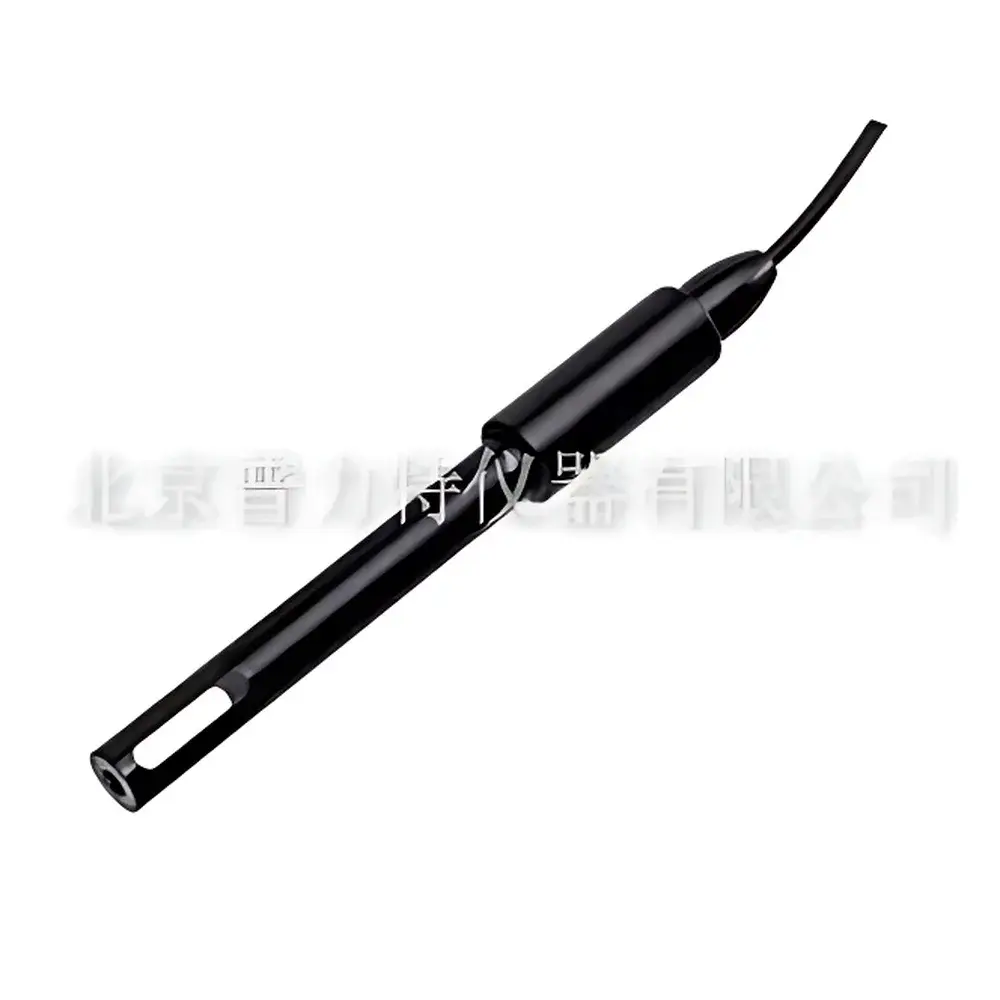
WQ-COND Conductivity Sensor
| Origin | USA |
|---|---|
| Manufacturer Type | Authorized Distributor |
| Origin Category | Imported |
| Model | WQ-COND |
| Instrument Type | Online Water Quality Analyzer |
| Price Range | USD $1,350 – $4,050 (FOB) |
Overview
The WQ-COND Conductivity Sensor is a high-reliability, four-electrode inline conductivity transducer engineered for continuous, field-deployable water quality monitoring in diverse hydrological environments—including freshwater streams, lakes, rivers, groundwater wells, estuarine zones, and marine coastal systems. It operates on the principle of conductometric measurement: applying an alternating current across four stainless steel electrodes to eliminate polarization effects and electrode fouling, thereby ensuring stable, drift-free readings across wide ionic strength gradients. The sensor integrates a precision thermistor-based temperature probe co-located with the conductivity cell, enabling real-time temperature compensation to standard reference conditions (25 °C) per ASTM D1125 and ISO 7888. Its robust titanium-alloy housing and pressure-rated sealing support submersion up to 25 meters (35 psi), while its compact cylindrical form factor (22 mm × 202 mm) minimizes flow disturbance and facilitates deployment in narrow boreholes or turbulent surface waters.
Key Features
- Four-electrode conductivity cell architecture for enhanced accuracy, reduced polarization error, and extended service life in high-fouling or variable-salinity environments
- Integrated Pt1000-class thermistor with ±0.2 °C accuracy and <20-second 99% thermal response time
- Dual isolated 4–20 mA analog outputs—one for compensated conductivity (at 25 °C), one for raw temperature—fully compliant with industrial process control standards (IEC 61000-6-2/4, NAMUR NE43)
- Ocean-grade 7.6 m primary cable (extendable to 150 m via shielded twisted-pair), rated for UV resistance, seawater immersion, and mechanical abrasion
- Hermetically sealed electronics compartment with IP68 ingress protection and operational stability from –5 °C to +70 °C ambient
- Pressure-compensated design validated to 35 psi (equivalent to 25 m static water column), suitable for long-term submerged installation
- Low-power operation: 20 mA base draw + output loop current; compatible with 10–36 VDC power supplies common in remote telemetry stations and solar-powered data loggers
Sample Compatibility & Compliance
The WQ-COND is optimized for aqueous matrices ranging from ultrapure freshwater (0–200 μS/cm) to hypersaline brines (200–2000 mS/cm), covering five user-selectable ranges with automatic range-switching logic. Its electrode geometry and excitation frequency minimize errors from capacitive coupling, colloidal interference, or redox-active species. The sensor meets key regulatory and methodological requirements for environmental compliance monitoring, including EPA Method 120.1 (Conductivity), ASTM D5391 (Standard Test Method for Electrical Conductivity of Water), and ISO 7888:2012 (Water quality — Determination of electrical conductivity). All materials in direct contact with sample water—electrodes, O-rings, and housing—are certified non-leaching per USP Class VI and NSF/ANSI Standard 61 for drinking water system components.
Software & Data Management
While the WQ-COND operates as a standalone analog transducer, it is fully interoperable with industry-standard SCADA, PLC, and environmental data acquisition platforms (e.g., Campbell Scientific CR series, HOBO RX3000, Siemens Desigo CC, and ABB Ability™). Its dual 4–20 mA outputs support direct integration into legacy analog infrastructures without protocol translation. For digital traceability and audit readiness, pairing with a data logger featuring GLP/GMP-compliant metadata tagging (time-stamped calibration events, sensor ID, temperature-corrected values) ensures alignment with FDA 21 CFR Part 11 requirements where applicable. Optional firmware-enabled diagnostics—including electrode impedance monitoring and self-test flagging—can be accessed via HART-compatible interface modules.
Applications
- Real-time salinity tracking in estuarine mixing zones and tidal monitoring networks
- Groundwater intrusion detection in coastal aquifers and managed aquifer recharge (MAR) facilities
- Effluent discharge compliance monitoring at municipal wastewater treatment plants (WWTPs)
- Process control of reverse osmosis (RO) and deionized (DI) water loops in pharmaceutical and semiconductor manufacturing
- Long-term ecological observatories measuring baseflow conductivity as a proxy for solute flux and land-use impact
- Autonomous buoy-based oceanographic profiling systems requiring low-power, corrosion-resistant sensing
FAQ
What calibration protocols are recommended for the WQ-COND?
Standard two-point calibration using traceable KCl standards (e.g., 1413 μS/cm and 12.88 mS/cm at 25 °C) is advised prior to deployment and after extended field exposure. In-situ zero-point verification with deionized water is not recommended due to air saturation and surface contamination artifacts.
Can the sensor be used in oil-contaminated or highly turbid water?
Yes—the four-electrode design mitigates coating-related drift better than two-electrode cells. However, routine mechanical cleaning (e.g., soft brush or ultrasonic bath) is required if biofilm or particulate accumulation exceeds 50 µm thickness.
Is the 7.6 m cable length fixed, or can custom lengths be ordered?
Standard delivery includes 7.6 m of marine-grade cable; custom lengths up to 150 m are available with factory-terminated connectors and full continuity/insulation resistance testing.
Does the sensor support digital communication protocols such as Modbus or SDI-12?
No—the WQ-COND is analog-only. For digital integration, pair with a signal conditioner or data logger supporting 4–20 mA input and internal linearization algorithms.
How often should field recalibration be performed?
Under stable conditions, quarterly verification is sufficient; in high-fouling or rapidly changing salinity environments (e.g., stormwater outfalls), monthly calibration is recommended per ISO/IEC 17025 quality management guidelines.
Related Products







