
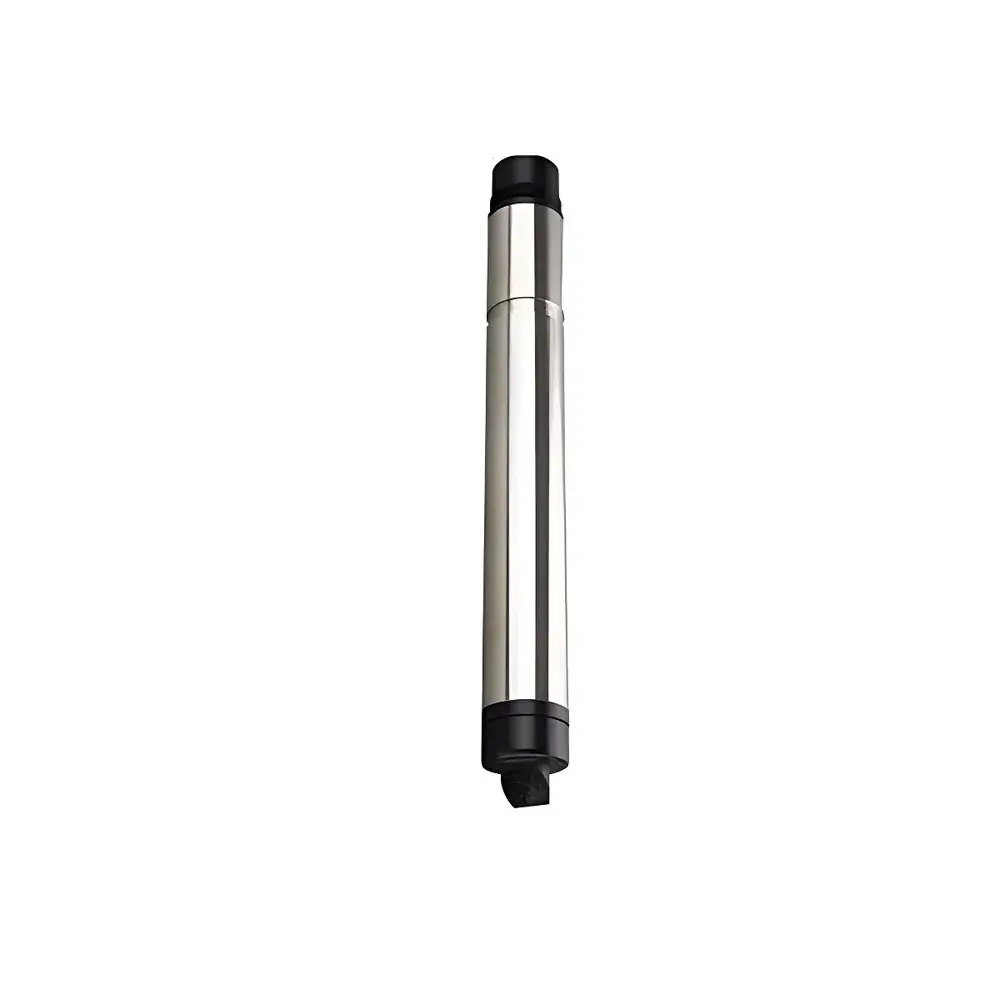
WTW FDO Optical Dissolved Oxygen Probe
| Brand | WTW |
|---|---|
| Origin | Germany |
| Model | FDO |
| Measurement Principle | Fluorescence-based (dynamic quenching) |
| Detection Parameter | Dissolved Oxygen (DO) |
| Instrument Type | Online Water Quality Analyzer |
| Compliance | Designed for continuous monitoring in wastewater treatment and environmental applications |
| Calibration | Factory-calibrated smart sensor with embedded calibration chip (IQMC) |
| Optical System | Dual-path EPRS (Equal Path Reference System) |
| Light Source | Green LED (GLT technology) |
| Sensor Geometry | 45° beveled tip for bubble rejection |
| Operating Environment | Aqueous media, activated sludge, surface water, and effluent streams |
Overview
The WTW FDO Optical Dissolved Oxygen Probe is an industrial-grade, maintenance-optimized sensor engineered for continuous, high-stability dissolved oxygen (DO) measurement in demanding aquatic environments. Unlike electrochemical (Clark-type) sensors, the FDO employs a fluorescence lifetime-based detection principle grounded in Stern–Volmer quenching kinetics. At the probe tip, a proprietary oxygen-permeable optical membrane is impregnated with a ruthenium-based fluorescent dye. When excited by a pulsed green LED (GLT technology), the dye emits red photoluminescence; molecular oxygen acts as a dynamic quencher, shortening the fluorescence decay time in direct proportion to its partial pressure in the sample. This lifetime measurement—rather than intensity—is inherently insensitive to light source drift, photodetector aging, or fouling-induced signal attenuation, delivering long-term stability without routine recalibration.
Key Features
- IQMC (Intelligent Quick Measurement & Calibration) Technology: Each optical cap is individually calibrated at the factory against traceable NIST-standard gas mixtures. Calibration coefficients—including temperature compensation parameters—are permanently stored on an integrated EEPROM chip within the cap, enabling plug-and-play replacement without manual reconfiguration.
- EPRS (Equal Path Reference System): A symmetrical dual-optical-path architecture ensures identical optical path lengths for both measurement and reference channels. This design actively compensates for gradual degradation of LEDs, photodiodes, and optical coatings over time—maintaining measurement integrity across the sensor’s full service life (typically >2 years under continuous operation).
- GLT (Green Light Technology): Utilizes a 520 nm green excitation source instead of conventional blue/violet LEDs. Lower photon energy minimizes photobleaching of the fluorophore, extending optical cap service life up to 18–24 months—even in high-UV or high-chlorine environments such as chlorinated effluent or UV disinfection basins.
- 45° Beveled Tip Geometry: The angled sensing surface disrupts laminar boundary layer formation and prevents air bubble entrapment—a common cause of erroneous low-reading artifacts in submerged installations. This feature is especially critical in aerated bioreactors and return activated sludge (RAS) lines where intermittent gas entrainment occurs.
- Robust Mechanical Design: IP68-rated housing with PEEK body and titanium or Hastelloy C-276 wetted parts ensures compatibility with aggressive wastewater matrices, including high-sulfide, high-salinity, and abrasive suspended solids conditions.
Sample Compatibility & Compliance
The FDO probe is validated for use in raw influent, primary clarifier effluent, aerobic and anoxic zones of activated sludge systems, membrane bioreactors (MBRs), and final effluent discharge points. It meets the operational requirements of ISO 5814:2012 (Water quality — Determination of dissolved oxygen — Electrochemical probe method) for optical alternatives, and supports GLP/GMP-aligned data integrity when paired with WTW IQ SensorNet or IDS-compatible controllers. While not a standalone regulatory instrument, its performance characteristics align with EPA Method 360.1 (for DO verification) and ASTM D888-12 (Standard Test Methods for Dissolved Oxygen in Water) when used within defined matrix limits (TDS < 20 g/L, turbidity < 400 NTU, H₂S < 2 mg/L).
Software & Data Management
The FDO integrates natively into WTW’s IQ SensorNet platform and third-party SCADA/DCS systems via Modbus RTU or RS-485. Real-time DO output is provided as a linear 4–20 mA analog signal or digital ASCII string, with optional temperature-compensated % saturation and mg/L outputs. Firmware updates and diagnostic logs—including cap usage hours, signal-to-noise ratio history, and membrane integrity alerts—are accessible via WTW LabX software or browser-based IQ Link interface. Audit trails comply with FDA 21 CFR Part 11 requirements when deployed with IQ SensorNet’s user-role management and electronic signature modules.
Applications
- Real-time DO control in aerobic digesters and sequencing batch reactors (SBRs)
- Process optimization in denitrification/anammox zones requiring sub-0.5 mg/L DO setpoints
- Effluent compliance monitoring per local discharge permits (e.g., EU Urban Wastewater Treatment Directive)
- Drinking water distribution system reservoir dechlorination endpoint detection
- Research-grade DO profiling in limnological and estuarine field studies using portable IQ portable meters
FAQ
Does the FDO require zero-point or span calibration during routine operation?
No. Due to IQMC and EPRS, the sensor operates without field calibration for up to 12 months—provided the optical cap remains intact and unsoiled. Verification against air-saturated water or certified standard solutions is recommended quarterly for QA/QC documentation.
Can the FDO be used in seawater or brackish water?
Yes—the probe housing and optical cap are chemically resistant to chloride concentrations up to 35 g/L. Salinity compensation is automatically applied via integrated temperature and conductivity inputs (when connected to compatible transmitters).
What is the typical lifetime of the optical cap?
Under standard municipal wastewater conditions, the GLT-enabled cap maintains metrological validity for 18–24 months. In high-UV or high-oxidant environments (e.g., post-ozonation), replacement intervals may reduce to 12 months.
Is the FDO compatible with non-WTW controllers?
Yes—via standard 4–20 mA output or Modbus RTU protocol. Full digital functionality (e.g., cap diagnostics, firmware updates) requires WTW IQ SensorNet or IDS-series transmitters.
How does the 45° tip improve measurement reliability compared to flat-tipped probes?
The bevel eliminates stagnant microzones where bubbles adhere, ensuring uninterrupted optical contact between the membrane and bulk liquid—critical for fast-response control loops in aerated tanks with fluctuating gas holdup.







