
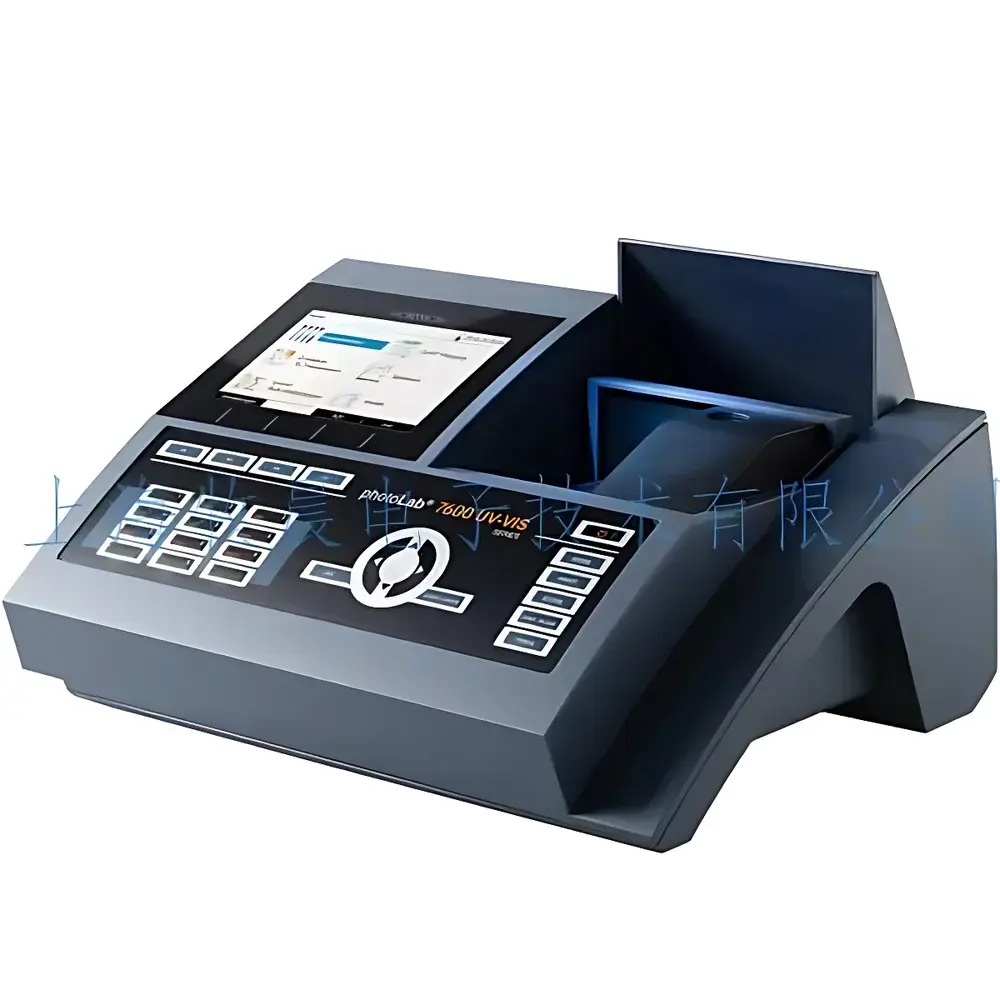
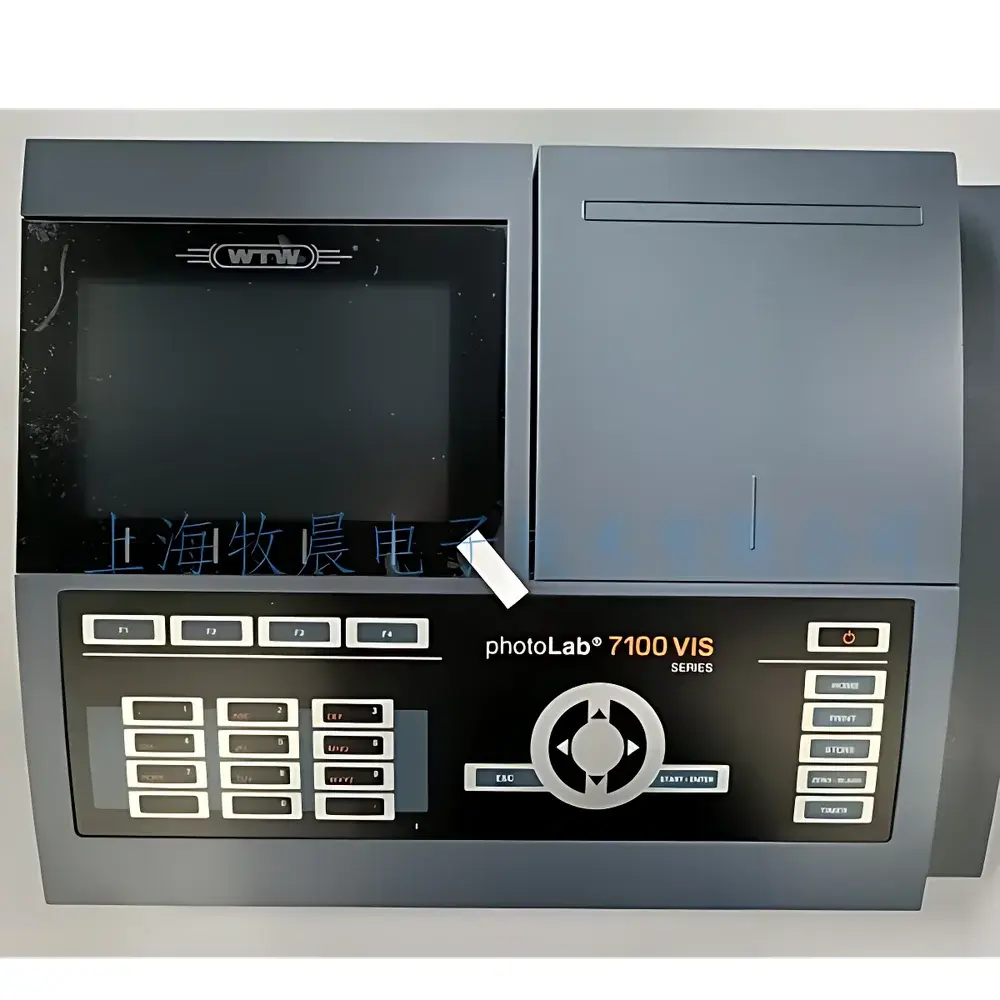
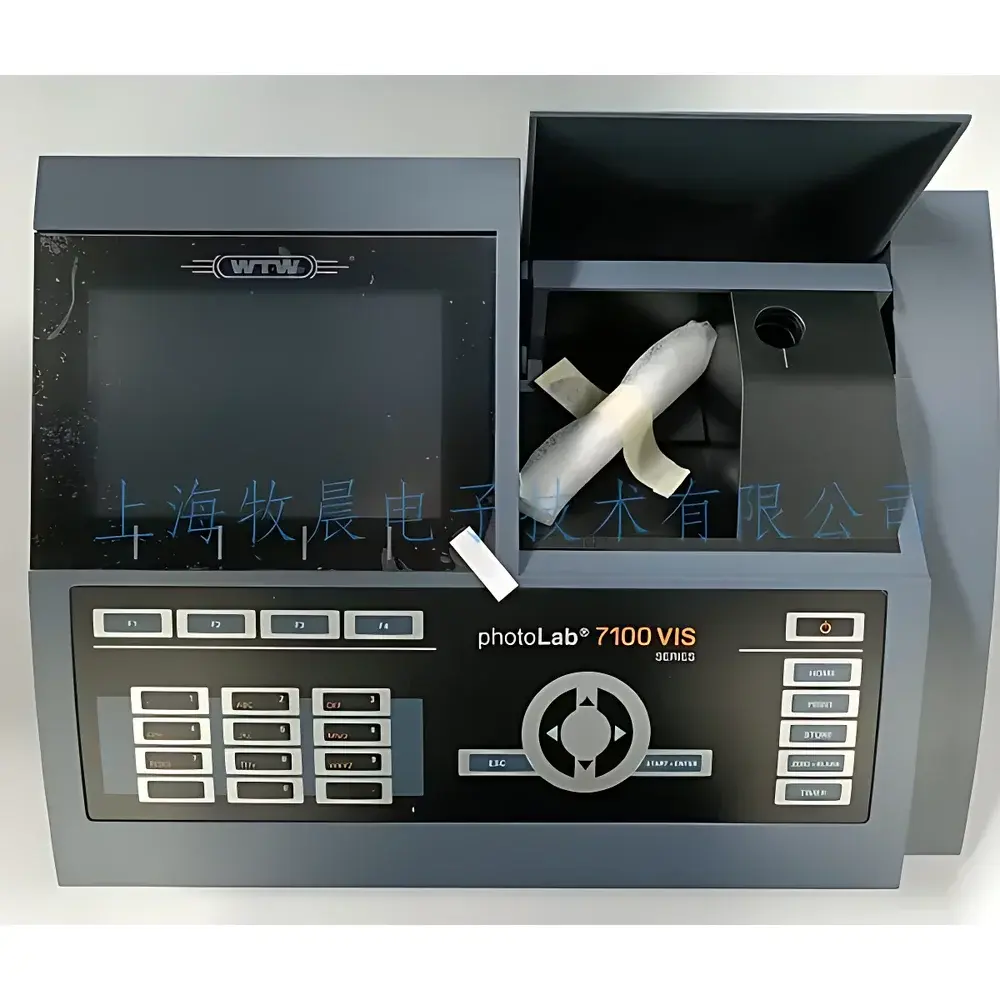
WTW photoLab 7100 VIS Benchtop Visible Spectrophotometer
| Brand | WTW |
|---|---|
| Origin | Germany |
| Model | photoLab 7100 VIS |
| Optical Design | Single-beam |
| Detector | CCD (Charge-Coupled Device) |
| Wavelength Range | 320–1100 nm |
| Wavelength Accuracy | ±1.0 nm |
| Wavelength Repeatability | < 0.5 nm |
| Spectral Bandwidth | 4 nm |
| Stray Light | ≤0.01% T |
| Display | 7″ backlit color touchscreen |
| Sample Holders | Auto-identifying 16 mm round, 10/20/50 mm rectangular cuvettes with barcode recognition |
| Data Storage | 5,000 measurement values, 500 spectra, 400 kinetic curves |
| Built-in Methods | >230 preprogrammed test protocols (e.g., free chlorine, nitrate, phosphate, COD) |
| Custom Methods | Up to 1,000 user-defined calibration curves |
| Reagent-Free Tests | >50 methods requiring no chemical reagents |
| Interface | 1× USB-A, 1× USB-B, 1× Ethernet |
| Compliance | Designed for GLP/GMP-aligned workflows |
Overview
The WTW photoLab 7100 VIS is a benchtop visible spectrophotometer engineered for precision, reproducibility, and operational efficiency in routine laboratory analysis. Based on single-beam optical architecture with a tungsten-halogen light source and high-resolution CCD detector, it delivers quantitative absorbance, transmittance, and concentration measurements across the 320–1100 nm spectral range—covering the full visible spectrum and extending into near-UV and near-NIR regions. Its core measurement principle relies on Beer–Lambert law-based photometric analysis, where sample absorbance at defined wavelengths correlates linearly with analyte concentration under controlled pathlength and matrix conditions. The instrument integrates a motorized monochromator with step-motor-driven grating and reference beam monitoring, ensuring stable wavelength selection and long-term photometric integrity. Designed for ISO/IEC 17025-compliant laboratories, it supports traceable calibration via factory-certified standards and user-executed zero- and span-calibration routines.
Key Features
- Automated cuvette recognition via integrated barcode scanning for 16 mm round, 10 mm, 20 mm, and 50 mm rectangular cells—ensuring automatic pathlength assignment and method-specific parameter loading.
- 7″ high-contrast color touchscreen interface with multilingual support (English, German, Chinese, Spanish, French), enabling intuitive navigation without external PC dependency.
- Comprehensive photometric modes: fixed-wavelength absorbance/transmittance/concentration, multi-wavelength quantification, spectral scanning (700–2000 nm/min), kinetic time-scan profiling, and spectral derivative analysis.
- Onboard self-diagnostic system validates optical path integrity, lamp stability, detector linearity, and baseline drift prior to each measurement cycle.
- Reagent-free analytical capability for over 50 parameters—including turbidity, color (Pt-Co/APHA), SAC (spectral absorption coefficient), and certain metal ion assays—eliminating consumable dependency and reducing analytical waste.
- Rugged IP30-rated enclosure, battery-backed operation (4× AA alkaline), and automotive power compatibility enable field-deployable use without compromising lab-grade accuracy.
Sample Compatibility & Compliance
The photoLab 7100 VIS accommodates standard optical glass or quartz cuvettes with pathlengths from 10 mm to 50 mm, supporting both aqueous and mildly organic solvent matrices. Its optical design minimizes scattering artifacts through optimized beam geometry and stray light suppression (<0.01% T at 340 nm), meeting ASTM E275 and ISO 6223 performance benchmarks for visible-range spectrophotometers. All firmware and method libraries are structured to align with Good Laboratory Practice (GLP) documentation requirements: each measurement record includes timestamp, operator ID, cuvette ID, calibration status, and environmental metadata (ambient temperature). When paired with the optional photoLab Software Suite, full 21 CFR Part 11 compliance is achievable—including electronic signatures, audit trails, and role-based access control.
Software & Data Management
The instrument operates autonomously but integrates seamlessly with photoLab Software Suite (Windows-based), enabling advanced spectral visualization, batch report generation, method synchronization, and database-driven QA/QC tracking. Raw spectral data (absorbance vs. wavelength) and kinetic profiles are exportable in CSV, XML, and proprietary .pls formats. The software embeds WTW’s validated photoLab Method Database—containing over 230 EPA-, DIN-, and ISO-referenced test protocols—and supports creation of custom calibration models using polynomial, linear, or logarithmic regression. All user-modified methods are version-controlled and timestamped, satisfying internal audit requirements for method validation history.
Applications
This spectrophotometer serves as a primary analytical tool in environmental monitoring labs (e.g., wastewater nutrient profiling, drinking water disinfectant residual testing), industrial QC settings (e.g., dye concentration verification, pharmaceutical excipient purity screening), and academic research (e.g., enzyme kinetics, nanoparticle characterization, pigment stability studies). Its reagent-free capabilities are particularly valuable for rapid turbidity assessment in membrane filtration validation or colorimetric evaluation of beverage products. The 500-spectrum storage capacity and dynamic curve logging support longitudinal studies requiring spectral fingerprinting across multiple timepoints or treatment conditions.
FAQ
Does the photoLab 7100 VIS support UV-range measurements?
No—the VIS variant is optimized for 320–1100 nm and does not include a deuterium lamp; for full UV-VIS coverage (190–1100 nm), the photoLab 7600 UV-VIS model is recommended.
Can custom calibration curves be transferred between instruments?
Yes—user-defined methods and spectral libraries are portable via USB drive or network sync using photoLab Software Suite.
Is the instrument suitable for GMP-regulated pharmaceutical testing?
It meets foundational instrumentation requirements for Category B equipment under EU GMP Annex 11; full compliance requires configuration with photoLab Software Suite and documented IQ/OQ/PQ protocols.
What maintenance is required for long-term photometric stability?
Annual verification using NIST-traceable neutral density filters and routine cleaning of the cuvette chamber and optical window with lint-free, alcohol-dampened wipes are sufficient under normal usage conditions.
How does the reagent-free functionality achieve quantitative results without chemistry?
It leverages inherent molecular absorbance properties—such as the characteristic 455 nm peak of dissolved organic carbon or the 525 nm absorbance of chlorophyll a—enabling direct correlation between spectral features and concentration without derivatization or color development steps.






