
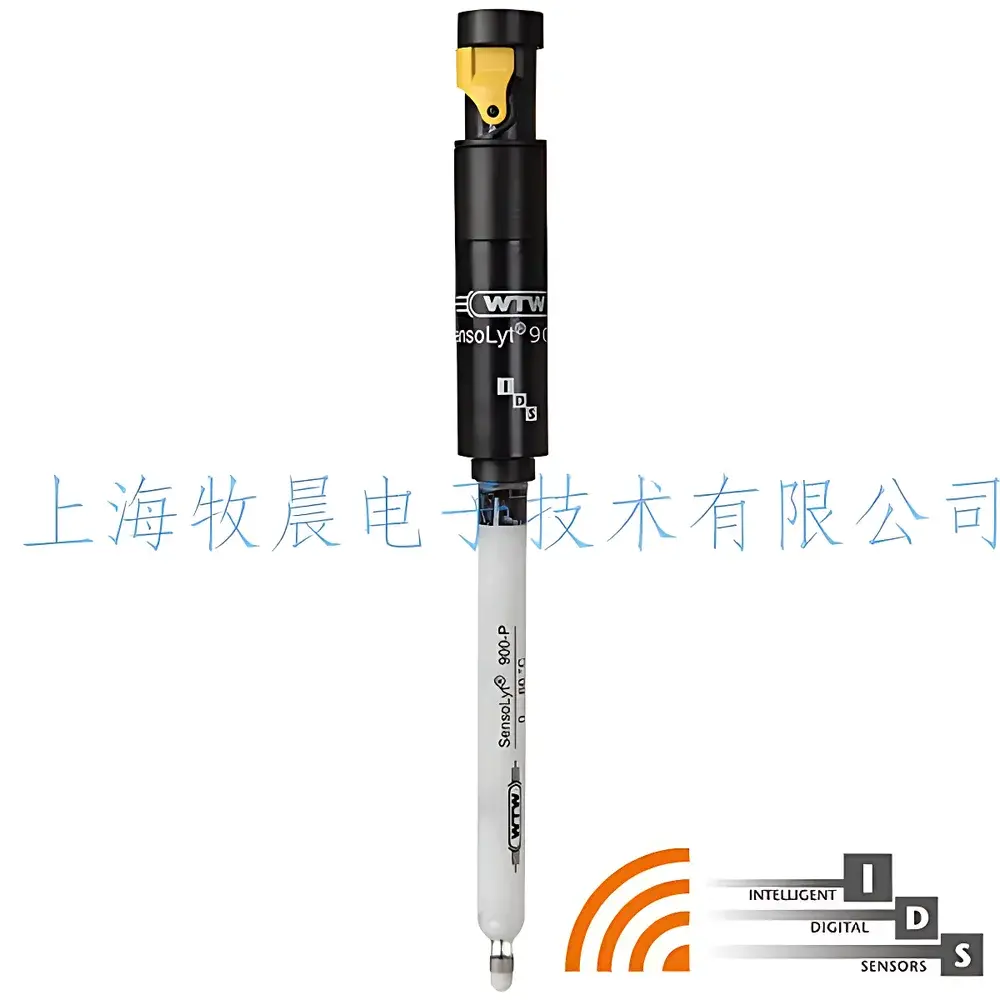
WTW SensoLyt® 900-P Digital pH Electrode
| Brand | WTW |
|---|---|
| Origin | Germany |
| Model | SensoLyt® 900-P |
| Measurement Range | 0.000–12.000 pH |
| Accuracy | ±0.004 pH |
| Temperature Sensor | NTC 30 kΩ |
| Membrane Resistance | < 400 MΩ at 25 °C |
| Operating Temperature | 0–80 °C |
| Electrode Length | 120 mm |
| Electrode Diameter | 12 mm |
| Connection | Digital IDS interface (AS/IDS-x or IDS WLM-S compatible) |
Overview
The WTW SensoLyt® 900-P Digital pH Electrode is an intelligent, high-precision electrochemical sensor engineered for rigorous pH measurement in both laboratory and demanding field applications. Built upon Xylem’s (formerly WTW) IDS (Intelligent Digital Sensor) platform, it integrates the sensing element, temperature compensation, and digital signal processing into a single, self-contained unit—eliminating analog signal degradation and enabling stable, noise-immune data transmission over extended cable lengths (up to 100 m with AS/IDS-x cabling). Its operational principle relies on the potentiometric Nernst response of a high-quality pH-sensitive glass membrane against a stable internal reference system, coupled with real-time thermistor-based temperature compensation (NTC 30 kΩ) for accurate pH calculation across variable thermal conditions. Designed for continuous immersion and pressure-rated up to 10 bar, the SensoLyt® 900-P supports mobile monitoring in deep-water sampling, wastewater infrastructure, and process streams where mechanical robustness and long-term stability are critical.
Key Features
- Digital IDS architecture ensures full signal integrity: all measurements (pH, mV, temperature) are digitized at the electrode tip, preventing electromagnetic interference and voltage drop over distance.
- Referid® polymer electrolyte fill system provides maintenance-free, leak-resistant operation with indefinite service life—no liquid refilling required and no risk of electrolyte depletion or crystallization.
- Cylindrical glass shaft with integrated ceramic junction delivers consistent ion exchange kinetics and high reproducibility across diverse matrices, including low-ionic-strength surface waters and moderately aggressive solutions.
- Automatic sensor recognition: each unit stores its unique serial number and up to 10 calibration records (including date, buffer values, slope, offset) directly in onboard memory—enabling full traceability and audit-ready calibration history.
- Pressure-rated construction (max. 10 bar) validated per DIN EN 61000-6-3 and IEC 60529 IP68, suitable for submerged deployment in boreholes, effluent channels, and marine profiling systems.
Sample Compatibility & Compliance
The SensoLyt® 900-P is optimized for aqueous samples with conductivity ≥ 50 µS/cm, including natural waters (lakes, rivers, seawater), drinking water, treated wastewater, and dilute chemical solutions (e.g., buffered acids/bases below 0.1 mol/L). It is not recommended for non-aqueous solvents, highly viscous media, or strong oxidizing agents (e.g., >5% HNO₃ or ClO₄⁻-rich matrices) due to potential membrane hydration loss or junction fouling. The electrode complies with ISO 7888 (water quality — determination of pH), ASTM D1293 (standard test method for pH of water), and supports GLP/GMP workflows through built-in calibration logging and electronic signature-capable software integration. Its digital architecture meets FDA 21 CFR Part 11 requirements when used with compliant IDS-enabled meters (e.g., MultiLine® SC or pH 3320) that enforce user authentication, audit trails, and data immutability.
Software & Data Management
When paired with WTW’s MultiLine® SC or pH 3320 meters—or via IDS WLM-S wireless module—the SensoLyt® 900-P enables seamless synchronization of raw sensor data, calibration metadata, and environmental context (time, location via GPS-enabled devices, operator ID) into structured CSV or XML exports. Firmware updates are performed over-the-air through the meter interface, ensuring ongoing compliance with evolving regulatory firmware validation standards. All stored calibration events include slope (%), asymmetry potential (mV), temperature at calibration, and pass/fail status per ISO/IEC 17025 criteria—facilitating automated report generation for QA/QC documentation and external accreditation audits.
Applications
- Regulatory environmental monitoring: continuous pH profiling in EPA-approved surface water networks and EU Water Framework Directive (WFD) compliance programs.
- Drinking water treatment: real-time pH control during coagulation, disinfection, and corrosion inhibition stages in municipal plants.
- Research hydrology: long-term in-situ deployment in groundwater wells and estuarine transects requiring pressure tolerance and drift stability (< 0.002 pH/day typical).
- Industrial process analytics: inline pH verification in pharmaceutical water-for-injection (WFI) loops and food-grade CIP rinse monitoring where digital traceability is mandated.
FAQ
Does the SensoLyt® 900-P require recalibration after every use?
No—its Referid® electrolyte and IDS architecture deliver exceptional short- and long-term stability; recalibration is only required per defined SOP intervals (e.g., daily for GLP labs, or before/after critical sample batches), not per measurement.
Can this electrode be used with non-WTW meters?
Only with instruments supporting the standardized IDS communication protocol (e.g., certain Metrohm, Hach, or Thermo Scientific models with IDS firmware licensing); analog adapters are not supported and would void accuracy specifications.
What is the expected service life under continuous immersion?
Under typical freshwater conditions (20–25 °C, pH 6–8), functional lifetime exceeds 24 months; in aggressive or high-temperature environments (>60 °C), performance verification via slope and zero-point checks is recommended every 90 days.
Is the ceramic junction cleanable if fouled?
Yes—the junction is mechanically accessible and can be regenerated using mild enzymatic cleaning solutions (e.g., 1% pepsin in 0.1 M HCl) followed by thorough rinsing with deionized water; ultrasonic cleaning is not recommended.
How does the electrode handle temperature gradients during rapid immersion?
The integrated NTC 30 kΩ sensor exhibits < 15 s thermal equilibration time (τ₉₀) in flowing water, and the IDS firmware applies dynamic thermal lag compensation to minimize transient pH error during thermal shock events.






