
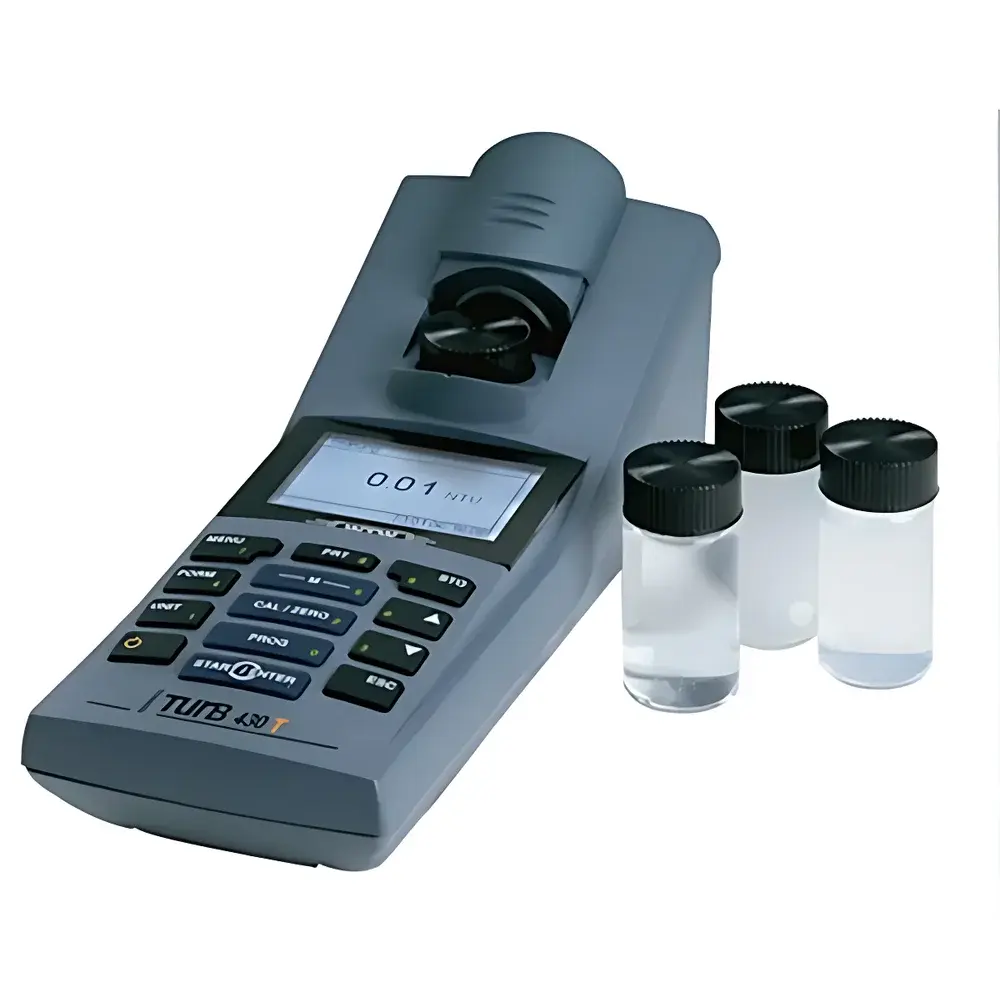
WTW Turb 430T / Turb 430IR Portable Turbidimeter
| Brand | WTW |
|---|---|
| Origin | Germany |
| Model | Turb 430T / Turb 430IR |
| Type | Portable |
| Measurement Range | 0–1100 NTU with automatic range switching |
| Resolution | 0.01 NTU (0.00–9.99 NTU) / 0.1 NTU (10.0–99.9 NTU) / 1 NTU (100–1100 NTU) |
| Operating Temperature | 0–50 °C |
| Accuracy | ±0.01 NTU or ±2% of reading |
| Repeatability | <±0.5% of reading or 0.01 NTU |
| Light Source | Turb 430IR — IR-LED at 860 nm |
| Response Time | 3 s (IR) / 7 s (tungsten) |
| Calibration | Automatic 1–3 point calibration |
| Data Storage | 1000 measurement records + calibration protocols |
| Real-Time Clock | Yes |
| Interface | RS232 and USB (with adapter) |
| Power Supply | 4 × AA alkaline batteries (≈2000 measurements with tungsten lamp |
Overview
The WTW Turb 430T and Turb 430IR are portable turbidimeters engineered for high-precision, field-deployable and laboratory-grade turbidity measurement in compliance with international water quality standards. Based on the nephelometric principle—measuring scattered light intensity at a 90° angle relative to the incident beam—these instruments deliver traceable, reproducible results across a broad dynamic range. The Turb 430IR utilizes an 860 nm infrared LED light source, eliminating interference from sample coloration and enabling stable, drift-free operation in colored or UV-absorbing matrices such as wastewater effluents or industrial process streams. In contrast, the Turb 430T employs a tungsten lamp optimized for applications requiring spectral continuity—particularly relevant for method validation against legacy reference procedures or regulatory comparability studies. Both variants adhere to ISO 7027 (for IR-LED mode) and ISO 7027-1:2016, and support full traceability under GLP and AQA frameworks.
Key Features
- Automatic multi-range detection (0–1100 NTU) with seamless switching and adaptive resolution: 0.01 NTU in low-range (0.00–9.99 NTU), 0.1 NTU in mid-range (10.0–99.9 NTU), and 1 NTU in high-range (100–1100 NTU)
- High repeatability (<±0.5% of reading or 0.01 NTU), ensuring consistency across repeated measurements under identical conditions
- Fast response time—3 seconds for IR-LED mode (Turb 430IR), 7 seconds for tungsten lamp mode (Turb 430T)—enabling efficient batch testing in QC laboratories or on-site monitoring
- Integrated real-time clock and non-volatile memory for storage of up to 1000 measurement records plus full calibration audit trails, including date/time stamps, operator ID (if configured), and standard values used
- RS232 and USB interfaces (with included adapter) for direct data export to LIMS or spreadsheet environments; supports ASCII and CSV output formats
- Robust, IP67-rated housing with chemical-resistant casing suitable for humid, dusty, or splash-prone environments typical of municipal water facilities and industrial plants
Sample Compatibility & Compliance
The Turb 430 series is validated for use with aqueous samples across potable water, wastewater, surface water, and process streams. Its 90° scattering geometry conforms to EPA Method 180.1 and ASTM D6508–22 for turbidity determination in drinking water and reclaimed water. The IR-LED configuration satisfies ISO 7027-1:2016 requirements for formazin-equivalent calibration and minimizes photometric interference from yellow-colored dissolved organic matter (e.g., humic substances). Instrument firmware includes configurable calibration intervals and pass/fail thresholds aligned with pharmacopoeial specifications—including European Pharmacopoeia 10.0 (Chapter 2.2.1) and United States Pharmacopeia , supporting GMP-compliant water system validation. Full electronic records meet FDA 21 CFR Part 11 requirements when paired with compliant data management software and user access controls.
Software & Data Management
Data transfer and instrument configuration are managed via WTW’s proprietary LabX® Light software (compatible with Windows 10/11), which enables remote setup, report generation, and automated calibration verification logs. All stored measurements include metadata: timestamp, temperature (when used with optional integrated Pt100 probe), operator code, calibration status, and measurement mode (T or IR). Audit trail functionality records every parameter change, calibration event, and data export action—supporting GLP audits and internal quality reviews. Exported files retain native precision and are compatible with statistical process control (SPC) platforms and enterprise QA databases without loss of significant digits.
Applications
- Drinking water treatment: Low-turbidity verification at filtration and disinfection stages (sub-1 NTU sensitivity critical for membrane integrity assessment)
- Pharmaceutical water systems: USP purified water and water-for-injection (WFI) monitoring in cleanroom environments
- Environmental field surveys: Rapid turbidity profiling of rivers, lakes, and stormwater outfalls using battery-powered portability
- Food & beverage production: Monitoring clarity of process waters, syrups, and clarified juices where particulate load affects product stability
- Educational labs: Teaching nephelometric principles, calibration traceability, and ISO/ASTM method alignment in analytical chemistry curricula
FAQ
What is the difference between Turb 430T and Turb 430IR?
The Turb 430T uses a tungsten lamp for broad-spectrum visible-light excitation, while the Turb 430IR employs an 860 nm infrared LED—reducing color interference and complying with ISO 7027 for standardized turbidity reporting.
Does the instrument support formal calibration documentation for audit purposes?
Yes. Each calibration event stores date/time, standard values, deviation metrics, and operator input. Calibration protocols are exportable as PDF or CSV with digital signatures enabled via LabX® Light.
Can the Turb 430 be used for compliance with US EPA Method 180.1?
Yes—the 90° scatter geometry, detector linearity, and calibration traceability to NIST-traceable formazin standards satisfy all instrumental requirements of EPA Method 180.1 when operated per manufacturer instructions.
Is temperature compensation automatic?
Temperature measurement requires an optional integrated Pt100 sensor; compensation is applied algorithmically during measurement if enabled, per ISO 7027-1 Annex B recommendations.
How long does the battery last under typical usage?
With alkaline AA cells: ~2000 measurements using the tungsten lamp (Turb 430T); ~3000 measurements using the IR-LED (Turb 430IR), assuming ambient temperature and default display timeout settings.




