
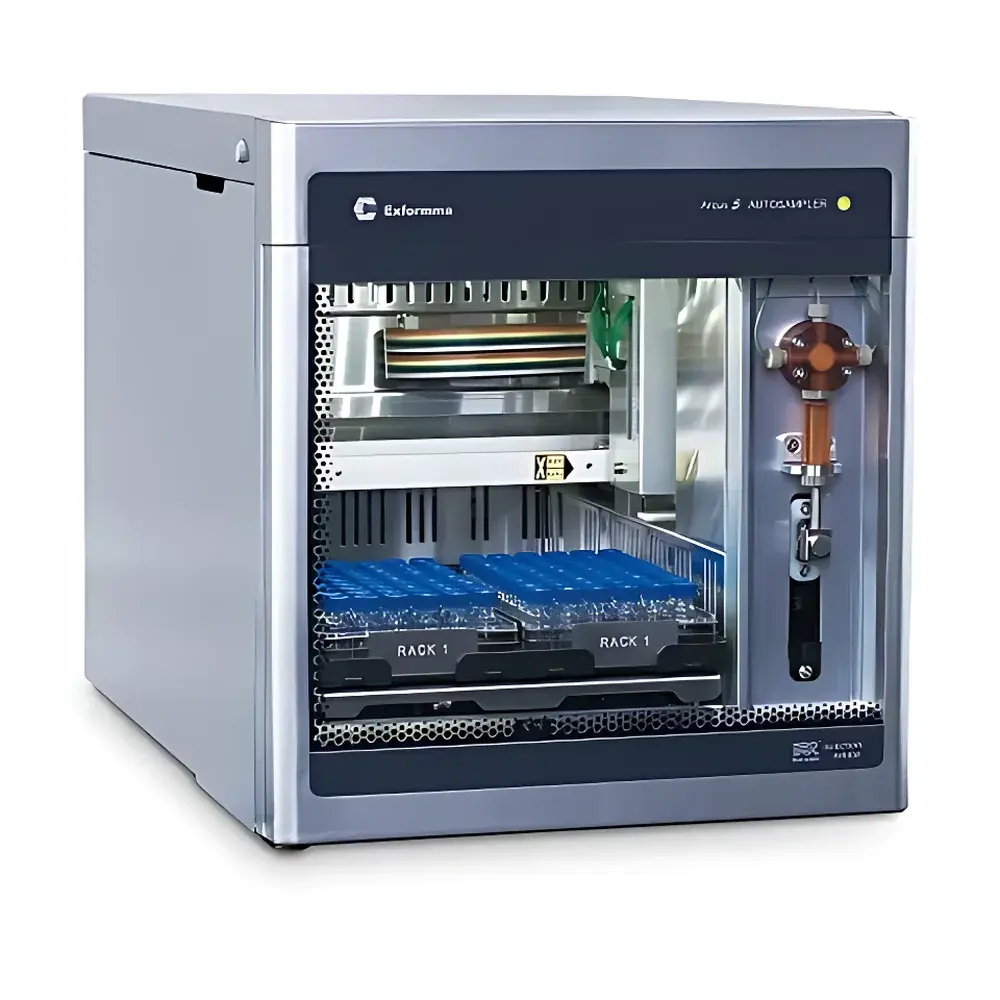
Wufeng Arcus 5 Multifunctional HPLC Autosampler
| Brand | Wufeng |
|---|---|
| Origin | Shanghai, China |
| Manufacturer Type | Authorized Distributor |
| Product Origin | Domestic (China) |
| Model | Arcus 5 |
| Instrument Type | HPLC Autosampler |
| Max Sample Capacity | 192 × 1 mL vials |
| Minimum Injection Volume | 0.1 µL |
| Standard Loop Volume | 50 µL (configurable) |
| Positioning Accuracy | ±0.1 mm |
| Motion Architecture | XYZ three-axis robotic arm |
| Needle Wash | Internal & external wall washing |
| Mechanical Durability | ≥1,000,000 injection cycles |
| Sample Carryover | <0.05% |
| Injection Precision | RSD <0.25% (full-loop), <0.5% (partial-loop, >10 µL), <0.8% (low-volume, <5 µL) |
| Max System Pressure | 40 MPa (standard HPLC), 60 MPa (UHPLC-compatible) |
| Sample Tray Options | 2 mL × 108 vials (standard) or configurable layouts |
| Injection Modes | Full-loop, Partial-loop, and Zero-dead-volume (ZDV) injection |
Overview
The Wufeng Arcus 5 Multifunctional HPLC Autosampler is an engineered solution for high-throughput, high-reproducibility liquid chromatography workflows. Designed around a precision XYZ robotic motion system and a dual-stage syringe pump architecture with sapphire-plunger metering valves, the Arcus 5 delivers sub-microliter volumetric accuracy while maintaining mechanical robustness under sustained UHPLC pressure regimes (up to 60 MPa). Its core operation relies on positive-displacement sampling via a fixed-loop or variable-volume aspiration mechanism, enabling seamless integration with both conventional HPLC and ultra-high-performance LC systems. The open-frame transparent enclosure provides real-time visual verification of all mechanical sequences—critical for method validation, troubleshooting, and GLP-compliant laboratory audits.
Key Features
- Triple-layer protection architecture: integrated pressure sensor (monitors line blockage in real time), bottle-presence detection (prevents empty-position sampling), and needle-tip obstruction sensor (retracts needle upon detecting misaligned or inverted vials)
- Side-port needle design with dual micro-grooves: eliminates septum particulate ingress and suppresses bubble formation during aspiration by equalizing fluid shear and pressure gradients
- Dual-wash station with independent internal/external rinse cycles using programmable solvent selection—reducing carryover to <0.05% across diverse analyte classes
- Sapphire-plunger metering pump: achieves >1,000,000 operational cycles with consistent sealing integrity; eliminates routine replacement of high-pressure seals for 3–5 years under typical QC lab usage
- Three injection modes supported: full-loop (highest precision), partial-loop (optimized for limited sample volume), and zero-dead-volume (ZDV) mode for trace-level quantitation with minimal dilution
- Self-diagnostic firmware logs critical component usage—including high-pressure valve actuations, seal cycle count, and syringe plunger wear metrics—for predictive maintenance and audit-ready traceability
Sample Compatibility & Compliance
The Arcus 5 accommodates standard 1 mL and 2 mL screw-thread or crimp-top vials (up to 192 positions at 1 mL or 108 positions at 2 mL), with optional tray configurations for custom plate formats. It complies with ISO/IEC 17025 calibration traceability requirements for automated liquid handling and supports instrument qualification protocols aligned with USP , ASTM E2656, and ICH Q2(R2) analytical method validation guidelines. All firmware-driven operations—including sequence execution, error logging, and parameter modification—are timestamped and user-attributed, satisfying FDA 21 CFR Part 11 electronic record and signature requirements when deployed with validated LIMS or CDS environments.
Software & Data Management
Controlled exclusively via Wufeng’s Arcus Control Suite—a Windows-based application supporting ASCII and XML method export—the system enables bidirectional communication with third-party chromatography data systems (CDS) including Waters Empower, Thermo Chromeleon, Agilent OpenLab, and Shimadzu LabSolutions. Method templates support conditional logic (e.g., skip-on-error, dynamic loop volume assignment per injection), and audit trails record every hardware state transition, parameter change, and alarm event with SHA-256 hash integrity verification. Raw diagnostic logs are exportable in CSV/JSON for integration into enterprise quality management systems (QMS) and automated CAPA workflows.
Applications
The Arcus 5 is routinely deployed in regulated pharmaceutical QC laboratories for stability-indicating assays, dissolution testing, and residual solvent analysis; in environmental labs for EPA Method 8081/8270 pesticide screening; and in academic proteomics cores for reproducible peptide injection prior to nano-LC-MS/MS. Its ZDV mode supports pharmacokinetic studies requiring <1 µL injections from precious microdialysate or cerebrospinal fluid samples. The modular wash protocol configuration allows method-specific optimization for highly viscous biological matrices (e.g., plasma extracts) or aggressive solvents (e.g., DMSO, TFA), minimizing cross-contamination without compromising cycle time.
FAQ
Is the Arcus 5 compatible with non-Wufeng HPLC systems?
Yes—it uses industry-standard RS-232, USB virtual COM, and Ethernet TCP/IP interfaces with ASCII command protocol documentation provided for OEM integration.
What validation documentation is supplied?
Factory-issued IQ/OQ documentation, pressure calibration certificates (traceable to NIM), and electronic logbook templates compliant with ALCOA+ principles are included.
Can the system be operated unattended overnight?
Yes—integrated thermal monitoring, leak detection, and automatic emergency shutdown prevent uncontrolled operation during extended runs.
How is needle positioning accuracy verified?
Each startup initiates a coordinate homing sequence referencing optical encoders and Hall-effect limit switches; positional repeatability is validated daily via built-in reference vial calibration routines.
Does the software support audit trail review with user role permissions?
Yes—administrator, analyst, and reviewer roles enforce separation of duties; all actions are immutably logged with digital signatures and IP address attribution.
Related Products




