
Wyatt DynaPro PlateReader High-Throughput Automated Nanoparticle Size Analyzer
| Brand | Wyatt |
|---|---|
| Origin | USA |
| Manufacturer | Wyatt Technology Corporation |
| Product Type | Laboratory Laser-Based Dynamic Light Scattering (DLS) Instrument |
| Measurement Range | 0.5–1000 nm |
| Repeatability | <1% |
| Measurement Time per Well | 1–5 s |
| Sample Format | 96-, 384-, or 1536-well microplates |
| Minimum Sample Volume | 4 µL |
| Scattering Angle | 150° |
| Laser Wavelength | 830 nm |
| Laser Power | 0–50 mW (programmable) |
| Minimum Concentration | 0.125 mg/mL |
| Dispersion Method | Wet Dispersion |
| Temperature Control | Ambient (no active thermostating) |
| Software Compliance | FDA 21 CFR Part 11, GLP/GMP-ready audit trail, electronic signature support |
Overview
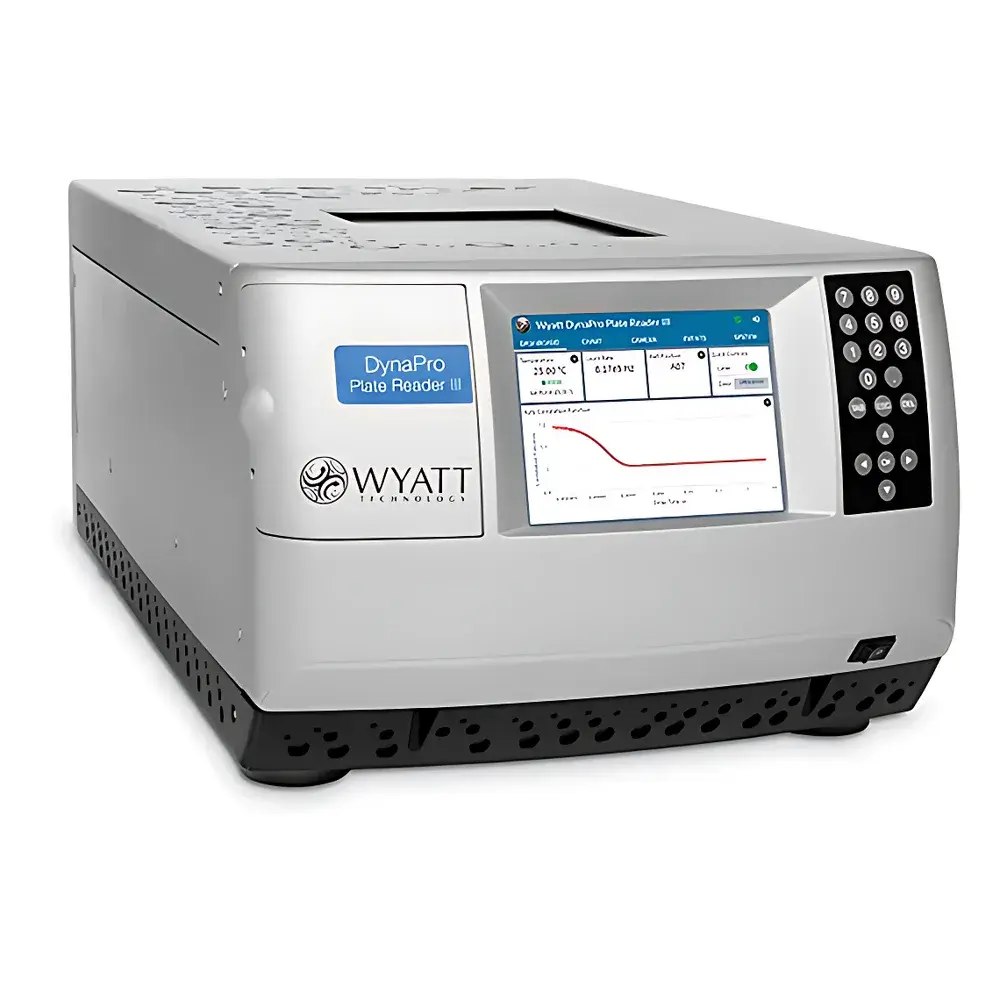
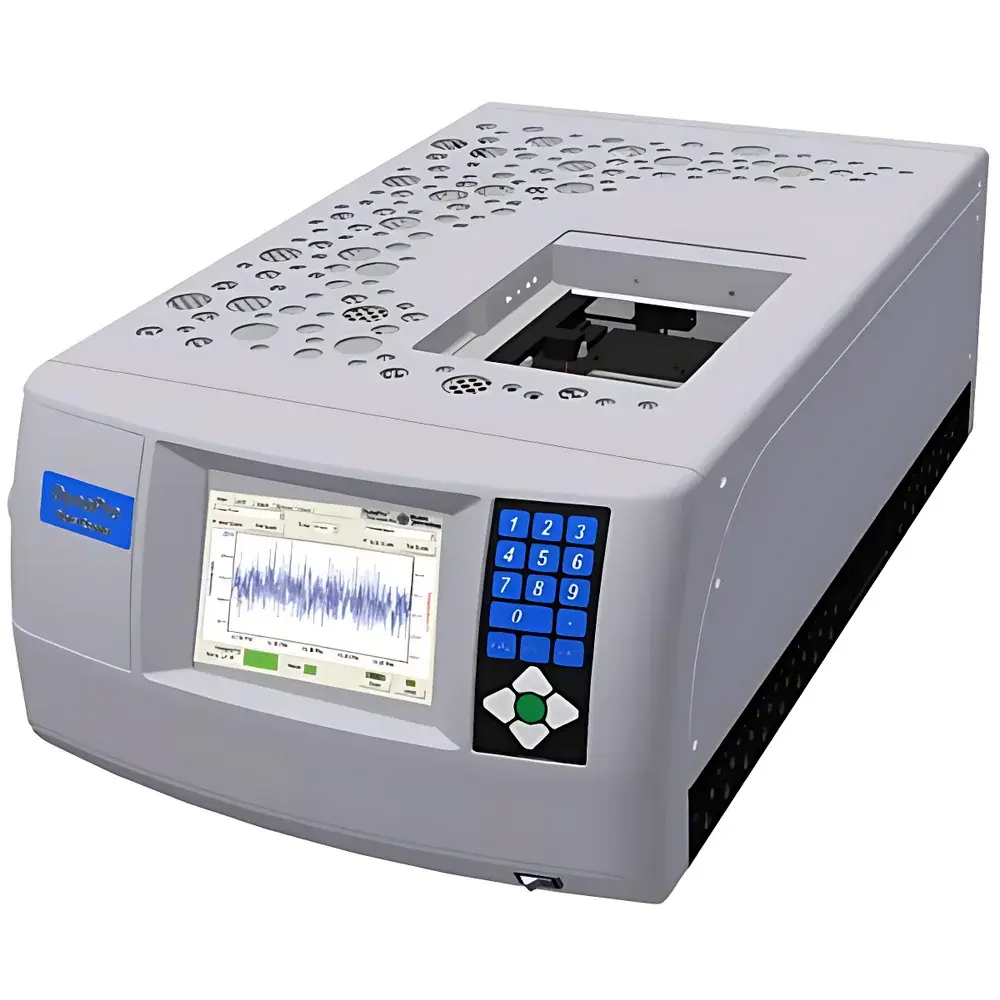
The Wyatt DynaPro PlateReader is a fully automated, high-throughput nanoparticle size analyzer engineered for precision dynamic light scattering (DLS) measurements in microplate format. Unlike conventional cuvette-based DLS systems, the PlateReader implements a fixed-angle (150°), backscattering-optimized optical architecture with an 830 nm near-infrared laser and programmable power control (0–50 mW). It operates on the principle of intensity autocorrelation analysis of scattered light fluctuations to determine hydrodynamic diameter distributions of macromolecules and nanoparticles in solution—enabling rapid, label-free assessment of size, polydispersity, and aggregation state. Designed specifically for early-stage biopharmaceutical development, it eliminates manual sample handling, cleaning, and alignment steps inherent in single-sample instruments. Its integration into existing laboratory automation workflows—including liquid handlers and robotic arms—supports unattended, 24/7 operation across hundreds to thousands of samples per day.
Key Features
- True high-throughput DLS: Simultaneous analysis of up to 1536 samples per run using standard ANSI/SBS-compliant microplates (96-, 384-, or 1536-well formats)
- No-cuvette operation: Eliminates quartz cell cleaning, calibration drift, and cross-contamination risks associated with reusable optics
- Minimal sample consumption: As low as 4 µL per well, critical for precious biologics such as monoclonal antibodies, mRNA-LNPs, and viral vectors
- Sub-second measurement kinetics: Typical acquisition time of 1–5 seconds per well enables full-plate analysis in under 3 minutes (384-well)
- Robust signal-to-noise architecture: Optimized 150° scattering geometry minimizes dust interference and enhances sensitivity for sub-10 nm species
- Programmable laser power: Enables gentle interrogation of light-sensitive samples (e.g., photosensitive proteins or fluorescent conjugates) without photodegradation
- Seamless hardware integration: Compatible with existing DynaPro NanoStar or DynaPro ZetaStar main units via proprietary optical coupling; also functions as a standalone system
Sample Compatibility & Compliance
The DynaPro PlateReader accommodates aqueous and organic solvent-based dispersions, including buffers commonly used in formulation screening (PBS, HEPES, acetate), surfactant solutions (Tween 20, polysorbates), and lipid nanoparticle suspensions. It supports native-state analysis of proteins, peptides, oligonucleotides, liposomes, exosomes, and synthetic polymers without labeling or fixation. All measurements comply with ISO 22412:2017 (DLS methodology) and ASTM E2490-18 (standard practice for DLS particle sizing). The instrument’s software platform meets FDA 21 CFR Part 11 requirements for electronic records and signatures, featuring time-stamped audit trails, user-access controls, and versioned data export—ensuring full traceability for regulatory submissions under ICH Q5C, Q5E, and USP .
Software & Data Management
Acquisition and analysis are performed using Wyatt’s Dynamics software v8.x, a validated, Windows-based application supporting automated plate mapping, real-time quality metrics (e.g., count rate, correlation fit residuals, baseline stability), and batch processing of multi-plate experiments. Data files (.dya) retain raw autocorrelation functions, instrument metadata, and environmental logs. Export options include CSV, Excel, and PDF reports compliant with GLP documentation standards. The software integrates with LIMS platforms via ODBC and supports scripting (Python API) for custom assay logic—such as automatic pass/fail thresholds based on polydispersity index (PDI) or temperature-induced aggregation onset detection.
Applications
- Formulation screening: Rapid evaluation of buffer composition, pH, excipient type, and ionic strength effects on protein stability
- Aggregation kinetics: Monitoring thermal or chemical stress-induced particle growth over time using integrated temperature ramping protocols
- Lipid nanoparticle (LNP) characterization: Size and PDI profiling during process development for mRNA vaccine candidates
- Antibody conformational analysis: Detecting subtle structural changes induced by oxidation, deamidation, or shear stress
- Small-molecule aggregation: Identification of promiscuous aggregators in HTS campaigns via concentration-dependent size shifts
- Vaccine adjuvant development: Quantifying particle size distribution of aluminum hydroxide or saponin-based delivery systems
FAQ
Is the DynaPro PlateReader compatible with non-Wyatt microplate handlers?
Yes—it communicates via standard RS-232 and Ethernet interfaces, supporting integration with third-party liquid handlers (e.g., Tecan, Hamilton, Agilent) through ASCII command protocols.
Does it support temperature-controlled measurements?
No—the current design operates at ambient temperature only. For thermally regulated studies, users integrate the PlateReader with external climate-controlled enclosures or pair it with Wyatt’s temperature-stabilized DynaPro NanoStar for orthogonal validation.
Can it measure zeta potential?
No—zeta potential requires electrophoretic light scattering (ELS), which is not implemented in the PlateReader platform. Zeta measurements must be performed separately using a dedicated ELS-capable instrument such as the DynaPro ZetaStar.
What is the minimum detectable concentration for IgG monomers?
At 0.125 mg/mL in PBS, the system reliably resolves monomeric IgG (~10 nm) from dimeric and higher-order aggregates with >95% confidence under optimized scattering conditions.
How is data integrity ensured during unattended overnight runs?
Each measurement includes checksum-verified raw correlation data, timestamped operator ID, and automated QC flagging for outliers—fully auditable within the Dynamics software’s Part 11-compliant database schema.



