
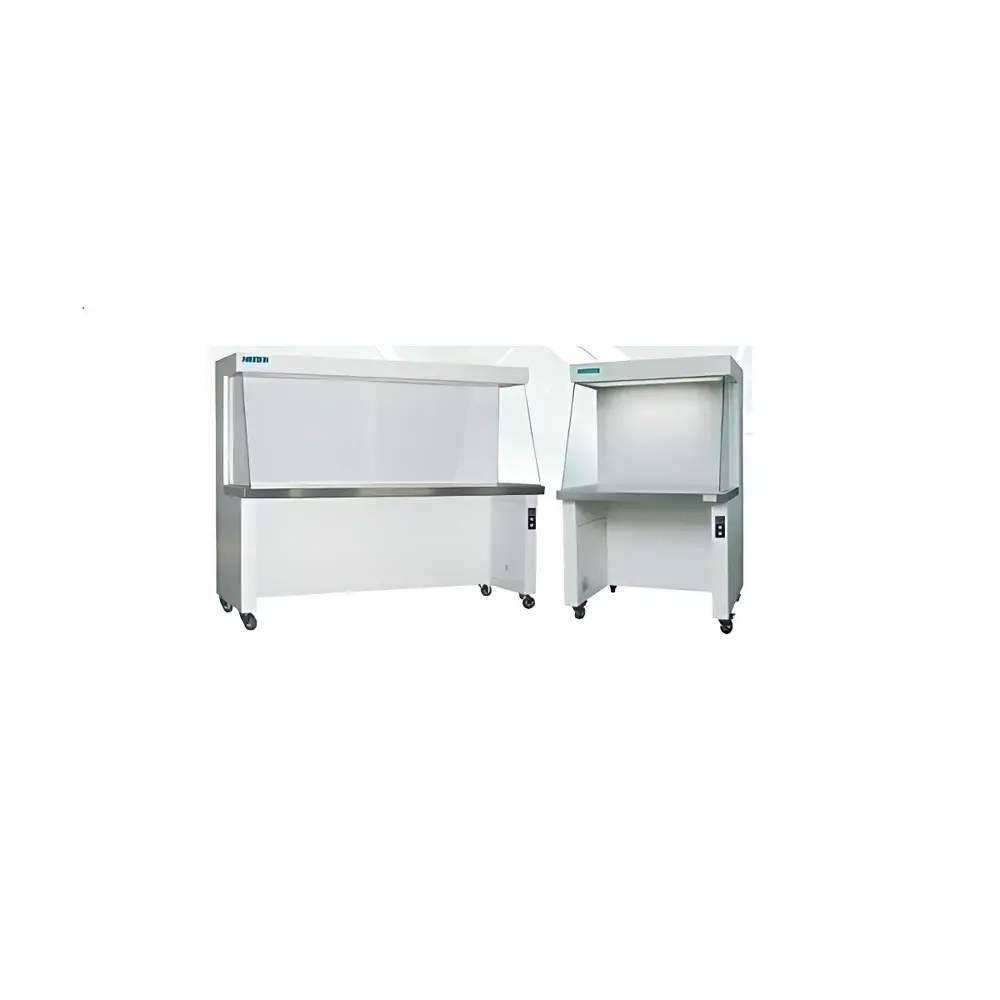
SW-CJ-1CU Horizontal Laminar Flow Clean Bench
| Origin | Jiangsu, China |
|---|---|
| Manufacturer Type | Distributor |
| Product Origin | Domestic |
| Model | SW-CJ-1CU |
| Instrument Category | Horizontal Flow Clean Bench |
| Cleanliness Class | ISO Class 5 (Fed. Std. 209E Class 100) |
| Noise Level | ≤62 dB(A) |
| User Capacity | Dual-user, single-face configuration |
| Airflow Pattern | Horizontal laminar flow |
| Average Air Velocity | 0.3–0.6 m/s (adjustable) |
| Vibration (Half-Peak) | ≤4 µm |
| Illumination | ≥300 lx |
| Power Supply | AC 200 V, 1Φ, 50 Hz |
| Max. Power Consumption | 0.65 kW |
| Net Weight | 200 kg |
| Work Area Dimensions (W×D×H) | 1680 × 480 × 600 mm |
| External Dimensions (W×D×H) | 1760 × 700 × 1450 mm |
| HEPA Filter Specification | 820 × 600 × 50 mm × 2 units |
| Lighting | 40 W fluorescent lamp × 1 |
| UV Lamp | 40 W × 1 |
| Work Surface | Imported stainless steel |
| Differential Pressure Gauge | Integrated |
| Fan System | Adjustable-speed centrifugal blower with touch-control voltage regulation |
Overview
The SW-CJ-1CU Horizontal Laminar Flow Clean Bench is an ISO Class 5-certified (Fed. Std. 209E Class 100) containment workstation engineered for non-hazardous applications requiring particle-free environments. Unlike vertical-flow or biosafety cabinets, this unit employs a unidirectional horizontal airflow system: air is drawn through a prefilter, conditioned, and then passed through dual high-efficiency particulate air (HEPA) filters (≥99.99% @ 0.3 µm) before exiting uniformly across the work surface at a controlled velocity of 0.3–0.6 m/s. This laminar profile minimizes turbulence and cross-contamination, ensuring consistent protection of sensitive samples—such as cell cultures, sterile media preparations, pharmaceutical formulations, and plant tissue explants—from airborne particulates and microorganisms. Designed for operation in ambient laboratory settings without external ducting, the SW-CJ-1CU complies with core environmental control principles outlined in ISO 14644-1 and supports adherence to Good Laboratory Practice (GLP) and current Good Manufacturing Practice (cGMP) workflows where operator and product protection—not personnel or environmental protection—is the primary objective.
Key Features
- Integrated differential pressure gauge for real-time monitoring of HEPA filter loading and resistance drift—enabling predictive maintenance and validation traceability.
- Touch-sensitive, stepless fan speed controller allowing precise adjustment of airflow velocity to maintain optimal laminar conditions under varying ambient loads or filter aging.
- Electropolished imported stainless-steel work surface—non-porous, corrosion-resistant, and compatible with common disinfectants including 70% ethanol and sodium hypochlorite solutions.
- Dual 40 W lamps: one fluorescent (general illumination ≥300 lx) and one germicidal UV-C (254 nm), independently switchable and interlocked with safety cutoff to prevent accidental UV exposure during operation.
- Robust structural frame with reinforced aluminum alloy housing and tempered glass front sash—designed for long-term dimensional stability and vibration damping (half-peak ≤4 µm).
- Low-noise operation (≤62 dB[A] at 1 m) achieved via acoustically optimized fan housing and vibration-isolated motor mounting—suitable for shared lab spaces and quiet-zone environments.
Sample Compatibility & Compliance
The SW-CJ-1CU is validated for use with non-pathogenic biological materials, sterile reagents, precision instrumentation calibration standards, and aseptic packaging components. It is routinely deployed in applications where ISO Class 5 air quality must be sustained over defined work zones—including microbial culture transfers, media plate pouring, chromatography vial preparation, and botanical micropropagation. While not certified for biohazardous or toxic agent handling (per NSF/ANSI 49 or EN 12469), its performance aligns with requirements specified in USP for low-risk compounding environments and ISO/TR 14644-14 for cleanroom-compatible equipment qualification. The unit’s construction materials meet RoHS Directive 2011/65/EU and its electrical design conforms to IEC 61010-1:2010 for laboratory equipment safety.
Software & Data Management
As a Class I passive airflow device, the SW-CJ-1CU operates without embedded firmware or digital data logging. However, its analog interface—comprising tactile controls, visual status indicators, and mechanical pressure monitoring—supports integration into facility-wide environmental monitoring systems (EMS) via optional analog signal outputs (0–10 V or 4–20 mA) for HEPA differential pressure and fan current draw. When deployed in regulated environments, users may document operational parameters manually or via external calibrated loggers; records comply with FDA 21 CFR Part 11 when paired with electronic audit-trail-capable EMS platforms. Routine performance verification—including airflow uniformity mapping, filter integrity testing (DOP/PAO), and illumination intensity measurement—follows ISO 14644-3 protocols and is recommended quarterly per EU GMP Annex 1 guidance.
Applications
- Cell culture maintenance and passaging in academic and industrial life science laboratories.
- Aseptic preparation of vaccines, monoclonal antibodies, and other biologics during upstream development phases.
- Plant tissue culture labs performing meristem isolation, callus induction, and regeneration assays.
- Pharmaceutical QC labs conducting sterility test setup, filter validation, and media fill simulations.
- Veterinary diagnostic facilities handling avian influenza virus isolation (non-infectious stages) and bacterial isolation from clinical specimens.
- Chemistry labs preparing ultra-pure solvent standards for ICP-MS and HPLC calibration.
FAQ
Is the SW-CJ-1CU suitable for handling BSL-2 agents?
No. This horizontal laminar flow bench provides product protection only and does not protect the operator or environment from aerosolized biohazards. BSL-2 work requires a certified Class II biological safety cabinet.
Can the unit be installed without external exhaust ducting?
Yes. The SW-CJ-1CU is a recirculating horizontal flow system; all air is filtered and returned into the lab space. No dedicated exhaust or make-up air infrastructure is required.
What maintenance intervals are recommended for HEPA filters?
Filter replacement frequency depends on ambient particulate load and usage hours. Under typical lab conditions (8 h/day, ISO 8 ambient), annual replacement is standard—preceded by differential pressure trending and integrity testing every 6 months.
Does the unit include validation documentation?
Factory-assembled units ship with a Certificate of Conformance (CoC) and filter test reports (including initial DOP scan data). IQ/OQ protocol templates and commissioning support are available upon request.
Is UV irradiation time programmable?
No. The UV lamp is manually operated with a mechanical timer switch; exposure duration must be set externally per institutional SOPs (typically 15–30 min pre-use).
Related Products



