
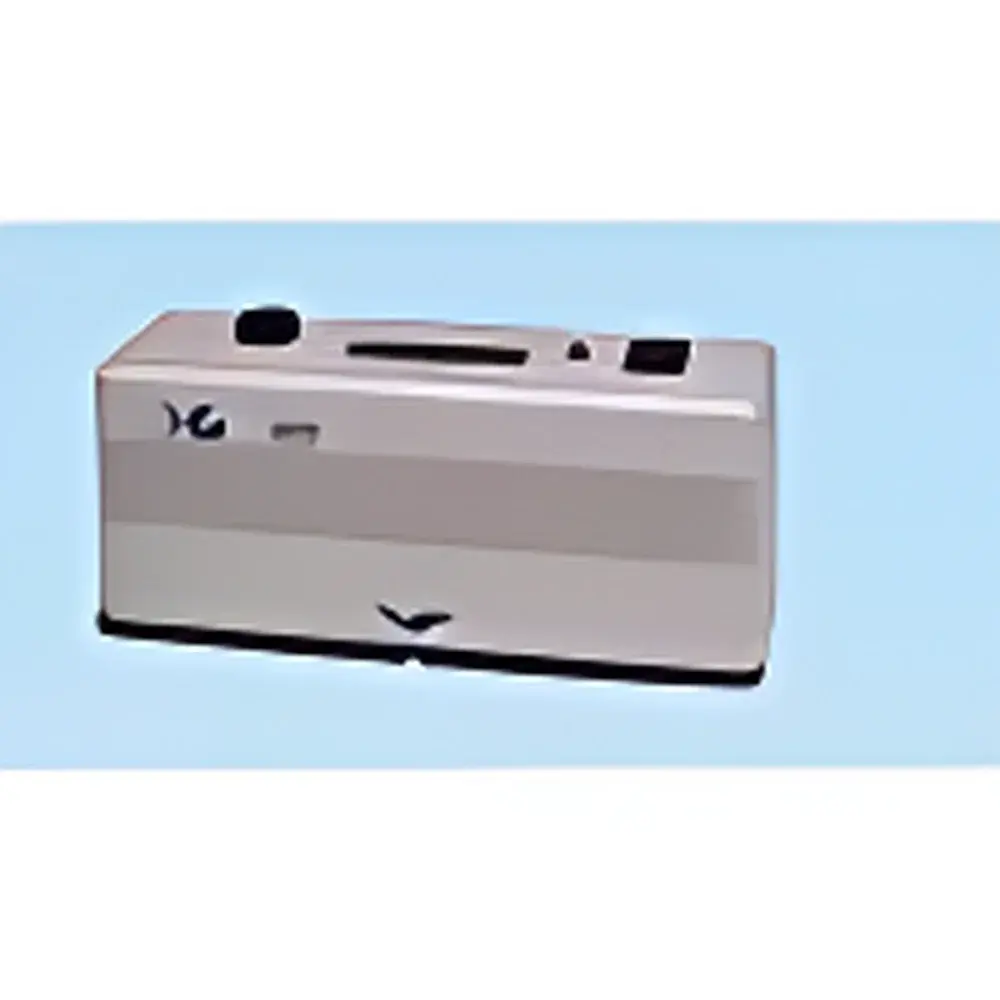
XGP Series Portable & Benchtop Multi-Angle Gloss Meter
| Origin | Tianjin, China |
|---|---|
| Manufacturer Type | Authorized Distributor |
| Origin Category | Domestic (China) |
| Model | XGP Series |
| Price Range | USD 1–1,400 |
| Instrument Type | Automatic |
| Haze Range | 0–30% |
| Transmittance Range | 0–100% |
| Haze Repeatability | ±0.2% |
| Transmittance Repeatability | ±0.5% |
| Gloss Measurement Angles | 20°, 60°, 85° (configurable as single/dual/triple-angle) |
| Gloss Range | 0–199.9 GU |
| Resolution | 0.1 GU |
| Accuracy | ±1.0 GU (per JJG 696 Class 1) |
| Stability | ±0.4 GU/30 min |
| Light Source | Long-life imported LED (≥100,000 h) |
| Angle Tolerance | ≤0.03° |
| Calibration | Auto-zero, Quartz Reference Standards |
| Power | Ni-MH rechargeable battery (12 h charge → ≥80 h continuous operation) |
Overview
The XGP Series Gloss Meter is a precision optical instrument engineered for the quantitative assessment of specular gloss — defined as the ratio of reflected luminous flux to incident luminous flux at a specified geometry — in accordance with ISO 2813, ASTM D523, and GB/T 9754 standards. It operates on the principle of directional reflectance measurement using a collimated light source and a matched receiver positioned at the mirror angle relative to the surface normal. The system supports three standardized incidence angles — 20° (optimized for high-gloss surfaces >70 GU), 60° (universal reference angle for medium-gloss materials), and 85° (designed for low-gloss or matte finishes <10 GU) — enabling compliance with international test protocols across diverse industrial substrates. Unlike subjective visual evaluation, this instrument delivers traceable, repeatable, and operator-independent gloss values expressed in Gloss Units (GU), facilitating objective quality control in regulated manufacturing environments.
Key Features
- Multi-angle configuration flexibility: Available as single-angle (20°, 60°, or 85°), dual-angle (20°/60°, 60°/85°, or 20°/85°), or triple-angle (20°/60°/85°) variants — either portable or benchtop-mounted — to match application-specific metrological requirements.
- Optical stability architecture: Incorporates a high-luminance, thermally stabilized LED light source with ≥100,000-hour service life and angular alignment tolerance ≤0.03°, ensuring long-term measurement fidelity without recalibration drift.
- Class 1 accuracy per JJG 696: Meets Chinese national metrological verification regulation for gloss meters, with maximum permissible error ±1.0 GU and short-term stability ≤±0.4 GU over 30 minutes.
- Integrated haze and transmittance capability: Simultaneously measures haze (0–30%, repeatability ±0.2%) and total transmittance (0–100%, repeatability ±0.5%) per ASTM D1003 and ISO 14782, supporting comprehensive optical characterization of transparent and translucent materials.
- Robust calibration infrastructure: Features automatic zero-point compensation and factory-traceable quartz reference standards with permanent calibration stability — eliminating thermal or aging-induced coefficient shifts.
- Extended operational autonomy: Powered by high-capacity Ni-MH rechargeable batteries; a 12-hour charge supports ≥80 hours of continuous measurement cycles under typical QC workflow conditions.
Sample Compatibility & Compliance
The XGP Series accommodates flat, rigid, or moderately curved non-metallic and metallic substrates including coated panels (paint, varnish, lacquer), plastic films and sheets (PET, PC, PMMA), printed paperboard, ceramic glazes, anodized aluminum, and electroplated surfaces. Its compact probe design allows access to confined geometries where conventional benchtop instruments cannot operate. All models comply with ISO/IEC 17025-aligned measurement uncertainty budgets when used with certified reference standards. Data acquisition meets GLP documentation requirements, and instrument logs support audit-ready traceability for pharmaceutical packaging (USP , ), automotive OEM coatings (SAE J1527), and food-contact material qualification (FDA 21 CFR Part 177).
Software & Data Management
While the base unit operates in standalone mode, optional USB/Bluetooth connectivity enables integration with proprietary PC-based software for automated report generation, statistical process control (SPC) charting (X̄-R, Cpk), batch-level trend analysis, and CSV export compliant with LIMS platforms. Raw data includes timestamp, operator ID, sample ID, angle selection, GU value, haze %, transmittance %, and environmental temperature/humidity metadata (when paired with external sensors). Audit trail functionality records all calibration events, parameter changes, and firmware updates — satisfying FDA 21 CFR Part 11 electronic record integrity requirements when configured with user authentication and digital signature modules.
Applications
- Coatings & Inks: Quantifying gloss uniformity across spray-applied automotive clearcoats, coil-coated steel, and gravure-printed flexible packaging.
- Plastics & Polymers: Monitoring extrusion line consistency for injection-molded housings, thermoformed trays, and optical lenses.
- Paper & Board: Verifying calendering effectiveness and surface finish consistency in premium printing stocks and folding cartons.
- Building Materials: Assessing polish retention on natural stone slabs, ceramic tiles, and architectural glass laminates.
- Electronics: Validating anti-glare treatment efficacy on display cover glasses and touch panel overlays.
- Regulatory Testing: Supporting ASTM D523-compliant gloss reporting for ASTM D3003 (automotive refinish), ISO 1382 (wood coatings), and EN 13523-11 (coil-coated metal).
FAQ
What is the difference between 20°, 60°, and 85° gloss measurement angles?
The 20° geometry enhances sensitivity for high-gloss surfaces (>70 GU), minimizing scatter contribution; 60° serves as the universal reference for medium-gloss materials (10–70 GU); 85° maximizes signal-to-noise ratio for low-gloss or textured surfaces (<10 GU) where diffuse reflection dominates.
Does the instrument require annual recalibration?
No routine recalibration is required if operated within specification and stored per manufacturer guidelines. However, periodic verification against certified quartz standards (recommended every 6 months in GMP environments) ensures continued traceability to NIM (National Institute of Metrology, China) references.
Can the XGP Series measure curved or textured surfaces?
It is validated for flat or gently curved surfaces (radius ≥50 mm). For heavily textured, porous, or highly irregular topographies, results represent average specular reflectance and should be interpreted with surface roughness metrics (e.g., Ra, Rz) obtained via profilometry.
Is haze and transmittance measurement compliant with ASTM D1003?
Yes — the optical path length, detector spectral response (380–780 nm), and integrating sphere geometry conform to ASTM D1003 Type A requirements for total haze and transmittance determination on transparent plastics and films.
How is measurement repeatability verified?
Repeatability is determined per ISO 5725-2:2019 — ten consecutive measurements on a stable reference standard yield standard deviation ≤0.2% for haze and ≤0.5% for transmittance, and ≤0.3 GU for gloss under controlled ambient lighting (≤50 lux ambient illumination).




