
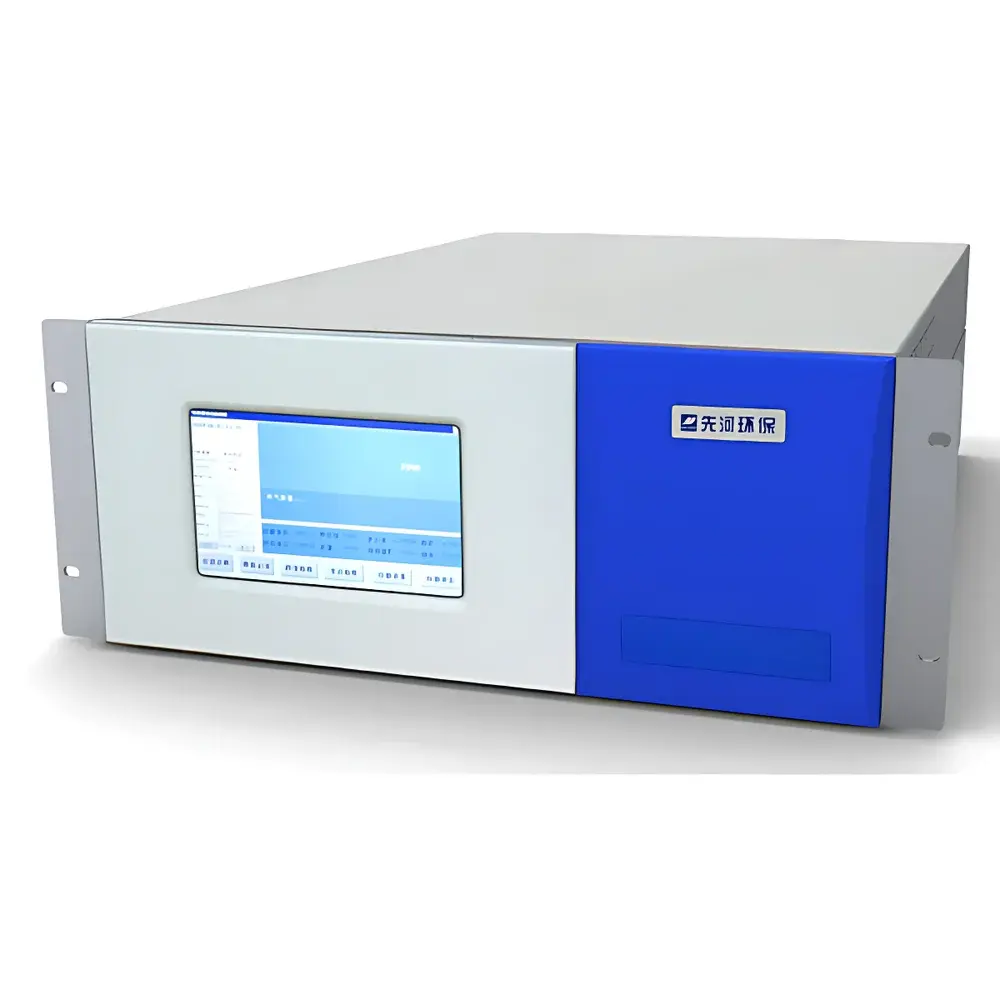
XHOZ7000 Ozone Analyzer by SAIL HERO
| Brand | SAIL HERO |
|---|---|
| Origin | Hebei, China |
| Manufacturer Type | Original Equipment Manufacturer (OEM) |
| Country of Origin | China |
| Model | XHOZ7000 |
| Measured Pollutant | O₃ |
| Detection Principle | Chemiluminescence (NO + O₃ → NO₂* + light) |
| Interference Rejection | SO₂, NO, NO₂, H₂O vapor, toluene, xylene, particulate matter, high-concentration aromatic VOCs |
| Calibration | Manual or remote zero/span calibration |
| Compensation | Automatic temperature and pressure compensation |
| Output Options | RS-232, RS-485, 0–5 V analog, 4–20 mA current loop (optional) |
| Certification | CEPAA Environmental Product Certification (China) |
Overview
The XHOZ7000 Ozone Analyzer is a laboratory-grade, continuous ambient air monitoring instrument engineered for precise, real-time quantification of ground-level ozone (O₃) in environmental and regulatory compliance applications. It operates on the well-established chemiluminescence detection principle: ozone reacts stoichiometrically with nitric oxide (NO) to produce excited-state nitrogen dioxide (NO₂*), which emits photons at ~600–3000 nm upon relaxation. This emitted light intensity is directly proportional to the ozone concentration in the sampled air stream. A high-sensitivity photomultiplier tube (PMT) detects the photon flux, converting it into a linear electrical signal calibrated in parts per billion (ppb) or micrograms per cubic meter (µg/m³). Unlike UV absorption-based analyzers, this method offers inherent selectivity for ozone in complex urban and industrial matrices—without requiring optical filters or spectral deconvolution—and demonstrates negligible cross-sensitivity to common interferents including sulfur dioxide (SO₂), nitrogen oxides (NO/NO₂), water vapor, aromatic hydrocarbons (e.g., toluene, xylene), and airborne particulate matter.
Key Features
- Chemiluminescence detection optimized for ambient O₃ measurement with sub-ppb detection limit and high long-term stability
- Integrated NO generator with catalytic converter ensuring consistent, interference-free reagent gas supply
- Full automatic temperature and barometric pressure compensation using onboard sensors (±0.1 °C, ±0.1 kPa resolution)
- Intuitive touchscreen interface with multilingual support (English and Chinese firmware options)
- Configurable output units: ppb, ppm, µg/m³, mg/m³ — selectable via software or front-panel menu
- Remote calibration capability via Modbus RTU over RS-485 or TCP/IP (when paired with optional communication module)
- Self-diagnostic system with event logging, fault code reporting, and audible/visual alarm outputs
- Robust mechanical architecture designed for unattended operation in outdoor sheltered enclosures (IP54-rated housing)
Sample Compatibility & Compliance
The XHOZ7000 is validated for use in fixed-site ambient air quality monitoring networks, mobile laboratories, and indoor/outdoor research deployments. It meets the performance specifications outlined in China’s HJ 654–2013 “Technical Requirements and Testing Methods for Ambient Air Quality Monitoring Instruments – Ozone Analyzers” and has received formal Environmental Protection Product Certification (CEPAA) from the China Environmental Protection Industry Association. While not pre-certified to EU EN 14625 or U.S. EPA EQOA-01 requirements, its chemiluminescence methodology aligns with the fundamental principles referenced in those standards. The analyzer supports GLP-compliant data integrity through timestamped calibration logs, sensor health diagnostics, and user-accessible audit trails. All firmware and configuration changes are logged with operator ID and timestamp, facilitating traceability during regulatory audits.
Software & Data Management
The embedded firmware provides local data storage (≥30 days of 1-minute averaged values) and supports standard serial protocols (Modbus RTU, ASCII command set) for integration into SCADA, DAQ, or centralized air quality management platforms. Optional PC-based configuration and visualization software enables advanced setup, trend analysis, and report generation (PDF/CSV export). Data output includes raw PMT voltage, compensated O₃ concentration, internal temperature/pressure readings, calibration status flags, and diagnostic codes. For networked installations, optional Ethernet or 4G LTE modules allow secure HTTPS-based data upload to cloud-hosted environmental dashboards compliant with ISO/IEC 27001 information security frameworks.
Applications
- Ambient air quality monitoring stations (urban, suburban, rural, background sites)
- Photochemical smog research and ozone formation mechanism studies
- Validation and intercomparison of satellite-derived tropospheric O₃ products
- Industrial fence-line monitoring near chemical plants, power generation facilities, and wastewater treatment plants
- Indoor air quality assessment in cleanrooms, hospitals, and educational institutions
- Mobile monitoring platforms (vehicle-mounted or drone-deployable with auxiliary power and flow control)
FAQ
What detection principle does the XHOZ7000 employ?
It uses gas-phase chemiluminescence based on the NO + O₃ reaction, generating measurable light emission proportional to ozone concentration.
Does the analyzer require external NO gas cylinders?
No—it integrates an electrochemical NO generator with built-in catalyst and purification stages, eliminating consumable gas supply dependencies.
Can the XHOZ7000 be integrated into existing air monitoring networks?
Yes—standard RS-232/RS-485 interfaces and optional Modbus TCP support ensure compatibility with most environmental data acquisition systems.
Is the instrument suitable for unattended operation over extended periods?
Yes—designed for continuous 24/7 operation with automated diagnostics, temperature/pressure compensation, and remote calibration capability.
How is data integrity ensured for regulatory reporting?
Through time-stamped calibration records, sensor health monitoring, and configurable audit trail logging—supporting GLP-aligned documentation practices.







