
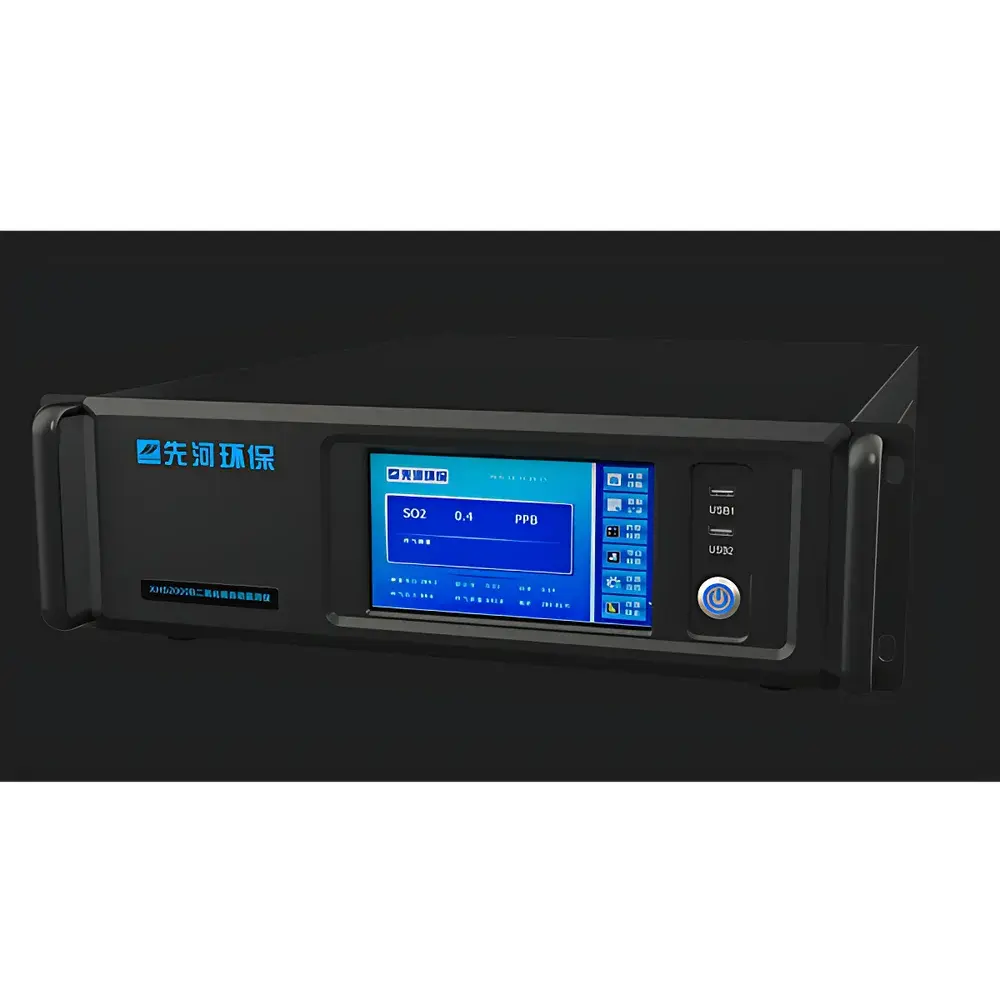
XHS2000B SO₂ Analyzer by SAIL HERO
| Brand | SAIL HERO |
|---|---|
| Origin | Hebei, China |
| Manufacturer Type | Original Equipment Manufacturer (OEM) |
| Country of Origin | China |
| Model | XHS2000B |
| Measured Pollutant | SO₂ |
| Detection Principle | UV Fluorescence (UVF) |
| Interference Mitigation | Integrated Hydrocarbon Scrubber for PAH Removal |
| Compliance | Certified by China Environmental Monitoring Instrument Quality Supervision & Inspection Center |
| Data Storage | >1 year of minute-averaged data (internal dynamic memory) |
| Environmental Compensation | Automatic temperature and pressure compensation |
| Communication Interfaces | RS232, RS485 (standard) |
| User Interface | Chinese-language menu with self-diagnostic and alarm functions |
| Power Recovery | Auto-restart on power restoration |
Overview
The XHS2000B SO₂ Analyzer is a fixed-site, continuous emission monitoring system (CEMS) engineered for high-sensitivity, real-time quantification of sulfur dioxide (SO₂) in ambient air and stack gas applications. It operates on the principle of ultraviolet fluorescence (UVF): SO₂ molecules are excited by pulsed 214 nm UV light, and upon returning to the ground electronic state, emit characteristic fluorescence at ~320 nm. This emitted signal is collected by a cooled photomultiplier tube (PMT), converted to a proportional analog voltage, and digitally processed to yield concentration values in parts per billion (ppb) or micrograms per cubic meter (µg/m³). The analyzer’s optical path is thermally stabilized and sealed against contamination, ensuring long-term baseline stability and minimal drift. Its design adheres to fundamental metrological requirements for environmental trace gas analysis—emphasizing linearity, specificity, and reproducibility under variable ambient conditions.
Key Features
- UV fluorescence detection with inherent selectivity for SO₂—no spectral overlap with NO₂, O₃, or common VOCs when operated within specified lamp bandwidth and optical filtering.
- Integrated hydrocarbon scrubber utilizing catalytic oxidation to remove polycyclic aromatic hydrocarbons (PAHs) and other fluorescent interferents prior to the reaction chamber—critical for urban and industrial monitoring where PAH co-emission is prevalent.
- Automatic temperature and barometric pressure compensation algorithms compliant with ISO 7933 and EPA Method 42 reference protocols, enabling accurate reporting across seasonal and altitudinal variations.
- Onboard diagnostics including lamp intensity monitoring, PMT gain validation, zero/span drift tracking, and flow sensor verification—each logged with timestamps and severity flags.
- Non-volatile internal memory supporting storage of ≥525,600 minute-averaged concentration records, calibration logs (date, operator ID, span gas lot number), and event-triggered alarms (e.g., low flow, high background, communication timeout).
- Modular I/O architecture: standard RS232/RS485 serial interfaces for Modbus RTU or ASCII protocol integration; optional analog outputs (0–5 V DC or 4–20 mA) configured per regulatory data acquisition system (DAS) requirements.
- Fail-safe power management: automatic cold-start sequence upon AC restoration, preserving configuration integrity and resuming measurement without manual intervention.
Sample Compatibility & Compliance
The XHS2000B is validated for use with ambient air (EPA Reference Method EQOA-001), flue gas (post-desulfurization, ≤10 % H₂O content), and indoor workplace environments meeting GB/T 18204.2–2014 (Chinese national standard for SO₂ determination). It satisfies technical criteria outlined in the China Ministry of Ecology and Environment (MEE) “Technical Requirements for Ambient Air Quality Monitoring Instruments” (HJ 653–2013), including zero drift ≤ ±2 ppb/24 h, span drift ≤ ±2 % of full scale/24 h, and response time (T₉₀) ≤ 120 s. Certification documentation includes formal test reports issued by the China Environmental Monitoring Instrument Quality Supervision & Inspection Center (CMA-accredited) and product listing under the China Association of Environmental Protection Industry (CAPI) Environmental Product Certification Scheme—both aligned with GLP-aligned laboratory practices and traceable to national metrological standards.
Software & Data Management
Data export follows standardized CSV and XML schema compatible with national-level air quality data platforms (e.g., CNEMC AQMS). Internal firmware supports audit-trail functionality: all parameter changes, calibration events, and alarm acknowledgments are timestamped, user-ID tagged, and write-protected. Remote configuration and firmware updates are supported via secure serial tunneling; no cloud dependency or proprietary software installation is required. For integration into larger CEMS or SCADA systems, the unit complies with IEC 61131-3 communication profiles and supports configurable polling intervals (1–300 s) and data packet structures per local regulatory DAS specifications.
Applications
- Ambient air quality monitoring networks (AQN) operated by municipal and provincial environmental bureaus.
- Continuous emissions monitoring at coal-fired power plants, cement kilns, and non-ferrous smelters subject to MEE Order No. 15 (2020) emission limits.
- Industrial hygiene assessments in sulfur-processing facilities and chemical manufacturing units.
- Research-grade field studies requiring long-term, unattended SO₂ trend analysis under varying humidity and particulate loading conditions.
- Calibration verification and intercomparison campaigns coordinated by national reference laboratories.
FAQ
What is the detection limit and linear range of the XHS2000B?
The instrument achieves a method detection limit (MDL) of 0.5 ppb (1σ, 60-second averaging) and maintains linearity up to 100 ppm with R² ≥ 0.9999 across five decades.
Does the analyzer require periodic consumables beyond the hydrocarbon scrubber?
The catalytic scrubber cartridge requires replacement every 6 months under continuous operation; UV lamp lifetime exceeds 12,000 hours; no optical filters or reagents are consumed during normal operation.
Is the XHS2000B compatible with international data reporting formats such as AQI or EU Air Quality Directive Annexes?
Yes—concentration outputs can be mapped to EU Directive 2008/50/EC limit values and U.S. NAAQS thresholds via configurable scaling factors and unit conversion tables embedded in the firmware.
How is calibration traceability maintained?
Calibration gases must be certified to ISO 6141 and accompanied by NIST-traceable certificates; onboard zero air is generated via catalytic purification (≤0.1 ppb SO₂ residual), and span verification uses dynamically diluted certified SO₂ standards.
Can the unit operate in high-humidity environments without condensation artifacts?
An integrated Nafion™ dryer module (optional) reduces sample dew point to <5 °C; standard configuration includes heated sample line (60 °C) and condensate trap with level sensing and auto-drain logic.







