
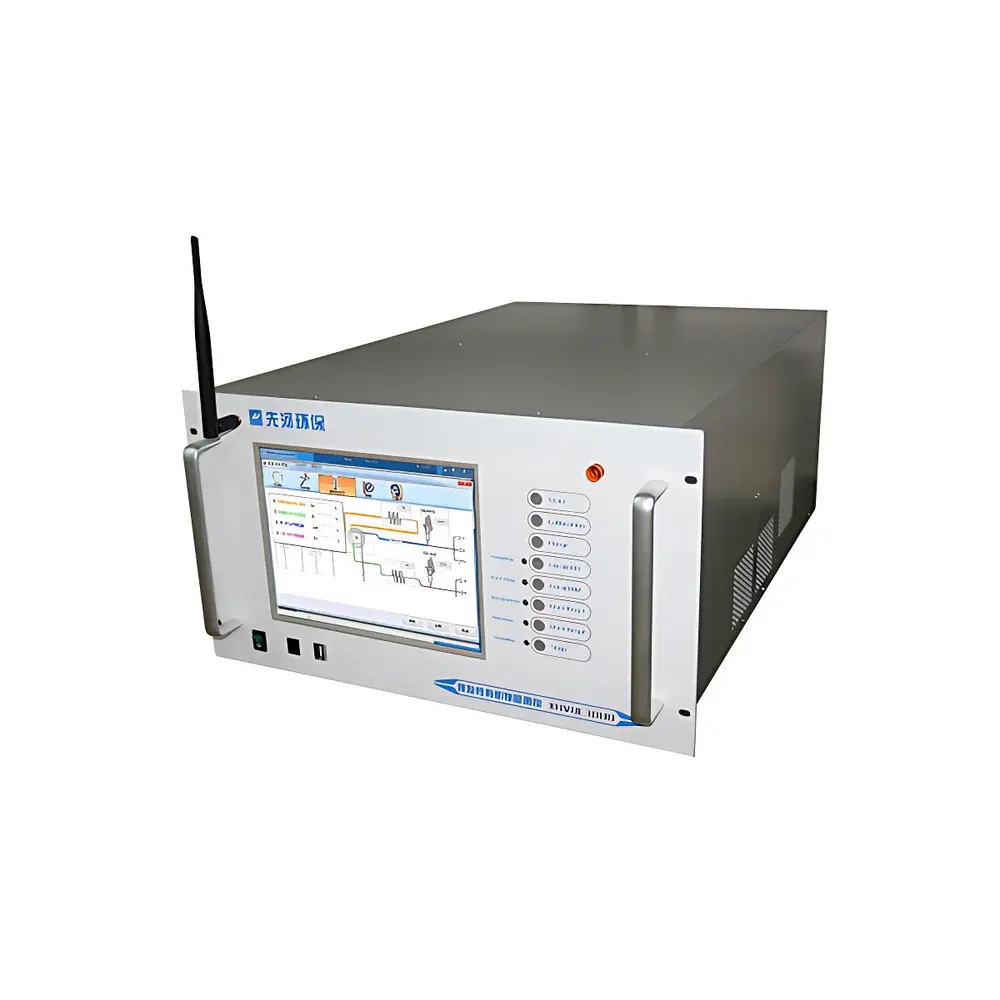
XHVOC 3000 Volatile Organic Compounds (VOCs) Monitoring System by SAIL HERO
| Brand | SAIL HERO |
|---|---|
| Origin | Hebei, China |
| Manufacturer Type | Original Equipment Manufacturer (OEM) |
| Country of Origin | China |
| Model | XHVOC 3000 |
| Pricing | Available Upon Request |
Overview
The XHVOC 3000 Volatile Organic Compounds (VOCs) Monitoring System is a fully integrated, laboratory-grade online gas chromatography–flame ionization detection (GC-FID) platform engineered for continuous, real-time quantification of methane (CH₄), non-methane hydrocarbons (NMHC), and aromatic hydrocarbons—including benzene, toluene, and ethylbenzene (collectively referred to as “BTEX”)—in ambient air, industrial fence-line environments, and emission source stacks. The system operates on the principle of gas-phase separation via capillary column chromatography followed by selective, high-sensitivity detection using a flame ionization detector (FID). Its design complies with core analytical principles outlined in EPA Method TO-15, ASTM D6420, and HJ 1012–2018 (Chinese standard for ambient VOCs monitoring), ensuring trace-level detection capability and metrological traceability. Unlike single-component analyzers, the XHVOC 3000 supports configurable method development to accommodate site-specific regulatory requirements, including extended analysis windows for C₂–C₁₂ hydrocarbons and oxygenated VOCs when coupled with appropriate pre-concentration and column selection.
Key Features
- Compliance-ready methodology: GC-FID configuration aligned with national and international reference methods for NMHC and BTEX quantification, supporting audit-ready data generation.
- Unattended 7×24 operation: Integrated sequence control enables autonomous sample introduction, calibration, analysis, and system diagnostics without manual intervention.
- Electronic Pressure Control (EPC) across all pneumatic channels: Ensures precise, drift-free carrier gas flow (He or N₂), make-up gas, and hydrogen/air ratios for FID—critical for retention time stability and peak area reproducibility over extended campaigns.
- Wide-dynamic-range FID detector: Linear response spanning 10⁶–10⁷ (mass-based), eliminating manual range switching and enabling simultaneous detection of low-ppbv background concentrations and high-ppm stack emissions within a single run.
- Modular expandability: Hardware and software architecture supports field-upgradable configurations—for example, adding a second GC column oven, dual-FID setup, or integration with an optional thermal desorption unit for offline canister analysis.
Sample Compatibility & Compliance
The XHVOC 3000 accepts gaseous samples directly from ambient air intakes, duct-mounted probes, or SUMMA canisters (via optional thermal desorption interface). It accommodates sample matrices containing humidity levels up to 90% RH (non-condensing) and particulate loadings < 10 µg/m³—within typical specifications for EPA-compliant ambient monitoring sites. All hardware components meet IP54 ingress protection standards for outdoor cabinet deployment. Regulatory alignment includes full support for data integrity requirements under GLP and ISO/IEC 17025 frameworks; audit trails, user access controls, and electronic signature functionality are implemented per FDA 21 CFR Part 11 guidelines when paired with the optional XH-DataManager software suite.
Software & Data Management
The embedded XH-Control v3.x firmware provides intuitive method setup, real-time chromatogram visualization, automatic peak integration, and customizable reporting templates (PDF/CSV). Data export conforms to IEEE 1451.2 and ASTM E1461 formats for seamless ingestion into enterprise environmental data management systems (EDMS) or regulatory portals such as China’s National Environmental Monitoring Platform (NEMSP). Remote diagnostics, firmware updates, and secure VPN-based access are supported via TLS 1.2 encrypted communication. All raw chromatographic data, method parameters, and audit logs are stored locally on industrial-grade SSD storage with RAID 1 redundancy and optionally mirrored to network-attached storage (NAS) or cloud repositories compliant with ISO 27001 security policies.
Applications
- Ambient air quality monitoring networks requiring speciated VOC data for ozone precursor assessment and PM₂.₅ secondary organic aerosol (SOA) modeling.
- Fence-line monitoring at petrochemical complexes, refineries, and solvent-using facilities to verify compliance with local VOC emission limits (e.g., China’s GB 37822–2019).
- Source testing and continuous emission monitoring (CEMS) for combustion processes, coating operations, and wastewater treatment off-gas streams.
- Research applications in atmospheric chemistry, including VOC reactivity studies, emission factor validation, and intercomparison campaigns with PTR-MS or GC-MS platforms.
FAQ
Does the XHVOC 3000 support quantitative analysis of individual BTEX compounds?
Yes—the system is configured with a polarizable capillary column (e.g., DB-624 or equivalent) and optimized temperature ramping to baseline-resolve benzene, toluene, ethylbenzene, xylenes, and styrene with Rs ≥ 1.5.
Can it be integrated with existing SCADA or EMS infrastructure?
Yes—Modbus TCP, OPC UA, and MQTT protocols are natively supported for bidirectional communication with plant-level automation systems.
What maintenance intervals are recommended for routine operation?
FID nozzle cleaning and detector optimization every 90 days; GC column bake-out every 30 days; EPC valve calibration annually or after 5000 operational hours.
Is third-party certification available for regulatory reporting?
SAIL HERO provides factory-issued performance verification reports traceable to NIM (National Institute of Metrology, China); site-specific certification per CNAS accreditation may be arranged through authorized partners.







