
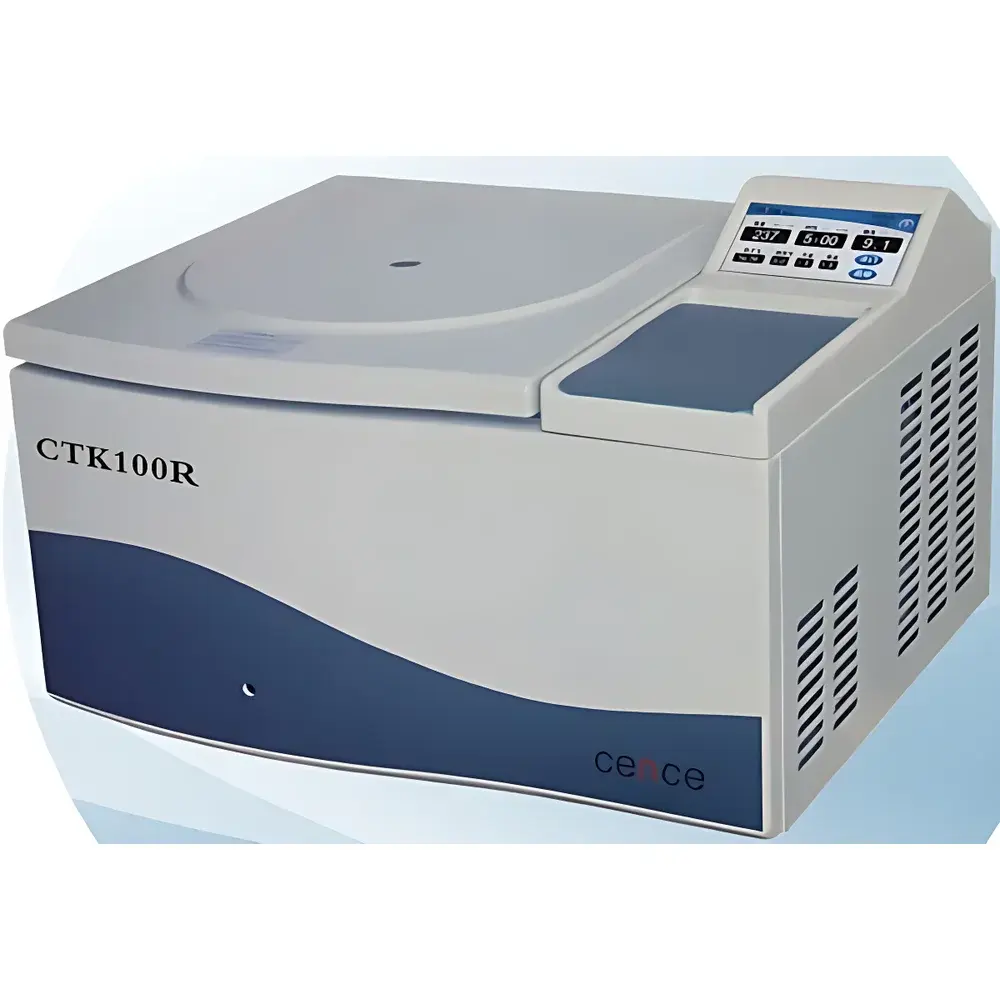
Xiangyi CTK100R Automatic Cap-Removal Refrigerated Centrifuge
| Brand | Xiangyi |
|---|---|
| Origin | Hunan, China |
| Manufacturer Type | Direct Manufacturer |
| Product Category | Domestic |
| Model | CTK100R |
| Instrument Type | Benchtop Centrifuge |
| Speed Class | Low-Speed Centrifuge (max. 4000 rpm) |
| Function | Refrigerated Centrifuge |
| Configuration | Horizontal Rotor Centrifuge |
| Separation Target | Large Organelles / Viruses |
| Max Capacity | 100 tubes (4 × 25 vacuum blood collection tubes, 75 mm length) or 84 tubes (100 mm length) |
| Max Speed | 4000 rpm |
| Max RCF | 3030 × g |
| Dimensions | 710 × 560 × 450 mm (L × W × H) |
| Weight | 95 kg |
| Temperature Range | −20 °C to +40 °C |
| Temp. Accuracy | ±1 °C |
| Refrigerant | R404a |
| Power Supply | AC 220 V, 50 Hz, 18 A |
| Total Power | 1500 W |
| Noise Level | ≤62 dB(A) |
| Timer Range | 1 s – 99 min 59 s |
| Drive System | AC Frequency-Controlled Motor |
| Rotor Balance | Automatic Dynamic Balancing |
| Safety | Electronic Lid Lock with Interlock (prevents start if lid open |
| Vibration Damping | Patented Dual-Stage Shock Absorption System |
| Display | High-Contrast LCD Touch Panel |
| RCF Calculation | Real-time Auto-Computation |
| Cap Removal Rate | >90% success rate for standard vacuum blood collection tubes (75 mm and 100 mm) |
Overview
The Xiangyi CTK100R Automatic Cap-Removal Refrigerated Centrifuge is a purpose-engineered benchtop instrument designed specifically for high-throughput clinical laboratories processing vacuum blood collection tubes. Unlike conventional centrifuges requiring manual cap removal post-separation—a step prone to operator-induced re-suspension, cross-contamination, and biosafety risk—the CTK100R integrates synchronized refrigerated centrifugation with automated, non-contact cap ejection. Its operational principle combines precisely controlled low-speed sedimentation (up to 4000 rpm, 3030 × g) with programmable temperature maintenance (−20 °C to +40 °C) and a mechanically actuated, tube-length-adaptive cap-removal mechanism. This integrated workflow eliminates manual handling between centrifugation and downstream analysis (e.g., serum/plasma aspiration, immunoassay loading), supporting ISO 15189-compliant pre-analytical standardization and reducing turnaround time in hematology and clinical chemistry workflows.
Key Features
- Automated cap removal system with >90% success rate across two standard vacuum tube lengths (75 mm and 100 mm), minimizing aerosol generation and operator exposure
- Refrigerated operation with high-efficiency imported R404a compressor and ±1 °C temperature control accuracy—critical for preserving thermolabile analytes (e.g., cortisol, ACTH, free T4)
- AC frequency-controlled motor enabling precise speed regulation (1–4000 rpm), rapid acceleration/deceleration profiles, and consistent rotor inertia management
- Real-time RCF (Relative Centrifugal Force) calculation displayed dynamically on the high-resolution LCD touch interface—eliminating manual conversion errors
- Dual-stage vibration damping architecture with self-adjusting dynamic balancing—ensures stable operation at full load (100 × 75 mm tubes) and extends bearing service life
- Electronically interlocked safety lid: prevents initiation if improperly closed; triggers immediate rotor deceleration and power cutoff upon unauthorized opening during run
- Intuitive touch-panel interface with multi-language support (English default), password-protected method storage, and audit-ready parameter logging
Sample Compatibility & Compliance
The CTK100R accommodates standardized vacuum blood collection tubes compliant with CLSI H20-A3 and ISO 6710 specifications—including EDTA-K2, heparin, serum separator (SST), and lithium heparin tubes. Its horizontal rotor configuration supports both 75 mm (max. 100 tubes, 4 × 25) and 100 mm (max. 84 tubes) formats without adapter changes. The instrument meets IEC 61010-1:2010 for laboratory electrical safety and incorporates design elements aligned with ISO 13485 quality management requirements for in vitro diagnostic (IVD) support equipment. Temperature stability and RCF reproducibility are validated per ASTM E2920-13 for centrifuge performance verification under routine load conditions.
Software & Data Management
While the CTK100R operates as a standalone unit, its embedded firmware supports GLP/GMP-aligned data integrity practices. All run parameters—including speed, time, temperature setpoint, actual RCF, final rotor temperature, and cap-removal status per batch—are timestamped and stored locally (≥1000 cycle history). Optional RS232/USB interfaces enable export of CSV-formatted logs for integration into LIMS or electronic lab notebooks. Audit trails comply with FDA 21 CFR Part 11 principles when paired with validated third-party software—user actions, parameter modifications, and error events are non-erasable and attributable.
Applications
- Routine serum and plasma separation in hospital core labs and reference laboratories
- Pre-analytical processing for immunoassays (e.g., ELISA, chemiluminescence), coagulation testing (PT, aPTT), and flow cytometry sample prep
- Viral load sample preparation where cold-chain integrity and minimal mechanical disturbance are required
- Blood bank operations involving platelet-poor plasma isolation prior to cryopreservation
- Research applications demanding reproducible organelle pelleting (e.g., mitochondria, lysosomes) from whole blood or buffy coat fractions
FAQ
Does the CTK100R support rotor autoclaving or chemical disinfection?
No—rotors and cap-removal mechanisms are precision-machined aluminum assemblies; cleaning must follow manufacturer-recommended protocols using 70% ethanol or isopropyl alcohol wipes. Autoclaving or immersion in corrosive agents voids warranty.
Can the instrument maintain −20 °C while operating at maximum speed?
Yes—the dual-circuit refrigeration system sustains −20 °C setpoint across the full speed range (1–4000 rpm) under nominal ambient conditions (≤25 °C, ≤60% RH). Performance validation reports available upon request.
Is the cap-removal mechanism compatible with non-standard or custom-labeled tubes?
Cap removal is optimized for ISO 6710-conforming tubes with standard crimped aluminum caps and polypropylene bodies. Tubes with oversized labels, adhesive overlaps, or non-uniform cap geometry may reduce success rate below 90%.
What documentation is provided for regulatory submissions?
Xiangyi supplies CE Declaration of Conformity (Annex II), Factory Calibration Certificate (traceable to NIM), Electrical Safety Test Report (IEC 61010-1), and Refrigeration Performance Validation Protocol—suitable for inclusion in ISO 15189 or CAP accreditation dossiers.



