
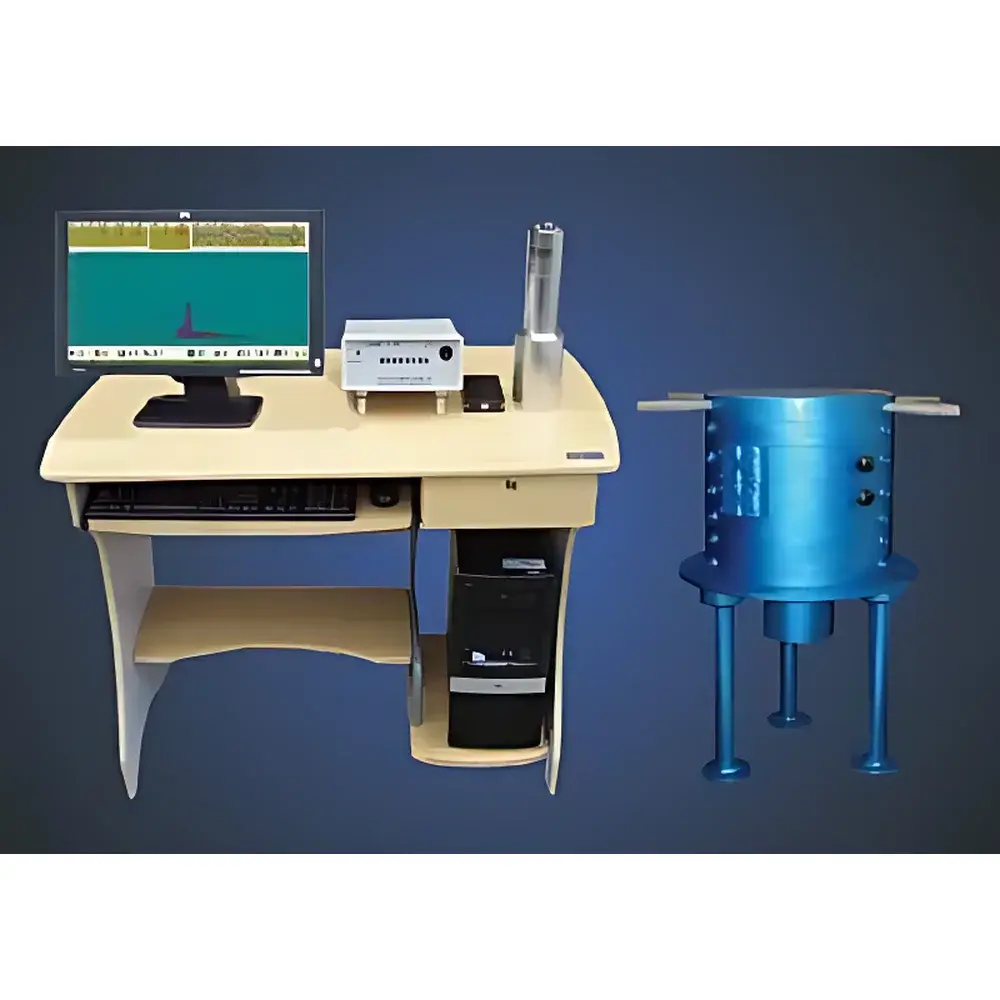
Xianxinda CIT-3000F Low-Background Multi-Channel Gamma Spectrometer for Building Material Radioactivity Testing
| Brand | Xianxinda |
|---|---|
| Model | CIT-3000F |
| Detector Type | Gamma Spectrometer |
| Scintillator | NaI(Tl), Ø75 mm × 75 mm |
| Shielding | Lead chamber, 100 mm wall thickness, 200 mm internal diameter |
| MCA Channels | 1024 / 2048 |
| Energy Resolution | <7% at 661 keV (¹³⁷Cs) |
| Differential Nonlinearity | 0.2% |
| Integral Nonlinearity | 0.01% |
| Pulse Shaping Time | 2.0 µs |
| Background Count Rate | ≤6 cps (50–3000 keV) |
| Measurement Uncertainty | ≤10% (k=2) |
| Stability | Peak shift ≤1% over 24 h |
| Sample Mass | 500 g |
| Acquisition Time Range | 10–65,500 s |
| Operating Temperature | 0–50 °C |
| Relative Humidity | ≤95% |
| Power Consumption | <300 mA |
| Host Dimensions | 31 × 32 × 13 cm |
| Host Weight | 3 kg |
| Software | Windows-based spectral analysis suite with Chinese GUI, Excel export, calibration database, and inverse matrix quantification algorithm |
| Compliance | JJG 417–2006, GB 6566–2010, CNAS-accredited calibration certificate issued by China National Institute of Metrology (CNIM) |
Overview
The Xianxinda CIT-3000F Low-Background Multi-Channel Gamma Spectrometer is a purpose-built nuclear measurement instrument engineered for quantitative determination of natural radionuclides—specifically ²²⁶Ra, ²³²Th, and ⁴⁰K—in construction materials, geological samples, and environmental matrices. It operates on the principle of gamma-ray spectroscopy using a high-sensitivity, low-potassium thallium-doped sodium iodide [NaI(Tl)] scintillation detector coupled to a digital multi-channel analyzer (MCA). The system achieves high counting efficiency and spectral fidelity through optimized pulse processing, real-time automatic gain stabilization, and advanced peak deconvolution via inverse matrix algorithms. Designed in strict accordance with JJG 417–2006 (Chinese metrological verification regulation) and GB 6566–2010 (limiting standards for radioactivity in building materials), the CIT-3000F serves as a legally traceable reference instrument for regulatory compliance testing in national quality supervision, third-party laboratories, and provincial radiation monitoring centers.
Key Features
- Digital pulse processing architecture with trapezoidal shaping (2.0 µs) ensures high throughput without dead-time losses or pulse pile-up distortion.
- Adjustable acquisition time from 10 s to 65,500 s enables flexible method optimization—from rapid field screening (e.g., 1,000 s model establishment) to high-precision laboratory quantification (e.g., 3,600 s per sample).
- Low-background lead shielding chamber (100 mm thick, 200 mm internal diameter) reduces ambient gamma contribution to ≤6 counts per second across 50–3000 keV, enhancing detection sensitivity for low-activity samples.
- High-resolution NaI(Tl) detector (Ø75 mm × 75 mm) delivers energy resolution better than 7% FWHM at 661 keV (¹³⁷Cs), supporting reliable separation of overlapping gamma lines from Ra, Th, and K decay chains.
- Computer-controlled gain adjustment with 1–65,535 digital steps enables precise energy calibration stability; long-term drift remains within ±1% over 24 hours.
- Modular hardware design features single-point magnetic-shielded detector coupling, minimizing susceptibility to external electromagnetic interference.
- Inverse matrix quantification algorithm corrects for inter-nuclide spectral interference (e.g., ²¹⁴Bi and ²²⁸Ac overlaps), improving accuracy of activity concentration calculations without manual peak fitting.
Sample Compatibility & Compliance
The CIT-3000F accepts standardized cylindrical samples of 500 g mass, prepared in sealed geometry (e.g., Marinelli beakers or standard polystyrene containers) to ensure reproducible self-absorption correction. It supports certified reference materials for ²²⁶Ra, ²³²Th, and ⁴⁰K (supplied with NIM-certified certificates) and is validated for routine analysis of cement, concrete aggregates, ceramic tiles, gypsum board, fly ash, and natural stone. Instrument performance meets metrological requirements defined in JJG 417–2006 and analytical validation criteria outlined in GB 6566–2010. All calibrations are traceable to national primary standards maintained by the China National Institute of Metrology (CNIM), and the system carries official verification documentation compliant with GLP-aligned laboratory practices.
Software & Data Management
The bundled Windows-native software provides full spectral acquisition, energy calibration, region-of-interest (ROI) definition, nuclide identification, and activity calculation. Its bilingual interface (Chinese/English toggle optional) includes context-sensitive help, automated background subtraction, and dynamic library management for user-defined standards and sample histories. Raw spectra and processed results—including net peak areas, efficiency-corrected activities (Bq/kg), and expanded uncertainty (k = 2)—are stored in structured binary format with timestamped metadata. Export functionality supports direct generation of Excel-compatible reports with customizable templates, audit-trail logs, and PDF certificate output. The software implements data integrity safeguards consistent with basic ALCOA+ principles, including electronic signatures, version-controlled methods, and immutable record retention.
Applications
- Regulatory screening of building materials for compliance with national radioactivity limits (GB 6566–2010 Class A/B/C classification).
- Quantitative assessment of natural radionuclide concentrations in raw mineral feedstocks used in cement and brick manufacturing.
- Environmental baseline surveys of soil, sediment, and fly ash for radiological impact assessments.
- Validation of radon exhalation rate models via ²²⁶Ra activity measurement in porous construction media.
- Method development and inter-laboratory comparison studies under CNAS or ISO/IEC 17025 accreditation frameworks.
- Field-deployable rapid analysis when paired with portable power supply and ruggedized laptop configuration.
FAQ
What radionuclides can the CIT-3000F quantify?
The instrument is calibrated and validated for ²²⁶Ra (via ²¹⁴Bi at 609 keV), ²³²Th (via ²²⁸Ac at 911 keV and ²¹²Pb at 239 keV), and ⁴⁰K (at 1461 keV); it also detects ¹³⁷Cs (662 keV) and ²⁴¹Am (59.5 keV) for cross-checking and contamination screening.
Is the system compliant with international radiation metrology standards?
While primarily aligned with Chinese national standards (JJG 417, GB 6566), its measurement uncertainty (≤10%, k=2), energy resolution, and calibration traceability meet technical equivalency with ISO 11929 and IEC 61452 requirements for gamma spectrometry in environmental radioactivity testing.
Can the CIT-3000F operate without a dedicated laboratory setup?
Yes—the compact host unit (3 kg, 31×32×13 cm) and modular probe allow deployment in mobile labs or field environments; however, optimal low-background performance requires use of the supplied 100-mm lead shield and stable temperature/humidity conditions (0–50 °C, ≤95% RH).
How is spectral interference between Ra and Th peaks resolved?
The software applies an experimentally derived inverse matrix correction based on multi-line least-squares fitting, which accounts for co-emitted gamma rays and detector response functions—eliminating reliance on manual peak deconvolution or empirical correction factors.
Does the system support remote operation or networked data transfer?
It communicates via RS-232C serial interface; while native TCP/IP or Ethernet is not integrated, third-party middleware or custom scripts can enable secure data forwarding to LIMS platforms using standard COM port emulation protocols.







