
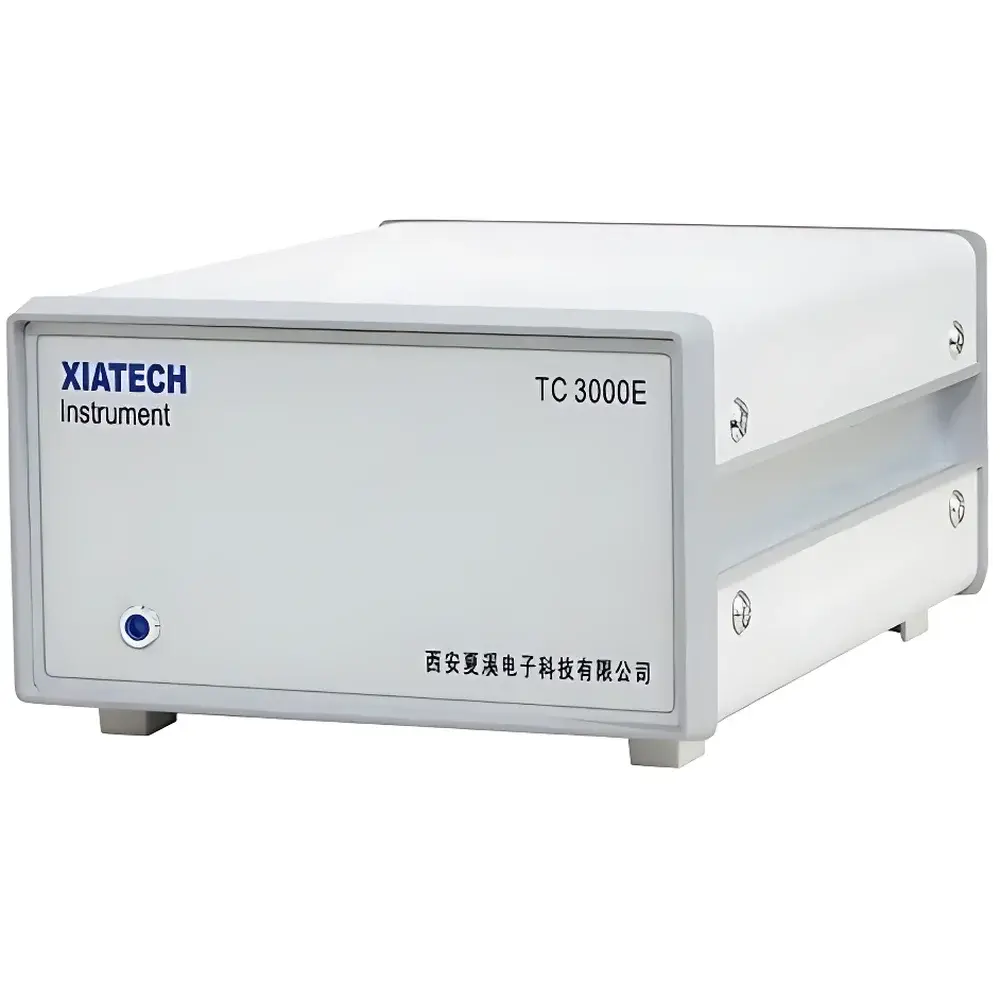
Xiatech TC3000E Portable Transient Hot Wire Thermal Conductivity Analyzer
| Brand | Xiatech |
|---|---|
| Model | TC3000E |
| Measurement Principle | Transient Hot Wire Method |
| Thermal Conductivity Range | 0.001–50 W/(m·K) (extendable to 100 W/(m·K)) |
| Accuracy | ±3% |
| Repeatability | ±3% |
| Resolution | 0.0005 W/(m·K) |
| Sample Temperature | Ambient (20–25 °C) |
| Test Atmosphere | Air (vacuum module optional) |
| Sample Forms | Solid blocks, sheets, powders, granules, pastes, gels, liquids |
| Minimum Solid Sample Size | >25 mm edge length (thickness varies by material) |
| Minimum Liquid/Gel/Paste Volume | >50 mL |
| Data Acquisition Time | 1–20 s |
| Dimensions (L×W×H) | 350 × 250 × 150 mm |
| Compliance | ASTM C1113, ASTM D5930, GB/T 10297, GB/T 11205 |
| Interface | USB |
Overview
The Xiatech TC3000E Portable Transient Hot Wire Thermal Conductivity Analyzer is a compact, field-deployable instrument engineered for rapid, reliable measurement of thermal conductivity across a broad spectrum of materials under ambient conditions. It operates on the internationally standardized transient hot wire (THW) method—a well-established absolute technique grounded in Fourier’s law of heat conduction. In this method, a thin, electrically heated platinum or nickel wire probe acts simultaneously as both heater and temperature sensor. When immersed in or inserted into a sample, a constant current pulse induces a controlled temperature rise; the resulting time-dependent voltage response is directly related to the material’s thermal conductivity via analytical solution of the radial heat diffusion equation. This principle ensures high intrinsic accuracy without calibration against reference standards—making the TC3000E particularly suitable for R&D labs requiring traceable, first-principles-based data and for quality control engineers conducting on-site verification of thermal insulation performance, interface thermal resistance, or phase-change material consistency.
Key Features
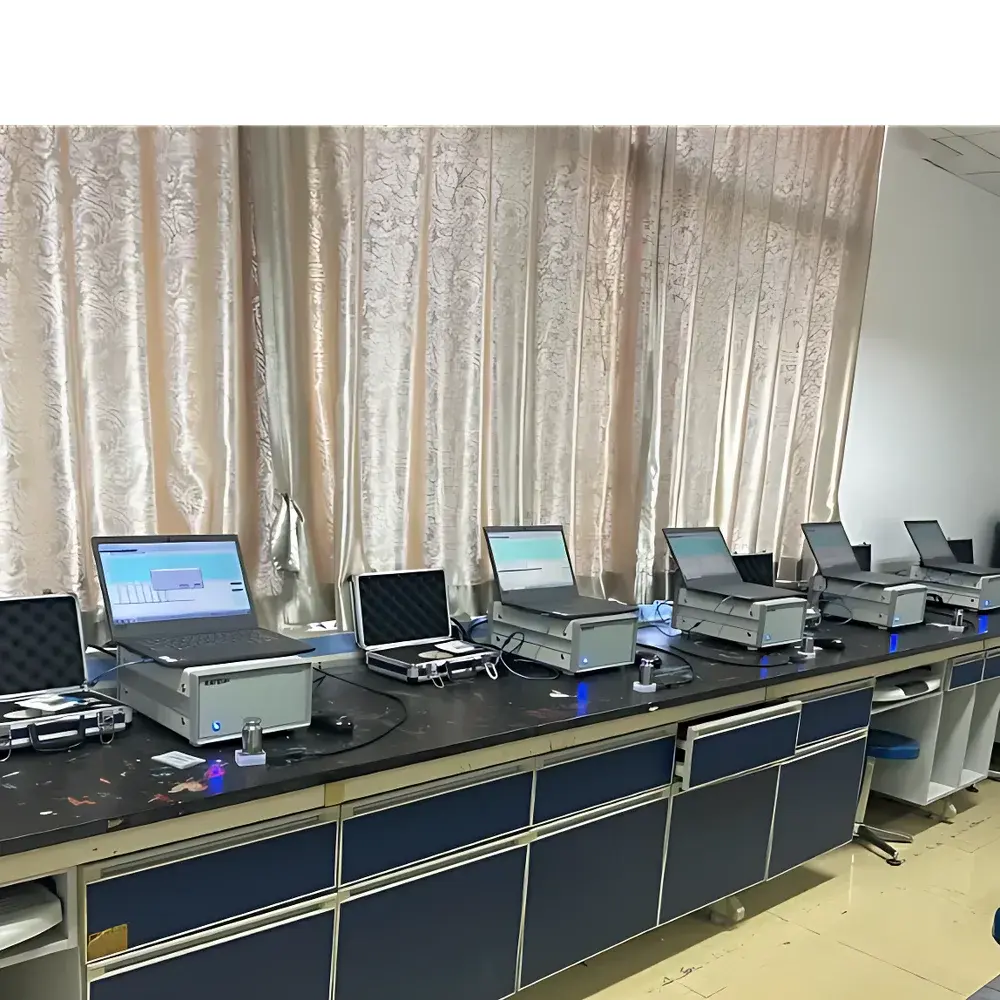
- Portable architecture: Weighing under 4.5 kg with integrated battery option (optional), the TC3000E is designed for benchtop, mobile lab, and field use—including construction sites, manufacturing floors, and geological survey locations.
- Universal probe compatibility: A single THW probe accommodates solids (blocks, irregular shapes), powders (loose or compacted), pastes, gels, and liquids—eliminating the need for probe swaps or mechanical fixtures.
- Rapid acquisition: Full thermal conductivity determination completed within 1–20 seconds per measurement, enabling high-throughput screening of batch samples or time-resolved monitoring during curing or hydration processes.
- Low sample demand: Requires only ≥25 mm edge-length for solid specimens (thickness determined empirically per material class); ≥50 mL for fluids and semi-solids—minimizing material waste and enabling testing of precious or limited-availability samples.
- Non-destructive operation: The THW method imposes negligible thermal perturbation and causes no structural alteration—critical for moisture-sensitive composites, biological tissues, or soft functional materials where integrity must be preserved post-test.
- Robust environmental tolerance: Operates stably at ambient laboratory or industrial conditions (20–25 °C, 30–70% RH); optional vacuum module enables low-pressure measurements to isolate gas-phase conduction effects in porous media.
Sample Compatibility & Compliance
The TC3000E supports heterogeneous sample morphologies without preprocessing: rigid solids (ceramics, metals, polymers), compliant elastomers (silicone rubbers, foams), particulate systems (metal powders, mineral aggregates), dispersions (nanofluids, colloidal suspensions), and viscous media (thermal greases, cosmetic gels, pharmaceutical emulsions). Its compliance with ASTM C1113 (standard test method for thermal conductivity of refractory materials by the hot-wire method), ASTM D5930 (standard test method for thermal conductivity of plastics), GB/T 10297 (Chinese national standard for thermal conductivity of insulating materials), and GB/T 11205 (rubber thermal conductivity) ensures data acceptance in regulatory submissions, inter-laboratory round robins, and ISO/IEC 17025-accredited environments. While not inherently GLP-compliant, the instrument’s deterministic physics-based output and USB-stored raw time-voltage datasets support audit-ready documentation when integrated into validated SOPs.
Software & Data Management
Bundled Windows-compatible software provides real-time curve visualization, automatic baseline correction, selectable fitting intervals (to exclude contact resistance artifacts), and export of conductivity values with uncertainty estimates. All raw voltage-vs.-time traces are saved in CSV format for secondary analysis using third-party tools (e.g., MATLAB, Python SciPy). The software logs operator ID, timestamp, ambient temperature, and probe serial number—facilitating traceability in multi-user facilities. Though lacking native 21 CFR Part 11 electronic signature functionality, audit trails can be maintained externally via file versioning and network-access-controlled storage, aligning with basic GMP documentation requirements for QC release testing.
Applications
- Building science: On-site verification of aerogel blankets, mineral wool, EPS/XPS foam panels, and vacuum insulation panels (VIPs).
- Electronics thermal management: Characterization of thermal interface materials (TIMs)—including silicone-based greases, phase-change pads, and metal-filled adhesives—before and after thermal cycling.
- Geotechnical & energy storage: In-field assessment of soil thermal resistivity for ground-source heat pump design; thermal diffusivity mapping of latent heat storage composites.
- Materials development: Screening of polymer nanocomposites, ceramic matrix formulations, and bio-based insulators during formulation optimization.
- Life sciences: Quantification of thermal transport in hydrogels, tissue-mimetic scaffolds, and cryopreservation media—where conventional guarded-hot-plate methods fail due to sample fragility or hydration loss.
FAQ
What is the minimum sample thickness required for solid measurements?
For optimal accuracy, solid samples should have an edge length ≥25 mm; thickness depends on thermal diffusivity—typically ≥10 mm for low-conductivity polymers and ≥3 mm for metals. Empirical validation is recommended for anisotropic or layered structures.
Can the TC3000E measure anisotropic materials?
Yes—by orienting the probe along principal axes and comparing results. However, directional resolution is limited by probe geometry; dedicated anisotropy modules are not included but can be implemented via custom fixture design.
Is vacuum operation necessary for accurate low-k measurements?
Not mandatory, but strongly advised for materials with k < 0.1 W/(m·K) (e.g., silica aerogels) to suppress convective interference in air-filled pores. The optional vacuum module achieves ≤10 Pa base pressure.
How does the TC3000E handle highly reflective or electrically conductive surfaces?
The THW method is insensitive to surface emissivity or electrical conductivity—unlike laser flash or photothermal techniques—making it uniquely suited for metals, graphite composites, and metallized films.
Does the instrument support automated temperature control?
No—the TC3000E operates exclusively at ambient temperature. For variable-temperature studies, external environmental chambers compatible with probe insertion are required.



