
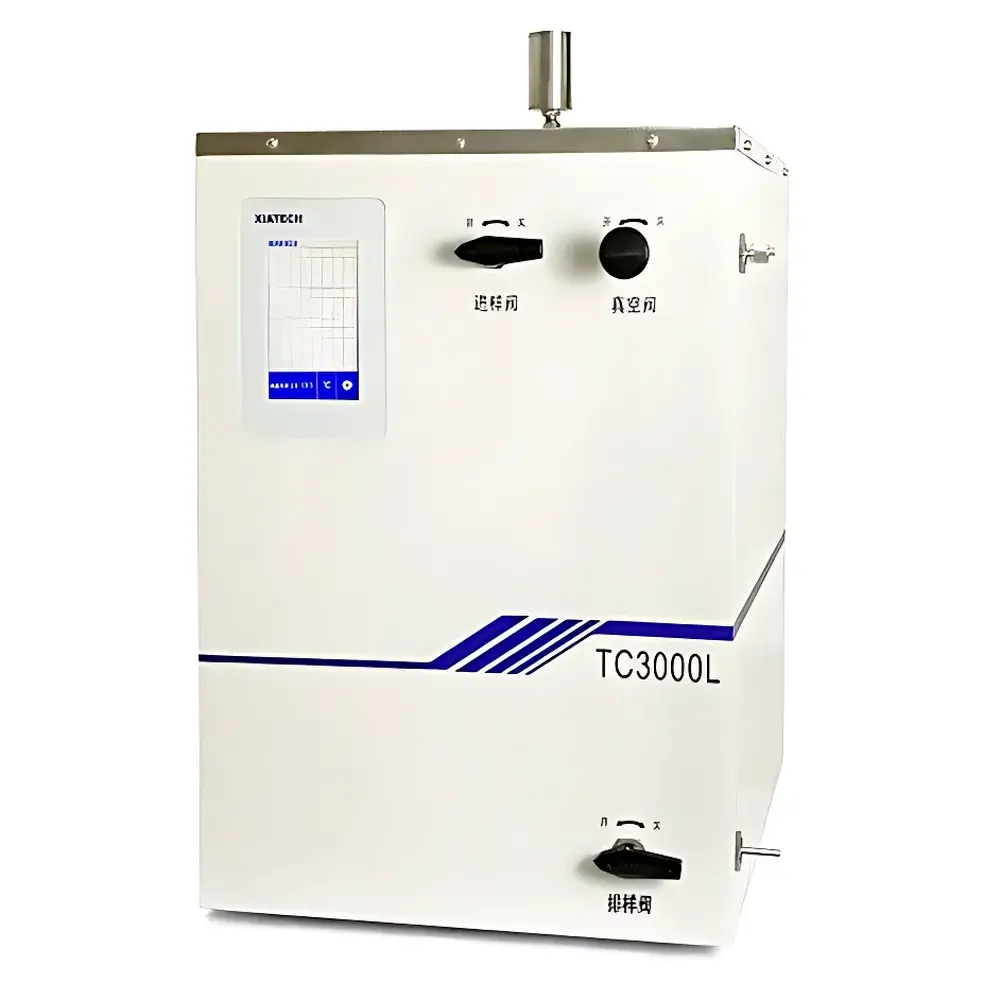
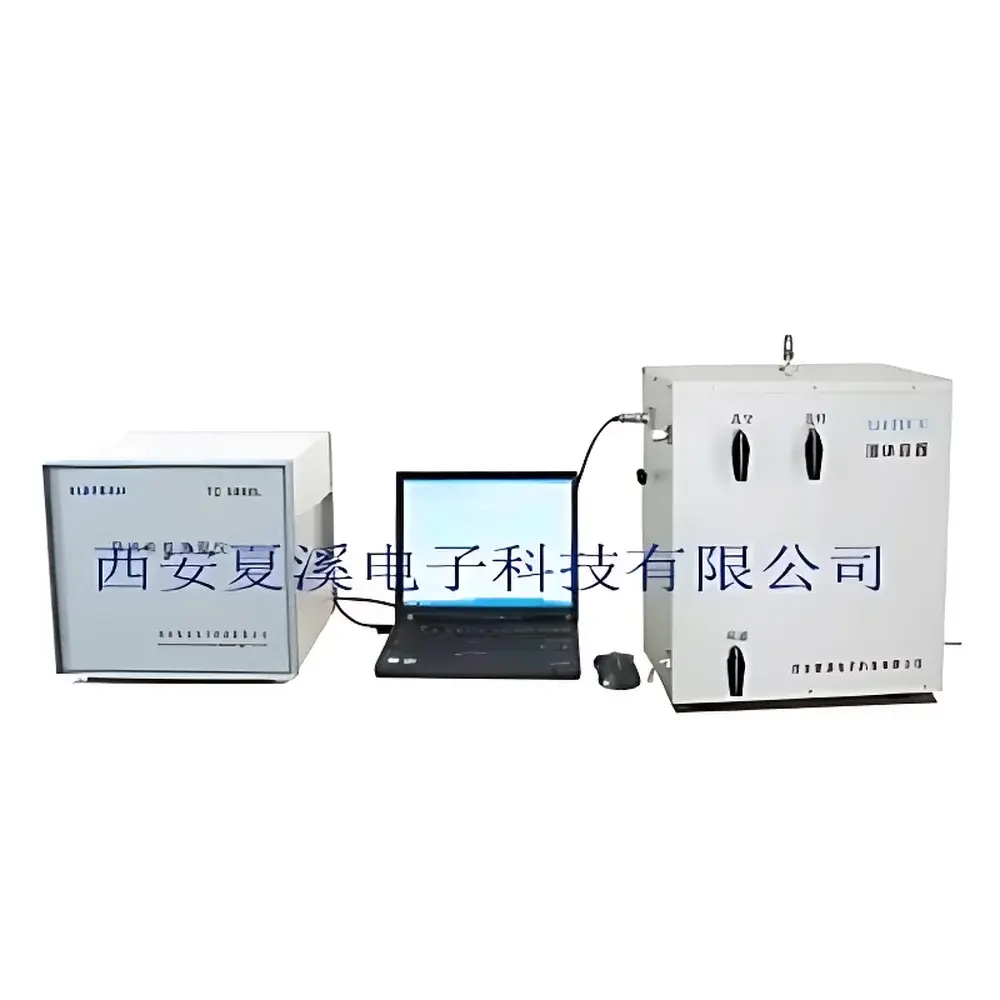
Xiatech TC3000L Transient Hot-Wire Thermal Conductivity Analyzer
| Brand | Xiatech |
|---|---|
| Model | TC3000L |
| Measurement Principle | Transient Hot-Wire Method |
| Temperature Range | –30 to 200 °C (depending on configuration) |
| Pressure Range | 0.1–15 MPa |
| Thermal Conductivity Range | 0.0005–5 W/(m·K) |
| Resolution | 0.0001 W/(m·K) |
| Accuracy | ±2–3% |
| Repeatability | ±2–3% |
| Sample Volume Required | ≥40 mL |
| Sample States | Liquid and gaseous phases |
| Test Atmosphere | Vacuum-compatible |
| Dimensions (L×W×H) | 550×500×600 mm |
| Compliance | ASTM D2717, ASTM D7896 |
| Data Interface | USB |
| Operating System | Windows |
Overview
The Xiatech TC3000L is a precision-engineered transient hot-wire (THW) thermal conductivity analyzer designed for high-accuracy, rapid characterization of thermal transport properties in fluids under controlled temperature and pressure conditions. Based on the fundamental principle of transient heat conduction in an infinite medium, the instrument measures the time-dependent temperature rise of a thin, electrically heated wire immersed in the sample fluid. By analyzing the linear relationship between temperature and natural logarithm of time in the early-stage response (typically within 2 seconds), the system calculates thermal conductivity with minimal influence from natural convection—especially critical for low-viscosity liquids and gases. Its robust mechanical architecture, including vibration-damping structural design and thermally stabilized probe housing, ensures measurement integrity in laboratory and pilot-scale environments where ambient disturbances are non-negligible. The TC3000L is explicitly engineered for research-grade fluid property databases, formulation development, and process fluid qualification across energy, chemical, and advanced materials sectors.
Key Features
- Rapid measurement cycle: Full thermal conductivity determination completed within ≤2 seconds—significantly reducing convective interference and enabling high-throughput screening.
- High metrological fidelity: Validated against certified reference materials (e.g., toluene and deionized water), delivering accuracy better than ±0.5% at calibration points and ≤±3% across the full 0.0005–5 W/(m·K) range.
- Extended operational envelope: Supports testing from –30 °C to 200 °C and up to 15 MPa, accommodating sub-ambient cryogenic liquids, high-temperature heat-transfer fluids, and pressurized refrigerant blends.
- Minimal sample consumption: Requires only ≥40 mL per test—critical for expensive or hazardous formulations such as ionic liquids, nanofluids, or novel refrigerants.
- Vacuum-compatible cell design: Enables measurements under inert or reduced-pressure atmospheres to suppress oxidation, boiling, or gas-phase interference during high-temperature liquid testing.
- Compliance-ready architecture: Fully aligned with ASTM D2717 (Standard Test Method for Thermal Conductivity of Liquids) and ASTM D7896 (Standard Test Method for Thermal Conductivity of Refrigerants and Refrigerant Mixtures), supporting regulatory submissions and inter-laboratory data comparability.
Sample Compatibility & Compliance
The TC3000L accommodates a broad spectrum of fluidic samples—including polar and non-polar liquids, supercritical fluids, and low-density gases—without requiring phase-specific hardware modifications. Verified applications include nanofluids (e.g., TiO₂, Al₂O₃, Fe₃O₄, ZrO₂ dispersions), hydrocarbon fuels (gasoline, diesel, kerosene), refrigerants (R134a, R12, R22, R123, dimethyl ether), lubricants, heat-transfer oils, antifreeze solutions, molten salts, and ionic liquids. All measurements adhere to GLP-aligned documentation practices, with timestamped raw voltage-time traces, environmental parameter logging (T, P), and automated uncertainty propagation per ISO/IEC 17025 guidelines. The system supports audit-ready data export compliant with FDA 21 CFR Part 11 requirements when integrated with validated third-party LIMS platforms.
Software & Data Management
The TC3000L operates via a dedicated Windows-based control suite featuring real-time signal visualization, adaptive curve-fitting algorithms (log(t)-based slope extraction), and automatic baseline correction. Raw thermal decay profiles are stored in HDF5 format with embedded metadata (sample ID, T/P setpoints, operator, calibration certificate ID). Export options include CSV, Excel, and XML for integration into MATLAB, Python (NumPy/Pandas), or enterprise data lakes. Software includes built-in validation tools for drift monitoring, probe resistance tracking, and statistical outlier detection per ISO 5725. Firmware updates and calibration traceability are managed through digitally signed packages with SHA-256 verification.
Applications
- Thermophysical property validation for computational fluid dynamics (CFD) and equation-of-state (EOS) model development.
- Quality control of thermal management fluids in EV battery cooling systems and data center immersion cooling.
- Refrigerant blend optimization under ASHRAE Standard 34 safety classifications.
- Nanofluid stability and thermal enhancement ratio (TER) quantification across temperature gradients.
- Formulation screening of low-GWP alternatives in HVAC&R applications.
- Supporting ASTM-compliant material safety data sheet (MSDS) and technical datasheet generation.
FAQ
What measurement standard does the TC3000L comply with?
ASTM D2717 and ASTM D7896—both specifying transient hot-wire methodology, probe geometry tolerances, and uncertainty reporting protocols.
Can the TC3000L measure gases?
Yes—its sensitivity down to 0.0005 W/(m·K) and vacuum-compatible cell enable reliable thermal conductivity determination for low-density gases and vapor-phase refrigerants.
Is pressure control integrated or optional?
Pressure regulation (0.1–15 MPa) is available as a configurable module; base systems operate at ambient or vacuum pressure.
How is calibration traceability maintained?
Each instrument ships with NIST-traceable calibration using primary-standard fluids (toluene, water); annual recalibration is recommended per ISO/IEC 17025.
Does the software support multi-user access with role-based permissions?
Native software provides single-user operation; enterprise deployment with role-based LIMS integration requires optional validation package and IT infrastructure alignment.



