
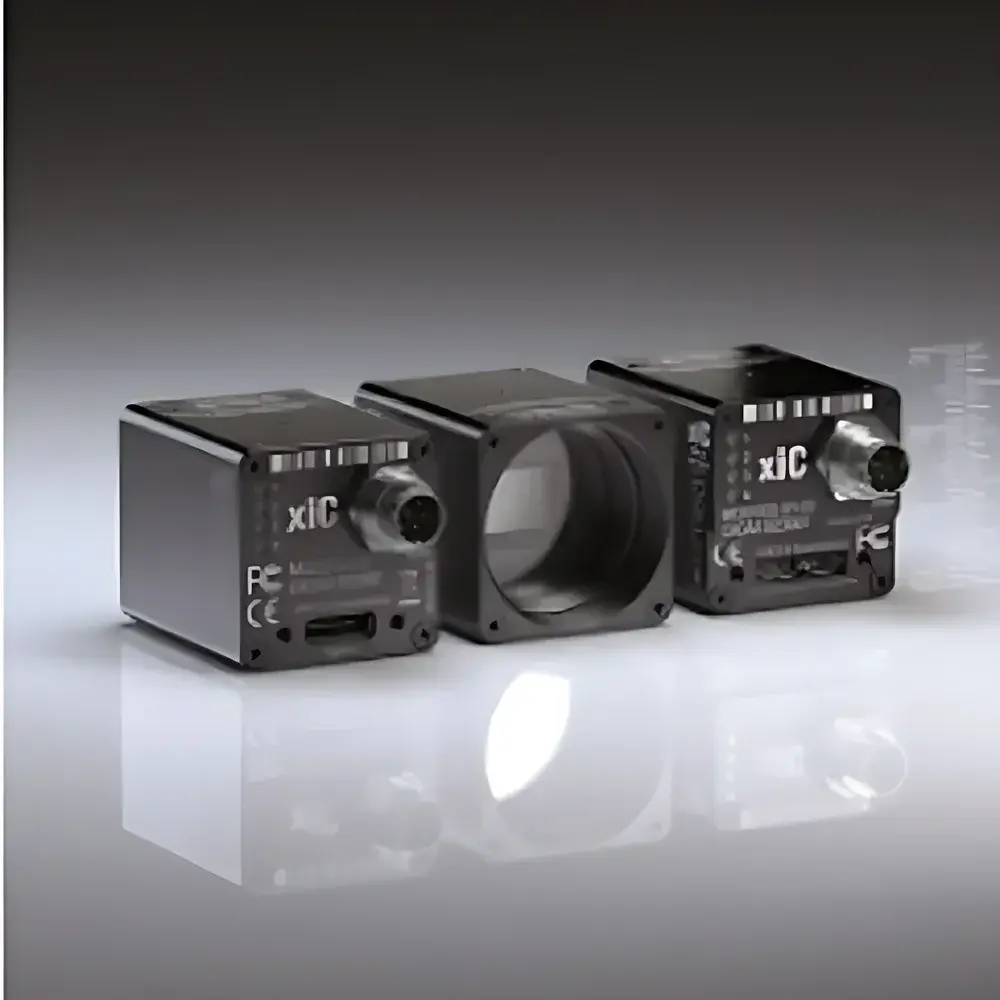
XIMEA xiC Series USB3.1 Industrial Camera with Sony Pregius CMOS Sensor
| Brand | XIMEA |
|---|---|
| Origin | Germany |
| Model | xiC |
| Interface | USB 3.1 Gen 1 (USB3 Vision compliant) |
| Dimensions | 26 × 26 × 33 mm |
| Weight | 38 g |
| Power Consumption | <3 W |
| Max Frame Rate | 165 fps @ 2.3 MP, 31 fps @ 12 MP |
| OS Support | Windows 7/10, macOS, Linux, ARM, Embedded Platforms |
| Sensor Options | IMX249, IMX265, IMX264, IMX267, IMX304 |
| SDK | GenICam/GenTL-compliant API with hardware-optimized image acquisition libraries |
| I/O | Programmable opto-isolated input/output, 4 status LEDs |
| Form Factor | Board-level OEM stack with flat flexible cable (FFC) interface |
| Compliance | USB3 Vision v1.0, EMVA 1288, RoHS, CE |
Overview
The XIMEA xiC Series is a board-level USB3.1 industrial camera platform engineered for integration into space-constrained, high-speed imaging systems requiring deterministic latency and low thermal footprint. Built around Sony’s global-shutter Pregius CMOS sensor family—including the IMX249 (1.2 MP), IMX265 (2.3 MP), IMX264 (2.3 MP monochrome), IMX267 (5.1 MP), and IMX304 (12 MP)—the xiC leverages backside-illuminated (BSI) pixel architecture to deliver high quantum efficiency (>70% peak QE), low read noise (<2.5 e⁻ RMS), and excellent linearity across dynamic range. Its measurement principle relies on synchronous global shutter exposure control, eliminating motion distortion in fast-moving scenes—a critical requirement for precision metrology, high-speed inspection, and time-resolved scientific imaging. Designed for deployment in embedded vision pipelines, the xiC operates without active cooling and maintains stable performance under continuous operation at ambient temperatures up to +50°C.
Key Features
- Ultra-compact mechanical footprint: 26 × 26 × 33 mm, mass of only 38 g—ideal for drone payloads, robotic end-effectors, and portable diagnostic instruments.
- USB 3.1 Gen 1 (5 Gbps) interface compliant with USB3 Vision v1.0 standard—ensuring interoperability with third-party GenICam-compliant software (e.g., HALCON, OpenCV, MATLAB Image Acquisition Toolbox).
- Low-power architecture consuming <3 W typical—enabling operation from USB bus power alone, even in power-sensitive edge computing environments.
- Programmable opto-isolated I/O lines support hardware-triggered acquisition, strobe synchronization, and external device coordination with <1 µs timing jitter.
- OEM-ready board-level design with FFC connector interface—facilitating direct integration into custom carrier boards or stacked multi-camera modules.
- Full cross-platform driver support: native kernel modules for Linux (including ARM64 and Jetson platforms), signed drivers for Windows 7/10/11, and user-space frameworks for macOS and real-time OS variants.
Sample Compatibility & Compliance
The xiC series supports standardized optical interfaces via C-mount or S-mount adapters (optional), accommodating lenses with focal lengths from 2.8 mm to 12 mm. It meets EMVA 1288:2014 for quantitative characterization of image sensor performance—including absolute sensitivity, dark noise, and photoresponse non-uniformity (PRNU). Regulatory compliance includes CE marking per EU Directive 2014/30/EU (EMC), RoHS 2011/65/EU, and REACH SVHC declaration. For regulated industries, the camera’s deterministic frame timestamping, non-volatile configuration storage, and firmware update audit log support GLP/GMP-aligned validation protocols. While not FDA-cleared as a medical device, its IMX267 and IMX304 variants are routinely deployed in Class I and IIa medical imaging subsystems compliant with IEC 62304 and ISO 13485 quality management systems.
Software & Data Management
XIMEA provides the xiAPI—a GenTL-compliant, multi-threaded SDK with zero-copy memory mapping, ROI-based partial-frame streaming, and hardware-accelerated on-device binning. The SDK includes calibration utilities for flat-field correction, pixel defect mapping, and gamma/LUT tables compliant with DICOM GSDF and sRGB color spaces. All configuration parameters—including exposure time, gain, black level offset, and trigger polarity—are stored in non-volatile memory and persist across power cycles. The xiC supports metadata embedding (timestamps, trigger IDs, sensor temperature) directly into image buffers, enabling traceable data lineage required for ISO/IEC 17025-accredited laboratories. Optional firmware extensions enable packet resend recovery for lossy USB links and hardware-based JPEG compression (YUV422) to reduce bandwidth overhead.
Applications
- High-speed 3D structured-light scanning in automated metrology cells, where sub-millisecond inter-frame timing ensures phase unwrapping integrity.
- Real-time visual servoing for collaborative robot arms operating at >100 mm/s, leveraging low-latency USB3 Vision transport and hardware trigger synchronization.
- In vivo retinal imaging systems requiring near-infrared sensitivity (IMX264 NIR-optimized variant) and motion artifact suppression via global shutter exposure.
- Smart traffic monitoring nodes deployed on roadside cabinets, utilizing ARM-based edge AI inference engines coupled with sustained 60 fps @ 2.3 MP acquisition.
- Portable material science microscopes integrating with FPGA-based real-time FFT processors for dynamic speckle contrast analysis.
- Broadcast-grade slow-motion capture in compact studio rigs, where USB3 Vision compatibility enables plug-and-play integration with Blackmagic Design ATEM switchers and vMix production suites.
FAQ
Does the xiC support hardware triggering with sub-microsecond jitter?
Yes—the programmable opto-isolated input accepts TTL or LVDS signals with configurable debounce and edge detection; measured trigger-to-exposure latency is 1.2 µs ± 0.3 µs.
Can multiple xiC cameras be synchronized over USB without external cabling?
No—USB does not natively support deterministic multi-camera synchronization. Synchronization requires external TTL trigger distribution or optional XIMEA SyncBox hardware.
Is the xiC compatible with NVIDIA JetPack SDK on Jetson Orin platforms?
Yes—precompiled ARM64 binaries and source patches for L4T kernel modules are provided in xiAPI v5.25+, supporting DMA-coherent buffer sharing with CUDA.
What is the maximum cable length supported for reliable USB3.1 Gen 1 operation?
Up to 3 m using certified passive SuperSpeed cables; active optical extension up to 10 m is validated with select third-party USB3 Vision extenders.
Are sensor-specific calibration files (e.g., PRNU, DSNU maps) included with each unit?
Yes—factory-calibrated flat-field and dark-frame profiles are embedded in EEPROM and accessible via xiAPI for real-time correction during acquisition.




