
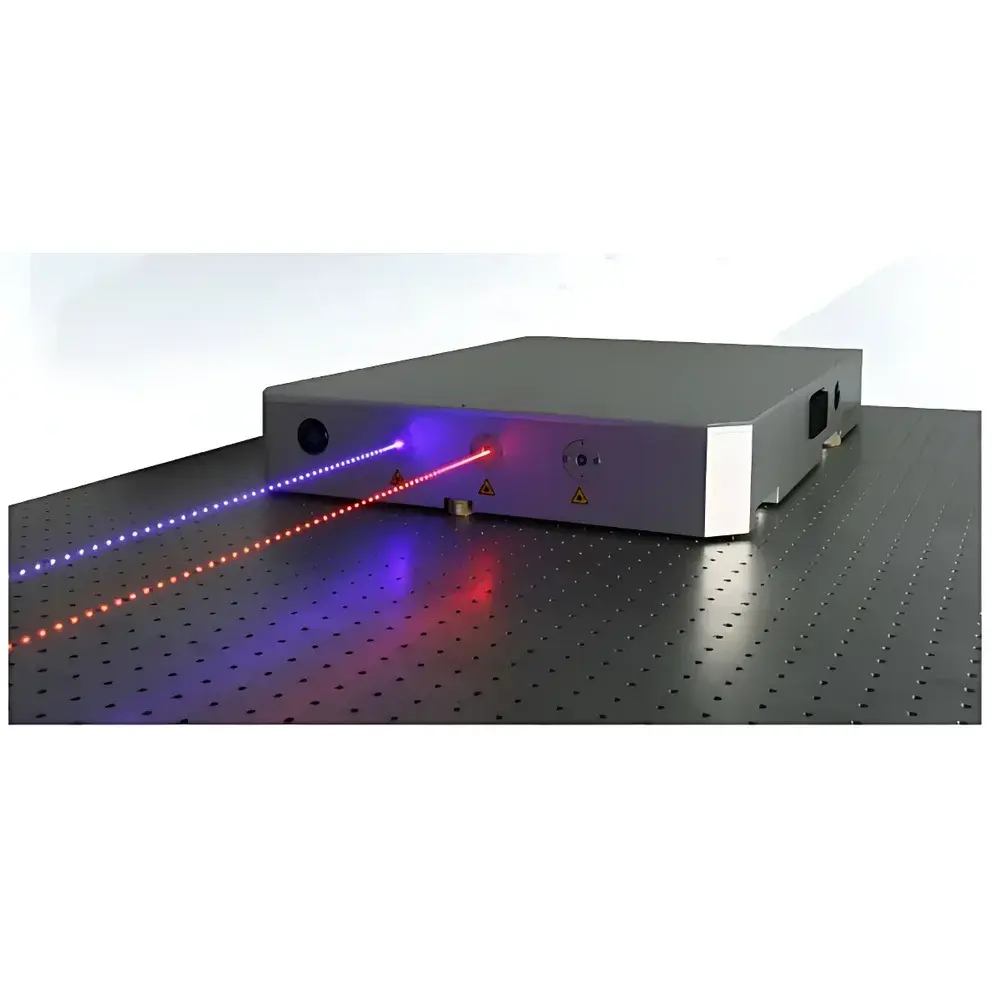
Xiton Pixie Series Picosecond Solid-State Laser
| Brand | Xiton |
|---|---|
| Origin | Germany |
| Model | Pixie Series |
| Wavelengths | 1342 nm / 671 nm / 447 nm |
| Average Power | 1.8 W (Pixie), 0.7 W (Pixie-S), 0.5 W (Pixie-T) |
| Pulse Width | <6 ps |
| Pulse Energy | 12 nJ (Pixie), 4.5 nJ (Pixie-S), 3.5 nJ (Pixie-T) |
| Repetition Rate | 143 MHz |
| Beam Quality (M²) | <1.3 |
| Pump Source | Laser Diode |
| Pulse-to-Pulse Stability | <0.5% RMS (24 h) |
| Pulse Shape | sech²-profile |
| Operating Mode | CW-mode-locked, industrial-grade |
| Compliance | CE, RoHS, IEC 60825-1:2014 Class 4 Laser Product |
Overview
The Xiton Pixie Series represents the first commercially deployed industrial-grade picosecond solid-state laser system delivering simultaneous high-repetition-rate, sub-6-ps pulses at three fundamental and frequency-converted wavelengths: 1342 nm (Nd:YVO4 fundamental), 671 nm (second harmonic), and 447 nm (third harmonic). Engineered for continuous 24/7 operation in semiconductor fabrication and flat-panel display manufacturing environments, the Pixie platform employs a patented passive mode-locking architecture based on semiconductor saturable absorber mirrors (SESAMs), ensuring exceptional long-term stability and >20,000 hours of diode-pump lifetime. Unlike conventional Q-switched or actively mode-locked systems, the Pixie’s self-starting, all-solid-state cavity eliminates mechanical actuators and external RF drivers—reducing failure points and enabling robust thermal management under factory-floor conditions. Its ultrashort pulse duration enables non-thermal ablation via multiphoton absorption and Coulomb explosion mechanisms, critical for processing transparent and heat-sensitive materials such as fused silica, sapphire, and organic emissive layers in OLED substrates.
Key Features
- Three-wavelength platform with fixed, factory-aligned outputs: 1342 nm (fundamental), 671 nm (SHG), and 447 nm (THG) — no manual realignment required
- Diode-pumped Nd:YVO4 oscillator-amplifier architecture with integrated harmonic generation crystals (LBO/BiBO)
- Pulse width consistently <6 ps (FWHM), verified by autocorrelation with <100-fs resolution
- Pulse-to-pulse energy stability <0.5% RMS over 24-hour continuous operation, measured with calibrated photodiode and fast digitizer
- Beam quality maintained at M² <1.3 across all wavelengths, enabling diffraction-limited focusing to ≤1.2 µm spot size (at 447 nm, λ/NA = 0.45)
- Industrial-grade enclosure with IP54-rated housing, active air-cooling, and RS-485/Ethernet interface for OEM integration
- No consumables, no gas replenishment, no optical realignment during scheduled maintenance intervals
Sample Compatibility & Compliance
The Pixie Series is validated for direct integration into automated material processing platforms handling brittle, transparent, and multilayer thin-film structures. It supports precise ablation of indium tin oxide (ITO), polyimide alignment layers, and encapsulation films on glass and flexible polymer substrates without microcracking or thermal halo formation. All models comply with IEC 60825-1:2014 Class 4 laser safety requirements, including interlock-ready shutter control, beam path containment, and embedded emission monitoring. The system meets CE marking directives for electromagnetic compatibility (2014/30/EU) and low-voltage safety (2014/35/EU). For regulated manufacturing environments, optional firmware enables audit-trail logging per FDA 21 CFR Part 11 Annex 11 requirements when interfaced with validated MES/SCADA systems.
Software & Data Management
Xiton provides the Pixie Control Suite—a Windows-based application supporting remote configuration of output power (via intra-cavity attenuator), repetition rate fine-tuning (±2 MHz), and real-time pulse energy monitoring. The SDK includes C/C++, Python, and LabVIEW APIs for seamless integration into motion-controlled galvo scanners or stage-based micromachining workstations. All operational parameters—including diode current, crystal temperature, and internal photodiode readings—are timestamped and exportable in CSV/JSON format. Optional time-stamped event logging synchronizes laser triggers with external sensors (e.g., plasma emission detectors or acoustic emission transducers), facilitating root-cause analysis in yield improvement workflows.
Applications
- Semiconductor backend processing: via drilling in SiC and GaN wafers, trench isolation in MEMS devices
- OLED and microLED display manufacturing: pixel-level patterning of emissive layers, bank structure ablation, touch sensor trimming
- Photomask repair: sub-micron defect removal on Cr-on-Quartz masks without substrate damage
- Thin-film solar cell scribing: selective removal of ZnO:Al, CdTe, and perovskite layers with <50 nm kerf width
- Medical device micromachining: stent cutting in nitinol and bioresorbable polymers with minimal recast layer
- Research applications requiring stable, turnkey picosecond sources for pump-probe spectroscopy or nonlinear microscopy
FAQ
Is the Pixie Series suitable for cleanroom environments?
Yes. The laser head features sealed optics, particle-free air filtration, and vibration-damped mounting. It meets ISO Class 5 particulate limits when installed with standard laminar flow hoods.
Can output wavelength be tuned or switched dynamically during operation?
No. Wavelength selection is hardware-defined per model (Pixie = 1342 nm, Pixie-S = 671 nm, Pixie-T = 447 nm). Inter-wavelength switching requires physical module replacement under controlled service conditions.
What maintenance schedule is recommended for uninterrupted production use?
Annual calibration of pulse energy and beam pointing stability is recommended. No optical alignment or crystal replacement is required within the first 18,000 operating hours.
Does the system support external triggering or synchronization with motion stages?
Yes. TTL-compatible sync output (≤1 ns jitter) and trigger input (programmable delay 0–100 ms) are provided via SMA connectors, compliant with PI, Aerotech, and Newport motion controller protocols.
How is laser safety enforced during integration into custom machinery?
The system provides dual-channel safety interlocks (IEC 61800-5-2 compliant), integrated with EN 61496-1 light curtains and emergency stop chains. Full safety documentation—including risk assessment templates and LOTO procedures—is supplied with each unit.






