
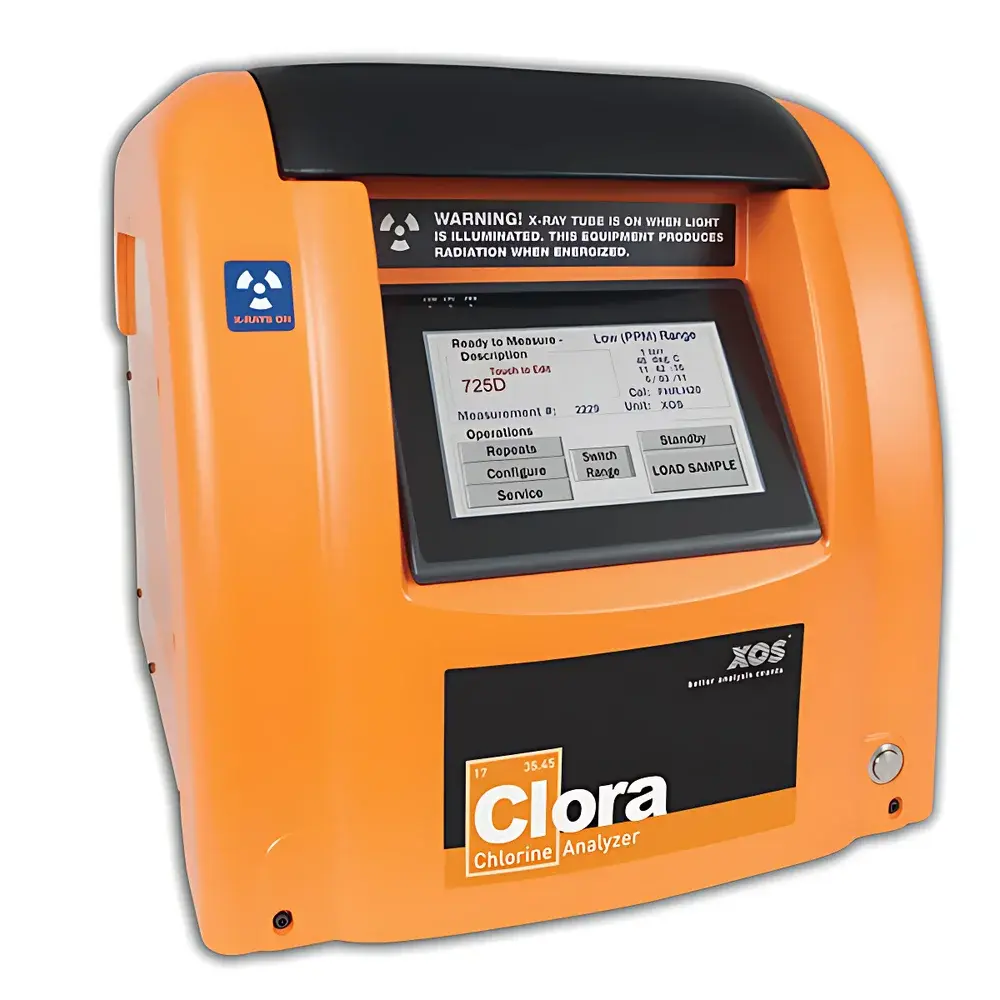
XOS Clora Single-Wavelength Wavelength-Dispersive X-Ray Fluorescence Chlorine Analyzer
| Brand | XOS |
|---|---|
| Model | Clora |
| Instrument Type | Benchtop WDXRF Analyzer |
| Excitation | Monochromatic X-ray Beam |
| Target Element | Chlorine (Cl) |
| X-ray Tube Power | 75 W |
| Detection Limit (LOD) | 0.13 ppm |
| Measuring Range | 0.13 ppm – 3000 ppm (standard), up to 4 wt% (optional) |
| Sample Volume | ≤10 mL |
| Measurement Time | 30–900 s (user-configurable) |
| Sample Form | Liquid hydrocarbons, aqueous solutions, solid powders (with AccuCell cup) |
| Compliance | ASTM D7536-16, ASTM D4929-19 (Method C), SH/T 0977-2019 |
| Optical System | Dual Hyperbolic Bent-Crystal Monochromators |
| Detector | High-resolution proportional counter or scintillation detector (configuration-dependent) |
| Calibration | Multi-curve storage, manual high-sulfur/low-chlorine correction |
| Optional Accessories | AccuFlow™ suspension compensation module, AccuCell™ sample cups, automated sample changer |
Overview
The XOS Clora is a benchtop single-wavelength wavelength-dispersive X-ray fluorescence (WDXRF) analyzer engineered for precise, non-destructive quantification of chlorine in liquid and solid hydrocarbon matrices. Unlike energy-dispersive (EDXRF) systems, the Clora employs monochromatic excitation—using dual hyperbolic bent-crystal optics—to isolate a single incident X-ray line (optimized for Cl K-shell ionization) and selectively collect only the Cl Kα fluorescent emission at 0.473 nm. This optical filtering eliminates spectral interferences from sulfur, metals, and matrix elements common in crude oil, distillates, and refinery streams, delivering exceptional signal-to-background ratio and measurement specificity. Designed for routine laboratory deployment in petroleum QC, refining process control, and regulatory compliance testing, the Clora operates without combustion, carrier gases, or high-temperature digestion—making it inherently safer, more sustainable, and compliant with ISO/IEC 17025 method validation requirements.
Key Features
- Monochromatic WDXRF architecture with dual bent-crystal optics ensures ultra-low background and high elemental selectivity for chlorine.
- Detection limit of 0.13 ppm Cl in liquid hydrocarbons—validated per ASTM D7536-16 and D4929-19 (Method C).
- Robust, maintenance-minimized design: no moving parts in the optical path; sealed X-ray tube with 75 W nominal power; long-life detector assembly.
- AccuFlow™ technology dynamically compensates for particle settling or phase separation during measurement—critical for heavy oils, residua, and emulsified samples.
- AccuCell™ sample cups provide consistent geometry, minimal wall effects, and compatibility with Etnom® polymer films for volatile or low-viscosity samples.
- Flexible measurement protocol: user-defined acquisition time (30–900 s), multi-curve calibration storage, and manual high-sulfur/low-chlorine correction to mitigate matrix-induced bias.
- Benchtop footprint (< 60 cm × 50 cm × 45 cm) enables integration into space-constrained labs; standard 100–240 V AC input—no external gas supply or exhaust required.
Sample Compatibility & Compliance
The Clora accommodates a broad range of sample types without chemical pretreatment: light distillates (gasoline, jet fuel, naphtha), mid- and heavy fractions (diesel, kerosene, biofuel blends, ethanol-gasoline), residual fuels (VGO, vacuum resid, asphalt), crude oils, lubricants, catalysts (powdered or pelletized), aqueous treatment streams, and polymer melts (e.g., polypropylene). All measurements adhere to internationally recognized test methods: ASTM D7536-16 (aromatics), ASTM D4929-19 Method C (crude oil organic chloride), and SH/T 0977-2019 (light distillates). The instrument’s firmware supports audit-trail logging and user-access controls aligned with GLP and GMP documentation practices. Data export formats (CSV, XML) facilitate traceability under FDA 21 CFR Part 11-compliant LIMS environments when paired with validated software configurations.
Software & Data Management
CloraControl™ software provides intuitive method setup, real-time spectrum visualization, and automated peak integration for Cl Kα. Calibration curves are stored with metadata (date, operator, reference standards used), and each analysis record includes full spectral raw data, acquisition parameters, and environmental sensor logs (temperature, humidity). Software supports IQ/OQ/PQ documentation templates for laboratory accreditation (ISO/IEC 17025). Exported datasets include uncertainty estimates derived from counting statistics and calibration model residuals. Optional network connectivity enables remote monitoring, centralized database synchronization, and role-based access control—suitable for multi-site enterprise deployments.
Applications
- Refinery feedstock screening: rapid detection of organochlorides in crude oil to prevent catalyst poisoning and ammonium chloride salt deposition in overhead systems.
- Fuel certification: verification of chlorine content in gasoline, diesel, and jet fuel against EN 228, ASTM D975, and ASTM D1655 specifications.
- Process troubleshooting: quantification of chloride carryover in fractionator bottoms, hydrotreater effluents, and caustic wash streams.
- Environmental compliance: monitoring chloride leachate in wastewater treatment sludge or produced water prior to discharge.
- Quality assurance in petrochemical intermediates: chlorine verification in BTX streams, styrene monomer, and polymer-grade propylene.
- Research applications: kinetic studies of dechlorination reactions, catalyst deactivation profiling, and speciation correlation via complementary techniques (e.g., GC-µECD).
FAQ
Does the Clora require hazardous consumables such as chlorine-specific electrodes or reactive gases?
No. The Clora is a fully non-destructive, X-ray–based technique requiring only electrical power and inert sample containment. No combustion, plasma, or chemical reagents are involved.
Can the Clora measure chlorine in high-sulfur crude oils without spectral interference?
Yes. The monochromatic excitation and crystal-based emission filtering eliminate S Kα (0.537 nm) overlap with Cl Kα (0.473 nm), enabling accurate quantification even at S/Cl ratios exceeding 1000:1.
Is method transfer possible between Clora units across different laboratories?
Yes. Calibration models are portable via encrypted .cal files; cross-unit reproducibility is maintained through factory-installed spectral alignment routines and NIST-traceable reference materials (e.g., XOS Chlorine Standard Set CS-1000).
What sample preparation is required for viscous residues or solids?
Minimal preparation: homogenize and load ≤10 mL into an AccuCell cup sealed with Etnom film. For solids, grinding to <100 µm and pelletizing under 10-ton pressure is recommended for optimal particle uniformity.
How frequently must the instrument be recalibrated?
Under routine use (≤20 samples/day), recalibration is typically required every 7–14 days using two-point verification standards; drift monitoring is automated via daily background and reference peak checks.




